Question
If the phase difference between Alternating Voltage and Alternating Current is $\frac{\pi}{6}$​ and the resistance in the circuit is $\sqrt{300}\Omega,$ then the impedance of the circuit will be.

Answer

  1. $20\Omega$
Explanation:
$\text{impedance}×\cos\theta = \text{resistance}$
$\text{impedance} = \frac{\text{resistance}}{\cos\theta}$
$=\frac{\sqrt{300}}{\frac{\cos\pi}{6}}$
$20\Omega$

Need a full question paper?

Generate a complete, print-ready paper with questions like this in minutes — across 16+ boards, with answer keys.
Start Generating Free

Similar questions

Which of the following wave is used in long distance communication?
Light waves can be polarised because they:
The plates of a parallel plate condenser are pulled apart with $a$ velocity $v$. If at any instant their mutual distance of separation is $d,$ then the magnitude of the time of rate of change of capacity depends on $d$ as follows
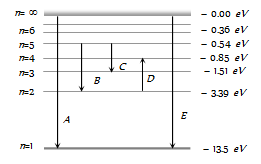
The energy levels of the hydrogen spectrum is shown in figure. There are some transitions $A, B, C, D$ and $E.$ Transition $A, B$ and $C$ respectively represent
The reason for the energy associated with a moving charge is:
The free end of a simple pendulum is attached to the ceiling of a box. The box is taken to a height and the pendulum is oscillated. When the bob is at its lowest point, the box is released to fall freely. As seen from the box during this period, the bob will:
  1. Continue its oscillation as before.
  2. Stop.
  3. Will go in a circular path.
  4. Move on a straight line.
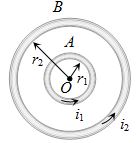
$A$ and $B$ are two concentric circular conductors of centre $O$ and carrying currents $i_1$ and $i_2$ as shown in the adjacent figure. If ratio of their radii is $1 : 2$ and ratio of the flux densities at $O$ due to $A$ and $B$  is $1 : 3,$ then the value of $i_1/i_2$  is
While walking on ice, one should take small steps to avoid slipping. This is because smaller steps ensure:
  1. Larger friction.
  2. Smaller friction.
  3. Larger normal force.
  4. Smaller normal force.
In a pure capacitive A.C circuit current and voltage differ in phase by.
A thin wire of length 2m is perpendicular to the x−and plane. It is moved with velocity $\overrightarrow{\text{m}}=(2\hat{{\text{i}}}+3\hat{\text{j}}+\hat{\text{k}})\text{m/s}$ through a region of magnetic induction $\overrightarrow{\text{B}}=(\hat{{\text{i}}}+2\hat{\text{j}})\text{In }\text{b/m}^2$ Then potential difference induced between the ends of the wire is.