a. What is the focal length of the lens used in sunglasses?
b. The following figures show the path of light rays through three lenses marked $L_1, L_2$, and $L_3$ and their focal points $F_1, F_2$, and $F_3$, respectively. Identify the nature of lenses.
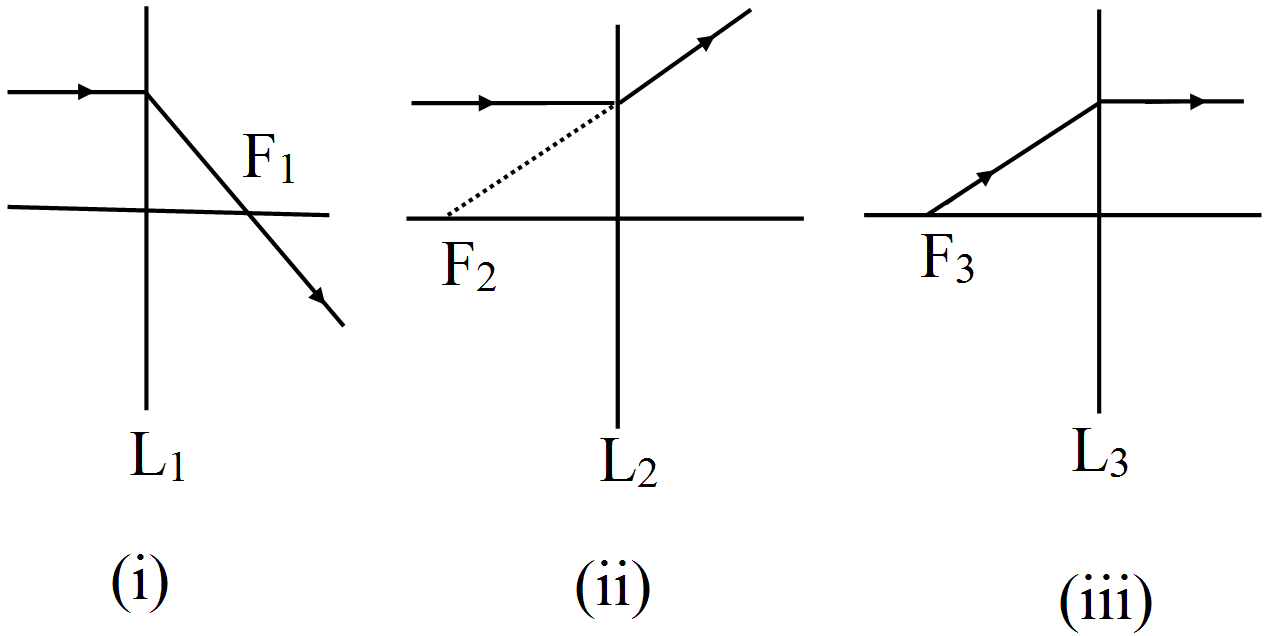
b. The following figures show the path of light rays through three lenses marked $L_1, L_2$, and $L_3$ and their focal points $F_1, F_2$, and $F_3$, respectively. Identify the nature of lenses.
Download our app for free and get started
a. The focal length of a Sunglass lens is theoretically infinite. It is because the radii of curvatures of the front and back surfaces are equal.
b. Lens $L_1: f_1$
Lens $L_2: f_2$
Lens $L _3: f _3$
onvex lens because concave lens can never form virtual and magnified image of an object and convex lens form such image only when the object is placed between the optical centre and principle focus of the convex lens.
b. Lens $L_1: f_1$
Lens $L_2: f_2$
Lens $L _3: f _3$
onvex lens because concave lens can never form virtual and magnified image of an object and convex lens form such image only when the object is placed between the optical centre and principle focus of the convex lens.

Download our appand get started for free
Experience the future of education. Simply download our apps or reach out to us for more information. Let's shape the future of learning together!No signup needed.*
Similar Questions
- 1View SolutionAn object 5.0 cm in length is placed at a distance of 20 cm in front of a convex mirror of radius of curvature 30 cm. Find the position of the image, its nature and size.
- 2View SolutionDefine principal axis, principal focus and focal length of a convex lens.
- 3View SolutionThe image formed by a spherical mirror is real, inverted and is of magnification - 2. If the image is at a distance of 30 cm from the mirror, where is the object placed ? Find the focal length of the mirror. List two characteristics of the image formed if the object is moved 10 cm towards the mirror.
- 4View SolutionA concave mirror produces a real image 1cm tall of an object 2.5mm tall placed 5cm from the mirror. Find the position of the image and the focal length of the mirror.
- 5View SolutionGiving reasons, state the ‘signs’ (positive or negative) which can be given to the following:
- Object distance (u) for a concave mirror or convex mirror.
- Image distances (v) for a concave mirror.
- Image distances (v) for a convex mirror.
- 6View SolutionDetermine how far an object must be placed in front of a converging lens of focal length 10cm in order to produce an erect (upright) image of linear magnification 4.
- 7View SolutionWhat is the advantage of using a convex mirror as a rear-view mirror in vehicles as compared to a plane mirror? Illustrate your answer with the help of labelled diagrams.
- 8View SolutionA 2.0cm tall object is placed 40 cm from a diverging lens of focal length 15cm. Find the position and size of the image.
- 9View SolutionWhat can you see in a completely dark room? If you switch on an electric bulb in this dark room as a light source, explain how you could now see:
- The electric bulb.
- A piece of white paper.
- 10View SolutionHow would a pencil look like if you saw it through (a) a concave lens, and (b) a convex lens? (Assume the pencil is close to the lens). Is the image real or virtual?