MCQ
What is the formula to find escape velocity?
  • A
    2gR
  • B
    gR
  • C
    $\sqrt{g R }$
  • $\sqrt{2 g R}$

Answer

Correct option: D.
$\sqrt{2 g R}$
D

Need a full question paper?

Generate a complete, print-ready paper with questions like this in minutes — across 16+ boards, with answer keys.
Start Generating Free

Similar questions

A body moves with velocity $v,\,\,2v$ and $3v$  in the first, second and third, one third distance of path travelled. Its average speed is
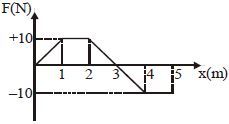
A position dependent force $F$ acting on a particle and its force-position curve is shown in the figure. Work done on the particle, when its displacement $0$ to $5\,m$ is ............. $\mathrm{J}$
A projectile can have the same range $R$ for two angles of projection. If $t_1$ and $t_2$ be the times of flights in the two cases, then the product of the two time of flights is proportional to
From a solid sphere of mass $M$ and radius $R$ a cube of maximum possible volume is cut. Moment of inertia of cube about an axis passing through its center and perpendicular to one of its faces is
Three copper blocks of masses M1, M2 and M3kg respectively are brought into thermal contact till they reach equilibrium. Before contact, they were at T1, T2, T3 (T1 > T2 > T3). Assuming there is no heat loss to the surroundings, the equilibrium temprature T is (s is specific heat of copper)

  1. $\text{T}=\frac{\text{T}_{1}+\text{T}_{2}+\text{T}_{3}}{3}$

  2. $\text{T}=\frac{\text{M}_{1}\text{T}_{1}+\text{M}_{2}\text{T}_{2}+\text{M}_{3}\text{T}_{3}}{\text{M}_{1}+\text{M}_{2}+\text{M}_{3}}$

  3. $\text{T}=\frac{\text{M}_{1}\text{T}_{1}+\text{M}_{2}\text{T}_{2}+\text{M}_{3}\text{T}_{3}}{3(\text{M}_{1}+\text{M}_{2}+\text{M}_{3})}$

  4. $\text{T}=\frac{\text{M}_{1}\text{T}_{1}\text{S}+\text{M}_{2}\text{T}_{2}\text{S}+\text{M}_{3}\text{T}_{3}\text{S}}{\text{M}_{1}+\text{M}_{2}+\text{M}_{3}}$
Consider two vectors ${\overrightarrow F _1} = 2\hat i + 5\hat k$ and ${\overrightarrow F _2} = 3\hat j + 4\hat k.$ The magnitude of the scalar product of these vectors is
A gas has $n$ degrees of freedom. The ratio of specific heat of gas at constant volume to the specific heat of gas at constant pressure will be.
The rotational kinetic energy of a solid sphere of mass $3 \;kg$ and radius $0.2\; m$ rolling down an inclined plane of height $7\; m$ is 
Real gases show markable deviation from that of ideal gas behavior at:
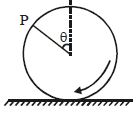
A wheel is rolling straight on ground without slipping. If the axis of the wheel has speed $v$, the instantenous velocity of a point $P$ on the rim, defined by angle $\theta $, relative to the ground will be