MCQ
What is the full form of $\text{UHF?}$
  • A
    Under heavy frequency
  • Ultra-high frequency
  • C
    Ultra heavy frequency
  • D
    Under high frequency

Answer

Correct option: B.
Ultra-high frequency

$\text{UHF}$ stands for Ultra high frequency. Cellular phones used radio waves to transmit voice communication in the Ultra high$-$frequency Band. The $\text{UHF}$ band extends from $900 MHz$ to $5 \times 109 Hz$ or $5000 MHz$. Radio waves are produced by oscillating circuits having an inductor and capacitor.

Need a full question paper?

Generate a complete, print-ready paper with questions like this in minutes — across 16+ boards, with answer keys.
Start Generating Free

Similar questions

A coil takes 15 min to boil a certain amount of water, another coil takes 20 min for the same process. Time taken to boil the same amount of water when both coil are connected in series
Electromagnetic waves are produced by:
When photon of energy $4.25\, eV$ strike the surface of a metal $A$, the ejected photoelectrons have maximum kinetic energy $T_A\, eV$ and de-Brolie wavelength ${\lambda _A}$. The maximum kinetic energy of photoelectrons liberated from another metal $B$ by photon of energy $4.70  \ eV$ is ${T_B} = ({T_A} - 1.50)\;eV$. If the de-Broglie wavelength of these photoelectrons is ${\lambda _B} = 2{\lambda _A}$, then
There is a current of 1.344 amp in a copper wire whose area of cross-section normal to the length of the wire is 1$mm^2$ . If the number of free electrons per $cm^3$ is $8.4\times 10^{22}$ , then the drift velocity would be
The circular coil of a galvanometer has fifty turns. The coil has a radius of $1\ cm$. The coil is placed in a radial magnetic field of $0. 010\ T$. The torsion coefficent of the spring on which the coil hangs is $3 \times 10^{-7}\ N-m-rad^{-1}$. Determine the deviation of the galvanometer's hand if the current through the coil is $1.0\ mA$......$^o$
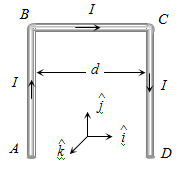
AB and CD are long straight conductor, distance d apart, carrying a current I. The magnetic field at the midpoint of BC is
What is the correct order in which the listed atomic models were advanced and accepted, earliest first?
An electron is accelerated through a potential difference of $1000$ volts. Its velocity is nearly
Focal length of objective and eye piece of telescope are $200\; cm$ and $4\; cm$ respectively. What is the length of telescope for normal adjustment?
Two electric bulbs whose resistances are in the ratio of $1 : 2$ are connected in parallel to a constant voltage source. The powers dissipated in them have the ratio