MCQ
What is the general electronic configuration for $2^{nd}$ row transition series
  • A
    $[Ne]3{d^{1 - 10}},4{s^2}$
  • B
    $[Ar]3{d^{1 - 10}},4{s^{1 - 2}}$
  • $[Kr]4{d^{1 - 10}},\,\,5{s^{1 - 2}}$
  • D
    $[Xe]5{d^{1 - 10}},\,\,5{s^{1 - 2}}$

Answer

Correct option: C.
$[Kr]4{d^{1 - 10}},\,\,5{s^{1 - 2}}$
c
The general electronic configuration for $2nd$ row transition series is $[ Kr ] 4 d ^{1-10} 5 s ^{1-2}$

Need a full question paper?

Generate a complete, print-ready paper with questions like this in minutes — across 16+ boards, with answer keys.
Start Generating Free

Similar questions

Out of molality $(m),$ molarity $(M),$ formality $(F)$ and mole fraction $(x),$ those which are independent of temperature are:
An electrolytic cell contains solution of $Ag_2SO_4$ and has Platinum electrodes. A current is passed until $1.6\,g$ of $O_2$ is liberated at anode. The amount of silver deposited at cathode would be ............ $\mathrm{g}$
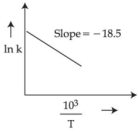
The rate constants for decomposition of acetaldehyde have been measured over the temperature range $700-1000\, K$. The data has been analysed by plotting $ln\, k\,$vs$\,\frac{10^{3}}{ T }$ graph. The value of activation energy for the reaction is $......\,kJ mol ^{-1}$. (Nearest integer) (Given : $R =8.31\, J \,K ^{-1} \,mol ^{-1}$ )
Calculate the molecular weight of a substance whose $7.0\%$ by mass solution in water freezes at $-0.93\,^oC$ . The cryoscopic constant of water is $1.86\,^oC\,kg\,molal^{-1}$ ........... $g\,mol^{-1}$.
Heating steel to bright redness and then cooling suddenly by plunging it into oil or water, makes it
Assertion : Ethers behave as bases in the presence of mineral acids.
Reason : Due to the presence of lone pairs of electrons on oxygen
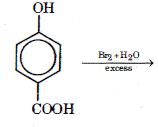
What is Product
Dissolving $120 \mathrm{~g}$ of urea (mol. wt. $60$) in $1000 \mathrm{~g}$ of water gave a solution of density $1.15 \mathrm{~g} / \mathrm{mL}$. The molarity of the solution is
Consider the following reaction :

Ethanol $\xrightarrow{{PB{r_3}}}X\,\xrightarrow{{alc.\,KOH}}\,Y$$\,\xrightarrow[{(ii)\,{H_2}O\,,\,heat}]{{(i)\,{H_2}S{O_4},\,room\,\,temperature}}Z$

the product $Z$ is

$0.50\,L$ of a $0.60\,M$ $CuSO_4$ solution is electrolyzed for a period of $30.0\,min$ using a current of $4.60\,A$. If inert electrodes are used, what is the final concentration of $Cu^{2+}$ remaining in the solution ? ............. $\mathrm{M}$