Question
What is the importance of binding energy per nucleon ?

Answer

Binding energy per nucleon
$ = \frac{\\text{Total binding energy}}{\text{Atomic mass number}} $.
It is the measure of stability of a nucleus. Greater is the binding energy per nucleon of a nucleous, much stable is the nucleus i.e. much external energy is required to decompose the nucleus into its nucleons.

Need a full question paper?

Generate a complete, print-ready paper with questions like this in minutes — across 16+ boards, with answer keys.
Start Generating Free

Similar questions

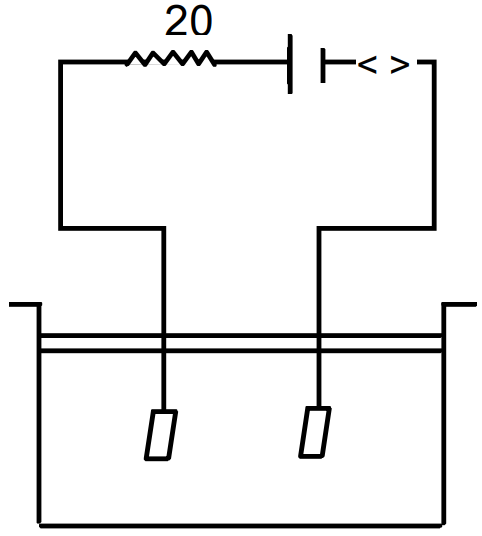
Figure shows an electrolyte of AgCl through which a current is passed. It is observed that 2.68g of silver is deposited in 10 minutes on the cathode. Find the heat developed in the $20\Omega$ resistor during this period. Atomic weight of silver is 107.9g/mole.
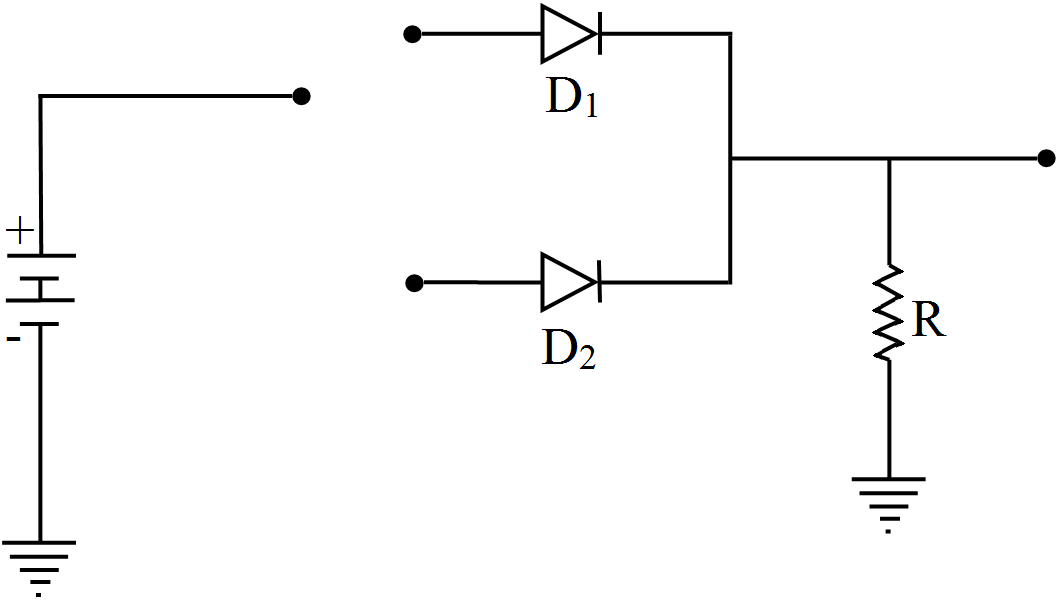
Name the logic gate which can be realised by using a p-n junction diode in the given diagram. Give its logic symbol and write the truth table. Name the gate which will be obtained by combining with a NOT gate.
The ground state energy of hydrogen atom is –13.6 eV. What are the kinetic and potential energies of the electron in this state?
An electron beam projected along the positive X-axis deflects along the positive Y-axis. If this deflection is caused by a magnetic field, what is the direction of the field? Can we conclude that the field is parallel to the Z-axis?
Write the formula for the force per unit length between two parallel current carrying wires. Using it, write the definition of Ampere and Coulomb.
Explain the root mean square value of alternating current.
Write laws of reflection.
By explaining the $($Electric$)$ current density, derive Ohm's law in vector form.
In some old texts it is mentioned that $4\pi$ lines of force originate from each unit positive charge. Comment on the statement in view of the fact that $4\pi$ is not an integer.
An electron enters with a velocity $v = v_0$ i into a cubical region $($faces parallel to coordinate planes$)$ in which there are uniform electric and magnetic fields. The orbit of the electron is found to spiral down inside the cube in plane parallel to the $x-y$ plane. Suggest a configuration of fields $E$ and $B$ that can lead to it.