Question
Write laws of reflection.

Answer

→(i) The angle of incidence and the angle of reflection are same. (i = r)
(ii) The incident ray, reflected ray and the normal to the reflecting surface at the point of incidence lie in the same plane. This plane is called the plane of incidence.
(iii) The incident ray and reflected ray lie on opposite sides of the normal.

Need a full question paper?

Generate a complete, print-ready paper with questions like this in minutes — across 16+ boards, with answer keys.
Start Generating Free

Similar questions

A 100W bulb together with its power supply is suspended from a sensitive balance. Find the change in the mass recorded after the bulb remains on for 1 year.
Answer the following questions:
A low voltage supply from which one needs high currents must have very low internal resistance. Why?
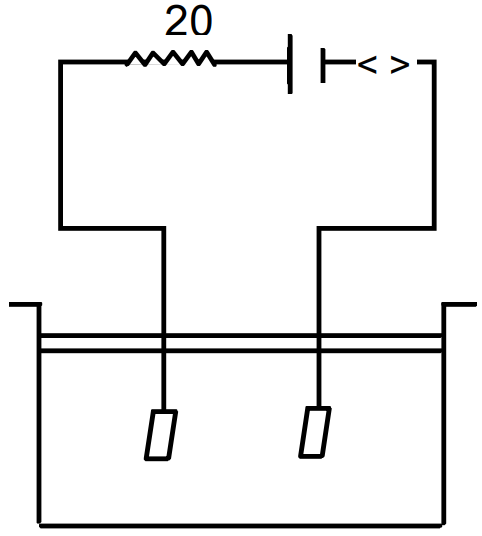
Figure shows an electrolyte of AgCl through which a current is passed. It is observed that 2.68g of silver is deposited in 10 minutes on the cathode. Find the heat developed in the $20\Omega$ resistor during this period. Atomic weight of silver is 107.9g/mole.
A hydrogen atom contains one proton and one electron. It may be assumed that the electron revolves in a circle of radius $0.53$ angstrom $(1$ angstrom $= 10^{-10}\ m$ and is abbreviated as A$)$ with the proton at the centre. The hydrogen atom is said to be in the ground state in this case. Find the magnitude of the electric force between the proton and the electron of a hydrogen atom in its ground state.
A bullet going with speed $350m/s$ enters a concrete wall and penetrates a distance of $5.0\ cm$ before coming to rest. Find the deceleration.
The changes in a function y and the independent dy variable x are related as $\frac{\text{dy}}{\text{dx}}=\text{x}^2.$ Find y as a function of x.
A metre scale is graduated at every millimetre. How many significant digits will be there in a length measurement with this scale?
The pressure measured by a constant volume gas thermometer is $40\ \text{kPa}$ at the triple point of water. What will be the pressure measured at the boiling point of water $(100^\circ C)$?
Consider two particles A and B having equal charges and placed at some distance. The particle A is slightly displaced towards B. Does the force on B increase as soon as the particle A is displaced? Does the force on the particle A increase as soon as it is displaced?
Show diagrammatically the behaviour of magnetic field lines in the presence of (i) paramagnetic and (ii) diamagnetic substances. How does one explain this distinguishing feature?