Question
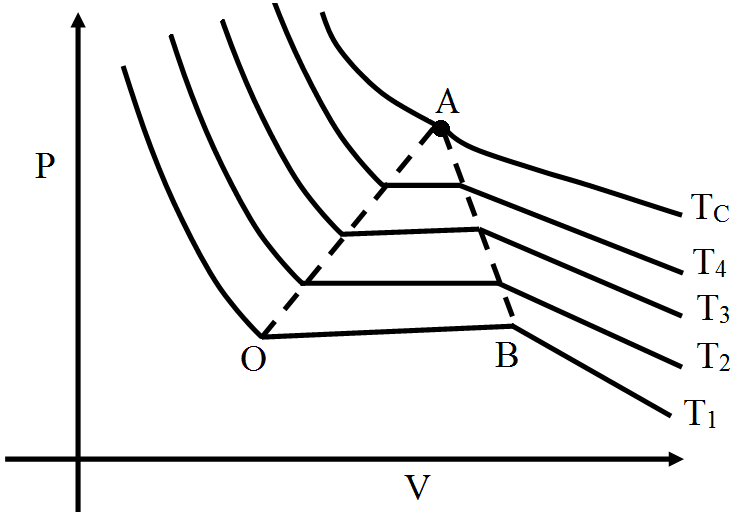
What is the Internal energy in the process of vapourisation?

Answer

During vapourisation, volume increases. So work done = P(Vf - Vi) and temperature does not change. So, dQ = mLv 
$\therefore$ from first law of thermodynamics, dU= dQ - DW
= mLv - P(Vf - Vi).

Need a full question paper?

Generate a complete, print-ready paper with questions like this in minutes — across 16+ boards, with answer keys.
Start Generating Free

Similar questions

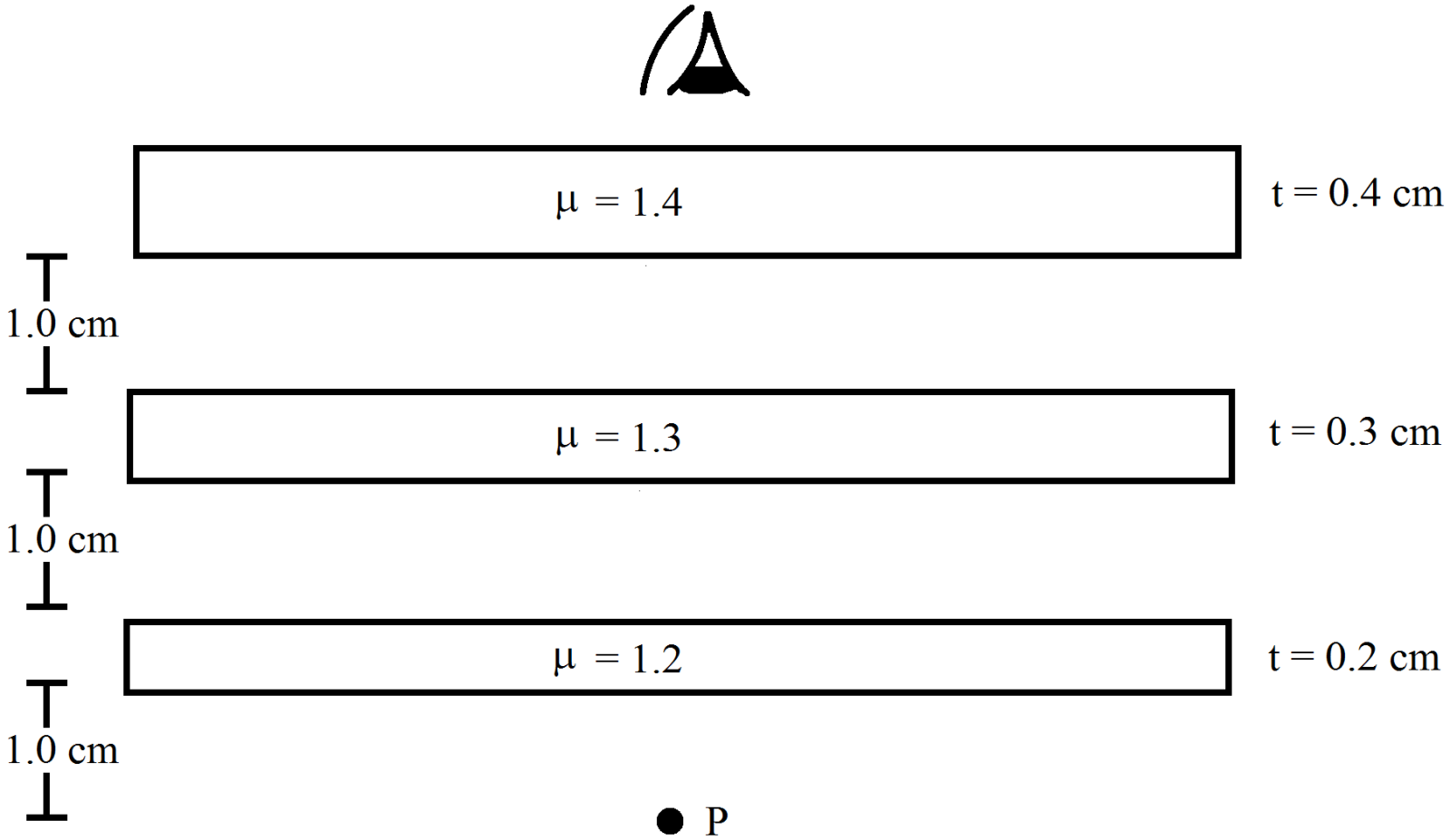
Locate the image of the point P as seen by the eye in the figure.

Two bodies make an elastic head-on collision on a smooth horizontal table kept in a car. Do you expect a change in the result if the car is accelerated on a horizontal road because of the noninertial character of the frame? Does the equation "Velocity of separation = Velocity of approach" remain valid in an accelerating car? Does the equation "Final momentum = Initial momentum" remain valid in the accelerating car?
How many astronomical units (A.U.) make 1 parsec?
The speed of a whirl wind in a tornado is alarmingly high. Why?
Prove that Newton's second law of motion is the real law of motion.
An electric bulb of volume 250cc was sealed during manufacturing at a pressure of 10-3mm of mercury at 27°C. Compute the number of air molecules contained in the bulb. Avogadro constant = 6 × 10²³mol-1, density of mercury = 13600kg/ m-3 and g = 10ms-2.
Suppose white light falls on a double slit but one slit is covered by a violet filter (allowing $\lambda=400\text{nm}$). Describe the nature of the fringe pattern observed.
0.75g of petroleum was burnt in a bomb calorimeter which contains 2kg of water and has a water equivalent 500 grams. The rise in temp. was 3°C. Determine the calorific value of petroleum.
A cyclist is riding with a speed of 27km/ h as he approaches a circular turn (on the road) of radius 80m, he applies brakes and reduces his speed at the constant rate 0.50m/ s2. Find the magnitude and direction of the net acceleration of the cyclist on circular turn?
Three equal charges, 2.0 × 10-6C each, are held fixed at the three corners of an equilateral triangle of side 5cm. Find the Coulomb force experienced by one of the charges due to the rest two.