Question
What is the law of equal division of energy, prove it the tatal energy of $\text n$ moles of gas molecules is $\text E =\frac{ 1 }{ 2 } \text {fnRT}$ energy. Explain the specific heats of monatomic, diatomic and triatomic gases from uniform distribution.

Answer

SELF

Need a full question paper?

Generate a complete, print-ready paper with questions like this in minutes — across 16+ boards, with answer keys.

Start Generating Free

Similar questions

A drunkard walking in a narrow lane takes 5 steps forward and 3 steps backward, followed again by 5 steps forward and 3 steps backward, and so on. Each step is 1m long and requires 1s. Plot the x-t graph of his motion. Determine graphically and otherwise how long the drunkard takes to fall in a pit 13m away from the start.
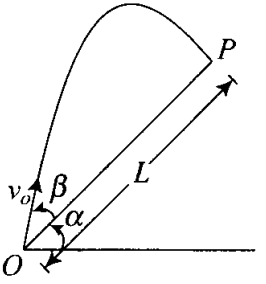
A particle is projected in air at an angle $\beta$ to a surface which itself is inclined at an angle $\alpha$ to the horizontal (Fig.).
  1. Time of flight.
(Hint: This problem can be solved in two different ways:
  1. Point P at which particle hits the plane can be seen as intersection of its trajectory (parobola) and straight line. Remember particle is projected at an angle $(\alpha+\beta)$ w.r.t. horizontal.
  2. We can take x-direction along the plane and y-direction perpendicular to the plane. In that case resolve g (acceleration due to gravity) in two differrent components, $g_x$ along the plane and $g_y$ perpendicular to the plane. Now the problem can be solved as two independent motions in x and y directions respectively with time as a common parameter.)
Calculate the stress developed inside a tooth cavity filled with copper when hot tea at temperature of $57^{\circ} \mathrm{C}$ is drunk. You can take body (tooth) temperature to be $37^{\circ} \mathrm{C}$ and $\mathrm{a}=1.7 \times 10^{-5} /{ }^{\circ} \mathrm{C}$ bulk modulus for copper $=140 \times 10^9 \mathrm{~N} / \mathrm{m}^2$
(a) When a molecule (or an elastic ball) hits a ( massive) wall, it rebounds with the same speed. When a ball hits a massive bat held firmly, the same thing happens. However, when the bat is moving towards the ball, the ball rebounds with a different speed. Does the ball move faster or slower?
(b) When gas in a cylinder is compressed by pushing in a piston, its temperature rises. Guess at an explanation of this in terms of kinetic theory using (a) above.
(c) What happens when a compressed gas pushes a piston out and expands. What would you observe?
(d) Sachin Tendulkar used a heavy cricket bat while playing. Did it help him in anyway?
  1. Define isothermal process. Derive an expression for work done during isothermal process.
  2. A refrigerator is to remove heat from the eatables kept inside at $10°C$. Calculate the coefficient of performance if room temperature is $36°C$.
A particle of mass $1kg$ moving with a velocity $\text{V}_1=(3\hat{\text{i}}-2\hat{\text{J})}\text{m/ s}$ experience a perfectly inelastic collision with another particle of mass 2kg having velocity $\text{v}_2=4\hat{\text{j}}-6\hat{\text{k}}\text{m/ s}$. Find the velocity and speed of the particle formed.
In a gamma decay process, the internal energy of a nucleus of mass M decreases, a gamma photon of energy E and linear momentum $\frac{\text{E}}{\text{c}}$ is emitted and the nucleus recoils. Find the decrease in internal energy.
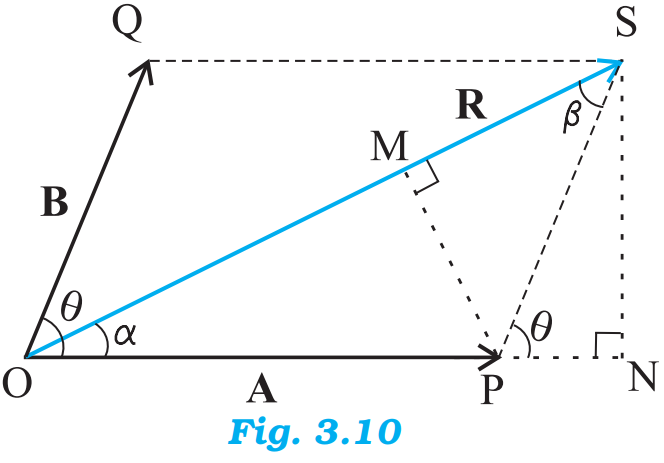
Find the magnitude and direction of the resultant of two vectors $A$ and $B$ in terms of their magnitudes and angle $\theta $ between them.
Image
A metal bar of length L and area of cross-section A, is rigidly clamped between two walls. The Young's modulus of its material is Y and the coefficient of linear expansion is $\alpha.$ The bar is heated so that its temperature is increased from 0 to $\theta^\circ\text{C}.$ Find the force exerted at the ends of the bar.
A star like the sun has several bodies moving around it at different distances. Consider that all of them are moving in circular orbits. Let r be the distance of the body from the centre of the star and let its linear velocity be v, angular velocity $\omega$, kinetic energy K, gravitational potential energy U, total energy E and angular momentum l. As the radius r of the orbit increases, determine which of the above quantities increase and which ones decrease.