Question
A star like the sun has several bodies moving around it at different distances. Consider that all of them are moving in circular orbits. Let r be the distance of the body from the centre of the star and let its linear velocity be v, angular velocity $\omega$, kinetic energy K, gravitational potential energy U, total energy E and angular momentum l. As the radius r of the orbit increases, determine which of the above quantities increase and which ones decrease.
Answer

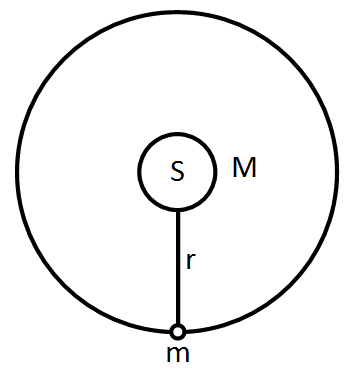
In equilibrium condition, when a body moves around a star, the gravitational pull result in a centripetal force. Let us consider a body of mass m is rotating around the star S of mass M in circular path of radius r.
$\text{F}_\text{c}=\frac{\text{mv}^2_0}{\text{r}}=\frac{\text{GMm}}{\text{r}^2}$
  1. Then orbital velocity $\text{v}_0=\sqrt{\frac{\text{GM}}{\text{r}}}\text{or}\text{ v}_0\propto\frac{1}{\sqrt{\text{r}}}$
Hence, on increasing radius of circular path orbital velocity decreases.
  1. Angular velocity $\omega=\frac{2\pi}{\text{T}}$ and $\text{T}^2\propto\text{r}^3$ by Kepler’s third law
$\therefore\ \omega=\frac{2\pi}{\text{Kr}^{\frac{3}{2}}} \text{ or }\omega\propto\frac{1}{\sqrt{\text{r}^3}}$

Hence, on increasing the radius of circular orbit the angular velocity decreased.
  1. Kinetic energy $\text{E}_\text{k}=\frac{1}{2}\text{ m }\frac{\text{GM}}{\text{r}}$
Or $\text{E}_\text{k}\propto\frac{1}{\text{r}}.$ Hence on increasing the radius of circular path the kinetic energy decreased.
  1. Gravitation potential energy $\text{E}_\text{p}=\frac{-\text{GMm}}{\text{r}}$ or $\text{E}_\text{p}\propto-\Big(\frac{1}{\text{r}}\Big)$ so.
On increasing radius of circular orbit the P.E. (Ep) increases.
  1. Total energy $\text{E}=\text{E}_\text{k}+\text{E}_\text{p}=\frac{\text{GMm}}{2\text{r}}+\Big(\frac{-\text{GMm}}{\text{r}}\Big)$
$\text{E}=\frac{-\text{GMm}}{2\text{r}}$

Hence, on increasing the radius of circular orbit the total energy E will also be increased.
  1. Angular momentum $=\text{L}=\text{mvr}=\text{m}\sqrt{\frac{\text{GM}}{\text{r}}}\text{r}$
$\text{L}=\text{m}\sqrt{\text{GMr}}$ or $\text{L}\propto\sqrt{\text{r}}$

Hence, the increasing radius r of circular orbit increases the angular momentum.

Need a full question paper?

Generate a complete, print-ready paper with questions like this in minutes — across 16+ boards, with answer keys.

Start Generating Free

Similar questions

What is the gravitational potential and gravitational potential energy of a body of $0.2kg$ at a height $1600km$ above the surface of the earth? ($G= 6.67 \times 10^{-11}Nm^2kg^{-2}$, mass of the earth = $6 \times 10^{24}kg$ and radius of the earth = $6400km$).
A uniform disc of radius R is put over another uniform disc of radius 2R of the same thickness and density. The peripheries of the two discs touch each other. Locate the centre of mass of the system.
Two parallel wires seprated by a distance of 10cm carry currents of 10A and 40A along-the same direction. Where should a third current be placed so that it experiences no magnetic force?
A man wants to reach from A to the opposite corner of the square C Fig. The sides of the square are 100m. A central square of 50m × 50m is filled with sand. Outside this square, he can walk at a speed 1m/ s. In the central square, he can walk only at a speed of $\upsilon\text{m/ s}(\upsilon<1)$. What is smallest value of v for which he can reach faster via a straight path through the sand than any path in the square outside the sand?
A particle is executing SHM. If $v_1$ and $v_2$ are the speeds of the particle at distance $x_1$ and $x_2$ from the equilibrium position, show that the frequency of oscillations is $\text{f}=\frac{1}{2\pi}\Big(\frac{\text{v}_1^2-\text{v}_2^2}{\text{x}_2^2-\text{x}_1^2}\Big)^\frac{1}{2}$
Consider the situation shown in figure. Suppose a small electric field E exists in the space in the vertically upward direction and the upper block carries a positive charge Q on its top surface. The friction coefficient between the two blocks is g but the floor is smooth. What maximum horizontal force F can be applied without disturbing the equilibrium?
[Hint: The force on a charge Q by the electric field E is F = QE in the direction of E.]
A parallel-plate capacitor having plate area $20cm^2$ and separation between the plates 1.00mm is connected to a battery of 12.0V. The plates are pulled apart to increase the separation to 2.0mm.
  1. Calculate the charge flown through the circuit during the process.
  2. How much energy is absorbed by the battery during the process?
  3. Calculate the stored energy in the electric field before and after the process.
  4. Using the expression for the force between the plates, find the work done by the person pulling the plates apart.
  5. Show and justify that no heat is produced during this transfer of charge as the separation is increased.
Two identical springs, each of spring factor k, may be connected in the following ways. Deduce the spring factor of the oscillation of the body in each case.
A small particle travelling with a velocity u collides elastically with a spherical body of equal mass and of radius r initially kept at rest. The centre of this spherical body is located a distance (p < r) away from the direction of motion of the particle. Find the final velocities of the two particles.

[Hint: The force acts along the normal to the sphere through the contact. Treat the collision as onedimensional for this direction. In the tangential direction no force acts and the velocities do not change].
Answer the following:
What is the temperature of the triple-point of water on an absolute scale whose unit interval size is equal to that of the Fahrenheit scale?