Question
What is the nature of electromagnetic waves?

Answer

It is a three-dimensional wave which is emitted by an oscillating electric circuit in which electric field and magnetic field oscillate perpendicularly. These waves do not require any material medium for their propagation and they can travel through vacuum also. Hence, they are different from mechanical waves. They travel with maximum speed in vacuum which is equal to the speed of the light. These waves are transverse in nature and the properties of the medium remain unchanged through which they travel.

Need a full question paper?

Generate a complete, print-ready paper with questions like this in minutes — across 16+ boards, with answer keys.
Start Generating Free

Similar questions

Draw a graph showing the variation of decay rate with number of active nuclei.
Four point charges qA = 2 μC, qB = –5 μC, qC = 2 μC, and qD = –5 μC are located at the corners of a square ABCD of side 10 cm. What is the force on a charge of 1 μC placed at the centre of the square?
The conductivity of a pure semiconductor is roughly proportional to $\text{T}^\frac{3}{2}\text{e}^{\frac{-\Delta\text{E}}{2\text{kT}}}$ where $\Delta\text{E}$ is the band gap. The band gap for germanium is 0.74eV at 4K and 0.67eV at 300K. By what factor does the conductivity of pure germanium increase as the temperature is raised from 4K to 300K?
Does the temperature of a body depend on the frame from which it is observed?
What is the basic difference between the atom and molecule of a diamagnetic and a paramagnetic material? Why are elements with even atomic number more likely to be diamagnetic?
How long can an electric lamp of 100W be kept glowing by fusion of 2.0 kg of deuterium? Take the fusion reaction as:
$^2_1\text{H}+^2_1\text{H}\rightarrow\ ^3_2\text{He}+\text{n}+3.27\text{ MeV}$
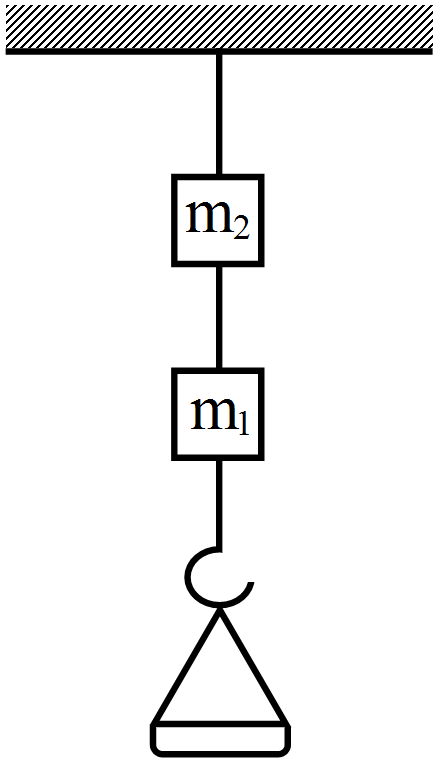
The two wires shown in are made of the,

same material which has a breaking stress of 8 × 10⁸N/m2. The area of cross-section of the upper wire is 0.006cm2 and that of the lower wire is 0.003cm2. The mass m1 = 10kg, m2 = 20kg and the hanger is light:
  1. Find the maximum load that can be put on the hanger without breaking a wire. Which wire will break first if the load is increased?
  2. Repeat the above part if m1 = 10kg and m2 = 36kg.
  1. At what distance should the lens be held from the figure in Exercise 9.29 in order to view the squares distinctly with the maximum possible magnifying power?
  2. What is the magnification in this case?What is the magnification in this case?
  3. Is the magnification equal to the magnifying power in this case? Explain.
A potentiometer wire of length 1 m has a resistance of 10$\Omega$. It is connected to a 6 V battery in series with a resistance of 5$\Omega$. Determine the emf of the primary cell which gives a balance point at 40 cm.
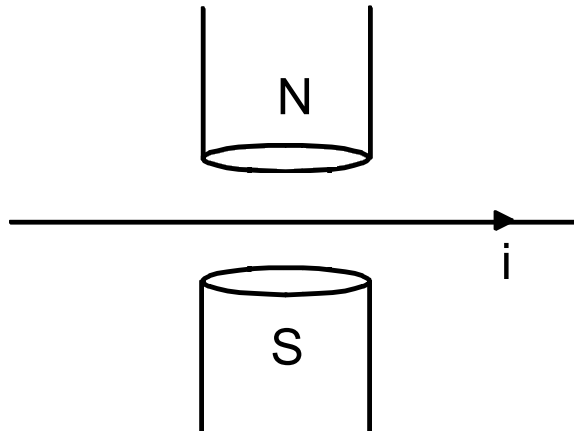
A magnetic field of strength 1.0T is produced by a strong electromagnet in a cylindrical region of radius 4.0cm, as shown in the figure. A wire, carrying a current of 2.0A, is placed perpendicular to and intersecting the axis of the cylindrical region. Find the magnitude of the force acting on the wire.