What is the number of chromosomes in the following cells of a human male?
- Spermatogonial cells.
- Spermatids.
- Primary spermatocytes.
- Sertoli cells.
Download our app for free and get started
- 46
- 23
- 46
- 46

Download our appand get started for free
Experience the future of education. Simply download our apps or reach out to us for more information. Let's shape the future of learning together!No signup needed.*
Similar Questions
- 1View SolutionDifferentiate between menarche and menopause.
- 2View SolutionCorpus luteum in pregnancy has a long life. However, if fertilisation does not take place, it remains active only for 10-12 days. Explain.
- 3View SolutionGive reasons why the human testes are located outside the abdominal cavity.
- 4View SolutionFirst half of the menstrual cycle is called proliferative phase as well as follicular phase. Explain.
- 5View SolutionOn the basis of the functions mentioned below, identify each one correctly.
- It helps in the movement of spermatozoan in a fluid medium.
- It contains hydrolytic enzymes and is used to contact and penetrate the egg during fertilisation.
- 6View SolutionWhat is the number of chromosomes in the following cells of a human male?
Primary spermatocytes. - 7View SolutionDraw a diagrammatic sketch of the microscopic view of a mammalian sperm and label any four parts in it.
- 8View SolutionMention the number of cells in the following stages:S. NoEmbryonic stagesNo. of cells(i)Zygote______________(ii)Morula______________(iii)Blastocyst______________
- 9View SolutionStudy the sectional view of human testis showing seminiferous tubules given below. Answer the questions that follow.
Write the functions of a and d. - 10View SolutionStudy the figure given below and answer the questions that follow:
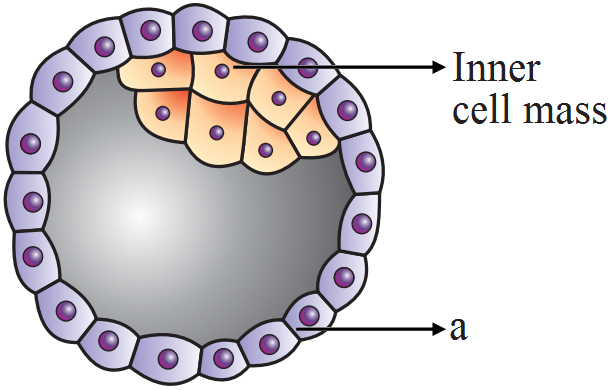
Mention the fate of the inner cell mass after implantation in the uterus.