MCQ
What is the path difference of destructive interference
  • A
    $n \lambda$
  • B
    $n(\lambda + 1)$
  • C
    $\frac{{(n + 1)\lambda }}{2}$
  • $\frac{{(2n + 1)\lambda }}{2}$

Answer

Correct option: D.
$\frac{{(2n + 1)\lambda }}{2}$
d
(d) For destructive interference path difference is odd multiple of $\frac{\lambda }{2}.$

Need a full question paper?

Generate a complete, print-ready paper with questions like this in minutes — across 16+ boards, with answer keys.
Start Generating Free

Similar questions

A body of mass $m$ is suspended by two strings making angles $\theta_{1}$ and $\theta_{2}$ with the horizontal ceiling with tensions $T_{1}$ and $T_{2}$ simultaneously. $T_{1}$ and $T_{2}$ are related by $T_{1}=\sqrt{3} T_{2}$. the angles $\theta_{1}$ and $\theta_{2}$ are
In a muonic atom, a muon of mass of $200$ times of that of electron and same charge is bound to the proton. The wavelengths of its Balmer series are in the range of
The dimensions of surface tension are
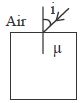
In the figure shown, for an angle of incidence $‘i’$ at the top surface, the minimum refractive index $\left( \mu  \right)$ needed for total internal reflection at the vertical surface will be
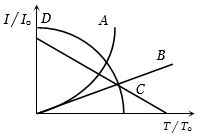
The ratio of thermionic currents $(I/I0)$ for a metal when the temperature is slowly increased ${T_0}$ to $T$ as shown in figure. ($I$ and $I_0$ are currents at $T$ and $T_0$  respectively). Then which one is correct?
Avalanche breakdown is due to
A galvanometer of resistance, $G,$ is shunted by a resistance $S$ $ohm$. To keep the main current in the circuit unchanged, the resistance to be put in series with the galvanometer is
A plane electromagnetic wave of wavelength $\lambda $ has an intensity $I.$  It is propagating along the positive $Y-$  direction. The allowed expressions for the electric and magnetic fields are given by
If a high power heater is connected to electric mains, then the bulbs in the house become dim, because there is a
A steel rod is projecting out of rigid wall. The shearing strength of steel is $345 \,\,MN/m^2.$ The dimensions $AB = 5\,\, cm,\,BC = BE = 2\,\, cm.$ The maximum load that can be put on the face $ABCD$ is .......... $kg$ (neglect bending of the rod)  $(g = 10\,\, m/s^2)$