MCQ
What is the path difference of destructive interference
  • A
    $n \lambda$
  • B
    $n(\lambda+1)$
  • C
    $\frac{(n+1) \lambda}{2}$
  • $\frac{(2 n+1) \lambda}{2}$

Answer

Correct option: D.
$\frac{(2 n+1) \lambda}{2}$
For destructive interference path difference is odd multiple of $\frac{\lambda}{2}$.

Need a full question paper?

Generate a complete, print-ready paper with questions like this in minutes — across 16+ boards, with answer keys.
Start Generating Free

Similar questions

In an ammeter $0.2\%$ of main current passes through the galvanometer. If resistance of galvanometer is $G,$ the resistance of ammeter will be
There is a body having mass $m$ and performing $\text{S.H.M.}$ with amplitude $a$. There is a restoring force $F=-K x$, where $x$ is the displacement. The total energy of body depends upon
Two identical blocks $A$ and $B$, each of mass ' $m$ ' resting on smooth floor are connected by a light spring of natural length $L$ and spring constant K, with the spring at its natural length. A third identical block ' $C$ (mass $m$ ) moving with a speed $v$ along the line joining $A$ and $B$ collides with $A$. the maximum compression in the spring is
The wavelength of the energy emitted when electron come from fourth orbit to second orbit in hydrogen is $20.397 cm$. The wavelength of energy for the same transition in $He ^{+}$is
Earth's magnetic field always has a horizontal component except at or Horizontal component of earth's magnetic field remains zero at
The magnitude of vector $\vec{A}, \vec{B}$ and $\vec{C}$ are respectively 12,5 and 13 units and $\vec{A}+\vec{B}=\vec{C}$ then the angle between $\vec{A}$ and $\vec{B}$ is
An inelastic ball is dropped from a height of $100 \mathrm{~m}$. Due to earth, $20 \%$ of its energy is lost. To what height the ball will rise
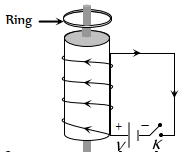
A conducting ring is placed around the core of an electromagnet as shown in fig. When key $K$ is pressed, the ringImage
Electric current is due to drift of electrons in
The coefficient of volumetric expansion of mercury is $18 \times 10 \%{ }^{\circ} \mathrm{C}$. A thermometer bulb has a volume $10 \mathrm{~m}$ and cross section of stem is $0.004 \mathrm{~cm}$. Assuming that bulb is filled with mercury at $0^{\circ} \mathrm{C}$ then the length of the mercury column at $100^{\circ} \mathrm{C}$ is