MCQ
What is the phase difference between electric and magnetic fields in an electromagnetic wave?
  • A
    $0$
  • $\pi$
  • C
    $\frac{\pi}{2}$
  • D
    $\frac{\pi}{4}$

Answer

Correct option: B.
$\pi$

The phase difference between electric and magnetic fields in an electromagnetic wave is$\pi$.

Need a full question paper?

Generate a complete, print-ready paper with questions like this in minutes — across 16+ boards, with answer keys.
Start Generating Free

Similar questions

A null point is found at $200\,cm$ in potentiometer when cell in secondary circuit is shunted by $5\,\Omega$. When a resistance of $15\,\Omega$ is used for shunting null point moves to $300\,cm$. The internal resistance of the cell is $..............\,\Omega$.
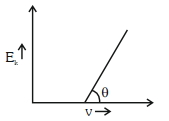
For the photoelectric effect, the maximum kinetic energy $\left(E_{\mathrm{k}}\right)$ of the photoelectrons is plotted against the frequency $(v)$ of the incident photons as shown in figure. The slope of the graph gives
The electrostatic force between the metal plates of an isolated parallel plate capacitor $C$ having a charge $Q$ and area $A$, is:
A long vertical wire carries a steady current of $5.0 \,A$. Asensitive magnetic compass is placed in a plane perpendicular to the wire and $10.0$ $cm$ south of it. It registers a deflection $60^{\circ}$ north of east. The magnitude of the horizontal component of the earth's magnetic field is (permeability of free space is $4 \pi \times 10^{-7} \,N/A{ }^2$ )
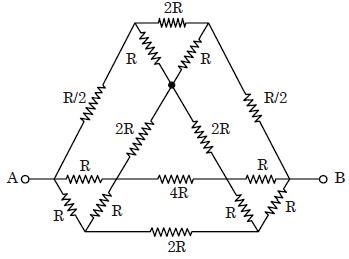
For the shown circuit, find the effective resistance between the points $A$ and $B$.
A charge q is at the center of the circle $\text{ABCDE.}$ Which among the following is true if the charge is taken from $A$ to $\text{B, C, D,}$ and $E?$
 
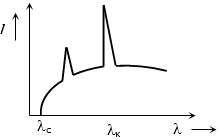
The intensity of $X-$ rays from a Coolidge tube is plotted against wavelength as shown in the figure. The minimum wavelength found is ${\lambda _c}$ and the wavelength of the ${K_\alpha } $ line is ${\lambda _k}$. As the accelerating voltage is increased
$A$ simple circuit contains an ideal battery and a resistance $R$. If a second resistor is placed in parallel with the first,
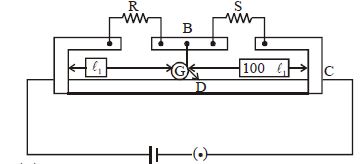
In a meter bridge the point $D$ is neutral point as shown in the figure.
The thermal radiation emitted by a body is proportional to $T^n$ where Tis its absolute temperature. The value of $n$ is exactly $4$ for: