MCQ
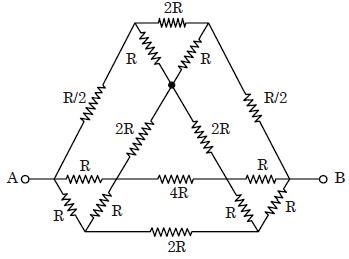
For the shown circuit, find the effective resistance between the points $A$ and $B$.
  • $R$
  • B
    $2R$
  • C
    $3R$
  • D
    $4R$

Answer

Correct option: A.
$R$
a

Need a full question paper?

Generate a complete, print-ready paper with questions like this in minutes — across 16+ boards, with answer keys.

Start Generating Free

Similar questions

Three particles, each having a charge of $10\,\mu C$ are placed at the corners of an equilateral triangle of side $10\,cm$. The electrostatic potential energy of the system is.....$J$ (Given $\frac{1}{{4\pi {\varepsilon _0}}} = 9 \times {10^9}\,N - {m^2}/{C^2}$)
The dominant mechanisms for motion of charge carriers in forward and reverse biased silicon P-N junctions are
Charges 4Q, q and Q and placed along x-axis at positions x = 0, x = l/2 and x = l, respectively. Find the value of q so that force on charge Q is zero
Two lithium nuclei in a lithium vapour at room temperature do not combine to form a carbon nucleus because:
During mean life of a radioactive element, the fraction that disintegrates is
When the light source is moving away, the Doppler effect for light is known as:
The peak value of an Alternating current is $ 6$ amp, then r.m.s. value of current will be
The electric fields of two plane electromagnetic plane waves in vacuum are given by

$\overrightarrow{\mathrm{E}}_{1}=\mathrm{E}_{0} \hat{\mathrm{j}} \cos (\omega \mathrm{t}-\mathrm{kx})$ and

$\overrightarrow{\mathrm{E}}_{2}=\mathrm{E}_{0} \hat{\mathrm{k}} \cos (\omega \mathrm{t}-\mathrm{ky})$

At $t=0,$ a particle of charge $q$ is at origin with a velocity $\overrightarrow{\mathrm{v}}=0.8 \mathrm{c} \hat{\mathrm{j}}$ ($c$ is the speed of light in vacuum). The instantaneous force experienced by the particle is 

Ray optics is valid, when characteristic dimensions are
Two long parallel wires whose centres are $a$ distance $d$ apart carry equal currents in opposite directions. If the flux within wires is neglected, the inductance of such arrangement of wire of length $l$ and radius $a$ will be