MCQ
What is the purpose of anode in a Cathode ray tube?
  • To provide potential energy to electrons
  • B
    To provide kinetic energy to protons
  • C
    To provide potential energy to protons
  • D
    To provide kinetic energy to electrons

Answer

Correct option: A.
To provide potential energy to electrons

In a Cathode ray tube electrons comes out from cathode. After cathode, anode is placed, which as being $+$ ively charged, accelerates electrons and provide them kinetic energy.

Need a full question paper?

Generate a complete, print-ready paper with questions like this in minutes — across 16+ boards, with answer keys.
Start Generating Free

Similar questions

An electric motor operating on a $60\, V$ $dc$ supply draws a current of $10 \,A$. If the efficiency of the motor is $50\%$, the resistance of its winding is.....$\Omega $
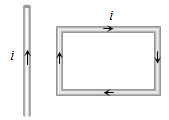
A rectangular loop carrying a current i is situated near a long straight wire such that the wire is parallel to the one of the sides of the loop and is in the plane of the loop. If a steady current I is established in wire as shown in figure, the loop will
An electron is accelerated through a potential difference of 200 volts. If e/m for the electron be $1.6\times 10^{11}$  coulomb/kg, the velocity acquired by the electron will be
A double star is a system of two stars rotating about their centre of mass only under their mutual gravitational attraction. Let the star have mass m and $2m$ and their separation be l. Their time period of rotation about their centre of mass will be proportional to
The de-Broglie wavelength $\lambda$
An $\alpha $-particle is accelerated through a potential difference of $200\,V$. The increase in its kinetic energy is.......$eV$
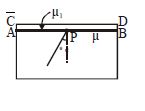
Initially $AB$ is the interface of slab of refractive index $μ$ and air. A ray of light strikes at $AB$ at the critical angle $\theta _c$ . Now a slab $ABCD$ of refractive index $μ_1$ is placed so that total internal reflection takes place at surface $CD$ (not at surface $AB$ ). What should be the value of $μ_1$ ?
A conducting circular loop is placed in a uniform magnetic field $0.04\,\,T$ with its plane perpendicular to the magnetic field. The radius of the loop starts shrinking at $2\,\,mm/s$ . The induced $emf$ in the loop when the radius is $2\,\,cm$ is
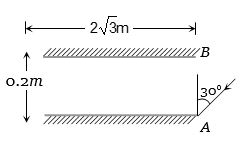
Two plane mirrors. $A$ and $B$ are aligned parallel to each other, as shown in the figure. A light ray is incident at an angle of $30^\circ $ at a point just inside one end of $A.$ The plane of incidence coincides with the plane of the figure. The maximum number of times the ray undergoes reflections (including the first one) before it emerges out is
A silicon speciman is made into a $P-$type semi-conductor by dopping, on an average, one Indium atom per $5 \times {10^7}$silicon atoms. If the number density of atoms in the silicon specimen is $5 \times {10^{28}}{\rm{atoms}}/{m^3}$ then the number of acceptor atoms in silicon per cubic centimetre will be