Question
What is the reactance of a capacitor connected to a constant DC source?

Answer

$\text{X}_\text{c}=\frac{1}{\omega\text{C}}$

As,

$\omega=0$

For,

$\text{DC},\text{X}_\text{c}=\infty.$

Need a full question paper?

Generate a complete, print-ready paper with questions like this in minutes — across 16+ boards, with answer keys.
Start Generating Free

Similar questions

What happens to coefficient of friction, when weight of body is doubled?
The normal duration of I.Sc. Physics practical period in Indian colleges is 100 minutes. Express this period in microcenturies. 1 microcentury = 10-6 × 100 years. How many microcenturies did you sleep yesterday?
When a bomb explodes in mid-air, at its highest point, what is the direction of motion of its core?
Boiling of water at its boiling point is an example of which process?
What will be the ratio of the velocity of efflux from two holes made with a separation (H - 2h) in a container holding liquid of height 'H' and one hole at a depth ‘h' from its bottom? Give reason.
Given below are some functions of x and t to represent the displacement (transverse or longitudinal) of an elastic wave. State which of these represent (i) a travelling wave, (ii) a stationary wave or (iii) none at all:
$\text{y}=2\cos(3\text{x})\sin(10\text{t})$
What is the mean translational kinetic energy of a mole of helium gas at 400K?
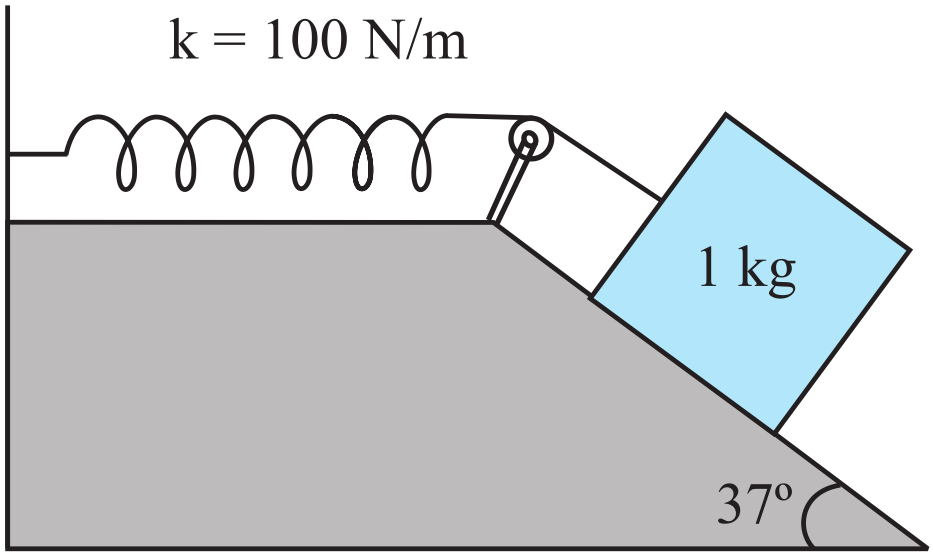
A 1kg block situated on a rough incline is connected to a spring of spring constant 100Nm-1 as shown in. The block is released from rest with the spring in the unstretched position. The block moves 10cm down the incline before coming to rest. Find the coefficient of friction between the block and the incline. Assume that the spring has a negligible mass and the pulley is frictionless.

If the angle of contact between a liquid and solid (a) is less than $90^{\circ} $ (b) is more than $90^{\circ} $ then would the liquid wet the solid? What will be its surface in a capillarly tube made from the solid? Will it rise in the capillary tube?
Use the definition of linear pomentum from the previous question. Can we state the principle of conservation of linear pomentum for a single particle?