Question
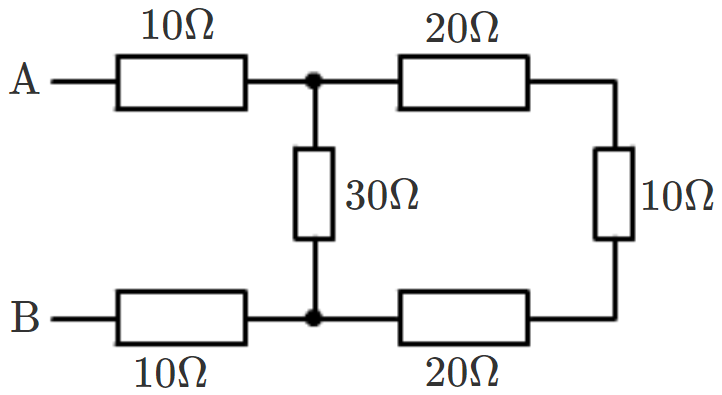
What is the resistance between A and B in the figure given below?
Answer

The three resistance of 20 ohm, 10 ohm and 20 ohm on the extreme right side are in series.

So, the resultant of these three resistance = 20 + 20 + 10 = 50 ohms.

This 50 ohms is in parallel with 30 ohms. so resultant of these two will be

$\frac{1}{\text{R}}=\frac{1}{30}+\frac{1}{50}$

$\frac{1}{\text{R}}=\frac{80}{1500}$

R = 18.75 ohms

Now, the resistance 10 ohms, 18.75 ohms and 10 ohms are in series.

Therefore, resultant resistance = 18.75 + 10 + 10 = 38.75 ohms.

Need a full question paper?

Generate a complete, print-ready paper with questions like this in minutes — across 16+ boards, with answer keys.

Start Generating Free

Similar questions

The electrical resistivities of three materials P, Q and R are given below:

 $\begin{matrix}\text{P}&2.3\times10^{3}\Omega\text{ m}\\\text{Q}&2.63\times10^{-8}\Omega\text{ m}\\\text{R}&1.0\times10^{15}\Omega\text{ m}\end{matrix}$

Which material will you use for making:
  1. Electric wires.
  2. Handle for soldering iron, and
  3. Solar cells?
Give reasons for your choices.

Make labelled ray diagrams to illustrate the formation of:
  1. A real image by a converging mirror.
  2. A virtual image by a converging mirror.
Mark clearly the pole, focus, centre of curvature and position of object in each case.
List three ways in which the magnetic field strength of a current-carrying solenoid can be increased?
An object is placed at a distance of 100cm from a converging lens of focal length 40cm.
  1. What is the nature of image?
  2. What is the position of image?
A convex lens produces an inverted image magnified three times of an object placed at a distance of 15cm from it. Calculate focal length of the lens.
What is the principle of an electric motor? Name some of the devices in which electric motors are used.
Name the defect of vision which can be corrected by a diverging lens. Show clearly by a ray diagram how the lens corrects the defect.
How will you use two identical prisms so that a narrow beam of white light incident on one prism emerges out of the second prism as white light? Draw the diagram.
A wire of given material having length l and area of cross-section A, has a resistance of $2\Omega$. Find the resistance of another wire of same material having length 2l and are of cross-section
$\frac{\text{A}}{2}$.
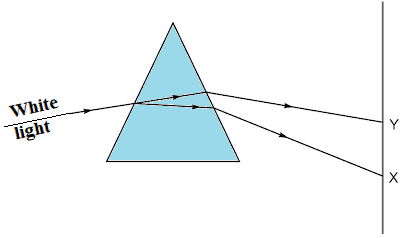
In the figure given alongside, a narrow beam of white light is shown to pass through a triangular glass prism. After passing through the prism, it produces a spectrum YX on the screen:
State the colour seen.
  1. At X, and
  2. At Y​​​​​​​​​​​​


​​​​​​​​​​​​
  1. violet.
  2. Red
  1. ​​​​​​​Why do different colours of white light bend through different angles with respect to the incident beam of light?
Define power of a lens. What is its unit? One student uses a lens of focal length 50cm and another of -50cm. What is the nature of the lens and its power used by each of them?