Questions · Page 1 of 3

Answer the questions.[Phy-3M]

🎯

Test yourself on this topic

50 questions · timed · auto-graded

Question 13 Marks
Which uses more energy: a 250W TV set in 1 hour or a 1200W to aster in 10 minutes?
Answer
Case1: TV set
P = 250W = 0.25 KWh
t = 1h
Energy consumed = P × t = 0.25 × 1 = 0.25KWh
Case2: Toaster
P = 1200W = 1.2KW, t = 10min $=\frac{10}{60}=\frac{1}{6}\text{h}$
Energy consumed $=\text{P}\times\text{t}=1.2\times\big(\frac{1}{6}\big)=0.2\text{kWh}$
Thus, TV uses energy.
View full question & answer
Question 23 Marks
A hot plate of an electric oven connected to a 220 V line has two resistance coils A and B, each of 24 Ω resistance, which may be used separately, in series, or in parallel. What are the currents in the three cases?
Answer
It is given that potential difference (V) = 220 V.

Resistance of coil (A) = Resistance of coil (B) = 24 Ω

  1. When either coil is used separately, the circuit $\text{(I)}= \frac{\text{V}}{\text{R}} = \frac{\text{220V}}{24\Omega} = 9.2 \text{A.}$

  2. When two coils are used in series total resistance 

$ \text{(R)}=\text{R}_1 + \text{R}_2 = 24 + 24 =48 \Omega$

Current flowing $\text{(I)} = \frac{\text{V}}{\text{R}} = \frac{220 \text{V}}{ 48\Omega} = 4.6 \text{A.}$

  1. When two coils are joined in parallel. Total resistance $\text{(R)}=\frac{1}{24} + \frac{1}{24}$

$= \frac{2}{24},\text{ R} =12 \Omega$

Current $\text{(I)} = \frac{\text{V}}{\text{R}} = \frac{220 \text{V}}{12} = 18.3\text{A.}$

View full question & answer
Question 33 Marks
Several electric bulbs designed to be used on a 220 V electric supply line, are rated 10 W. How many lamps can be connected in parallel with each other across the two wires of 220 V line if the maximum allowable current is 5 A?
Answer
Resistance R1 of the bulb is given by the expression,

Supply voltage, V = 220 V

Maximum allowable current, I = 5 A

Rating of an electric bulb P = 10 watts

Because R = v2/ P

$\text{R}_1=\frac{(220)^2}{10}=4840 \ \Omega$

According to Ohm's law,

V = IR

Let R is the total resistance of the circuit for x number of electric bulbs

R = V/I

$=\frac{220}{5}=44 \ \Omega$

resistance of each electric bulb, $\text{R}_1 = 4840 \ \Omega$

$\frac{1}{\text{R}}=\frac{1}{\text{R}_1}+\frac{1}{\text{R}_2}+\dots$upto x times

$\frac{1}{\text{R}}=\frac{1}{\text{R}_1}\times\text{x}$

$\text{x}=\frac{\text{R}_1}{\text{R}}=\frac{4840}{44}=110$

View full question & answer
Question 43 Marks
(i) State the law that explains the heating effect of current with respect to the measurable properties in an electrical circuit.
(ii) List the factors on which the resistance of a conductor depends.
Answer
i. Joules law of heating states that the heat dissipated across a resistor is directly proportional to
(a) the square of the current flowing through it
(b) The resistance of the conductor
(c) duration of flow of current.
$
H =1^2 R t \text { (alternative answer). }$
 ii. Resistance of a conductor depends on
(a) the length of the conductor
(b) the area of the cross section
(c) nature of material
(d) temperature of the conductor.
View full question & answer
Question 53 Marks
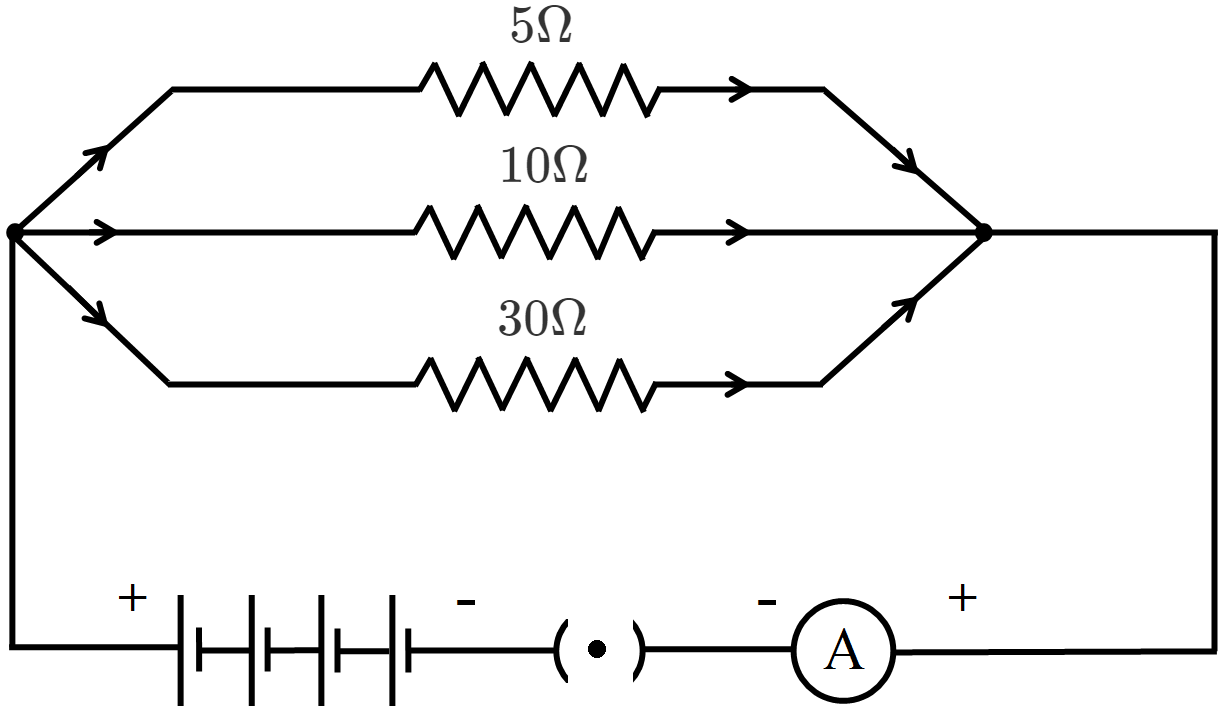
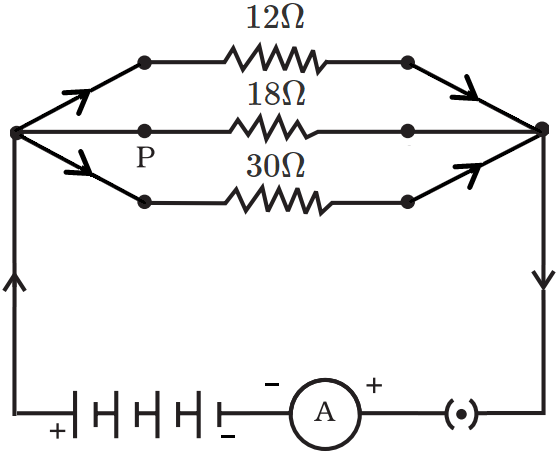
For the circuit shown in the diagram given below:

Calculate:
  1. the value of current through each resistor.
  2. the total current in the circuit.
  3. the total effective resistance of the circuit.
Answer
(a) All the resistors are connected in parallel. They are getting an equal voltage across their ends, which is equal to the voltage of the battery.
Hence, the current flowing through each resistor = $\frac{\text{Voltage across the battery}}{\text{Resistance of the resistor}}$
The voltage across the battery $=6 V$
Current flowing through 5-ohm resistor $=\frac{6 V}{5 \Omega}=1.2 A$
Current flowing through 10-ohm resistor $=\frac{6 V}{10 \Omega}=0.6 A$
Current flowing through 30-ohm resistor $=\frac{6 V}{30 \Omega}=0.2 A$

(b) The total current in the circuit = Sum of the current through all the resistors $=1.2 A+0.6 A+0.2 A=2 A$

(c) The total resistance of the circuit
$=\frac{\text { Total voltage }}{\text { Total current }}=\frac{6 V}{2 A}=3 \Omega$
View full question & answer
Question 63 Marks
  1. Define the term ‘volt’.
  2. State the relation between work, charge and potential difference for an electric circuit.

Calculate the potential difference between the two terminals of a battery if 100 joules of work is required to transfer 20 coulombs of charge from one terminal of the battery to the other.

Answer
  1. One volt is the potential difference between two points in a current carrying conductor when 1 joule of work is done to move a charge of 1 coulomb from one point to another.
  2. Work = charge x potential difference $(\text{OR }\text{W = Q} \times \text{V})$

$V = \frac{W}{Q}$

$V = \frac{\text{100 J}}{\text{20 C}}$

$\therefore V = \text{5 volt}$

View full question & answer
Question 73 Marks
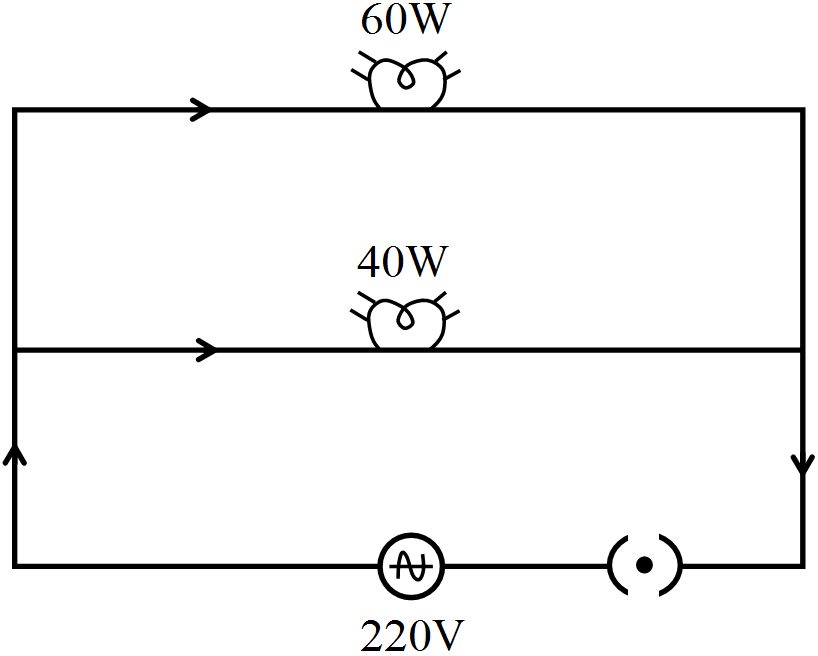
Two lamps, one rated 60 W at 220 V and the other 40 W at 220 V, are connected in parallel to the electric supply at 220 V.
  1. Draw a circuit diagram to show the connections.
  2. Calculate the current drawn from the electric supply.
  3. Calculate the total energy consumed by the two lamps together when they operate for one hour.
Answer
  1.  


  1.  

$\text{I} = \frac{\text{P}}{\text{V}}$

$\text{I}_{1} = \frac{\text{60 W}}{\text{220 V}} = \frac{3}{11}\text{A}$

$\text{I}_{2} = \frac{\text{40 W}}{\text{220 V}} = \frac{2}{11}\text{A}$

$\text{I} = \text{I}_{1} + \text{I}_{2} = \frac{3}{11} + \frac{2}{11} = \frac{5}{11} \text{A} = 0.45 \text{ A}$

  1.  

$\text{E} = \text{P} \times \text{t}$

$= \text{(40 W + 60 W)} \times 1\text{ h} = \text{100 Wh or 0.1 kWh}$

View full question & answer
Question 83 Marks
  1. Distinguish between the terms ‘overloading’ and ‘short-circuiting’ as used in domestic circuits.
  2. Why are the coils of electric toasters made of an alloy rather than a pure metal?
Answer
  1. Overloading occurs when an electric circuit draws more current than the permitted value and short circuiting occurs when the ends of a circuit are connected by a conductor of very low resistance as compared to that of circuit.
  2. The coils of electric toaster made of an alloy rather than pure metal because:
  1. Resistivity of alloys is generally higher than its constituent metals.
  2. It has high melting point.
  3. It does not oxidize i.e., burn.
View full question & answer
Question 93 Marks
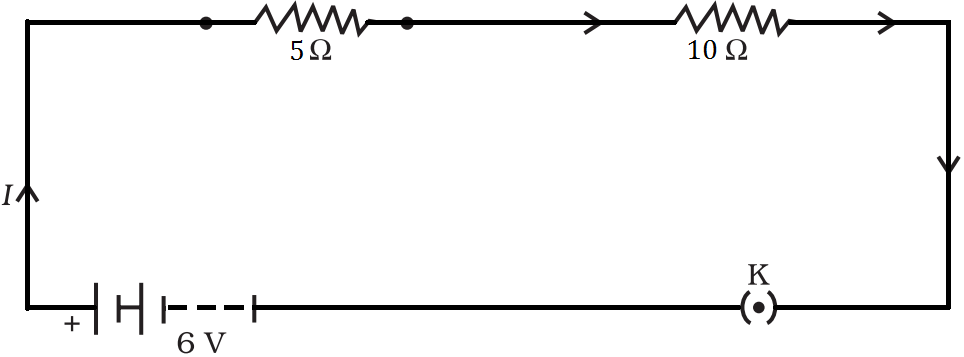
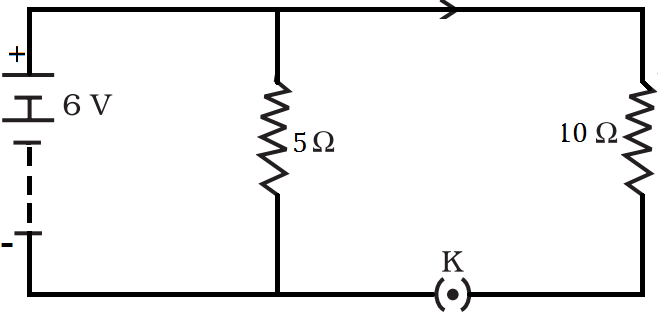
Two resistors, with resistances $\text{5 } \Omega \text{ and } \text{10 } \Omega$ respectively are to be connected to a battery of emf 6 V so as to obtain:
(i) Minimum current flowing. (ii) Maximum current flowing.
  1. How will you connect the resistances in each case?
  2. Calculate the strength of the total current in the circuit in the two cases.
Answer
  1.  
  1. In series


  1. In parallel arrangement


  1. For series arrangement:

$\text{R = R}_{1} + \text{R}_{2} = \text{5 }\Omega + \text{10 }\Omega = \text{15 }\Omega$

$\text{I} = \frac{\text{V}}{\text{R}} = \frac{\text{6V}}{15\Omega} = 0.4\text{A}$

For parallel arrangement:

$\frac{1}{\text{R}} = \frac{1}{\text{R}_{1}} + \frac{1}{\text{R}_{2}} = \frac{1}{5} + \frac{1}{10} = \frac{3}{10}$

$\therefore \text{R} = \frac{10}{3}\Omega$

$\text{I} = \frac{\text{V}}{\text{R}} = \frac{6\text{V}}{\frac{10}{3}\Omega} = 1.8 \text{ A}$

View full question & answer
Question 103 Marks
For the circuit shown in the diagram given below:

Calculate:
  1. The value of current through each resistor.
  2. The total current in the circuit.
  3. The total effective resistance of the circuit.
Answer
  1.  

$\text{I} = \frac{\text{V}}{\text{R}}$

$\text{I}_{1} = \frac{\text{6V}}{5\Omega} = 1.2\text{A}$

$\text{I}_{2} = \frac{6\text{V}}{10\Omega} = 0.6\text{A}$

$\text{I}_{3} = \frac{6\text{V}}{30\Omega} = 0.2\text{A}$

  1.  

$\text{I} = \text{I}_{1} + \text{I}_{2} + \text{I}_{3} = 1.2\text{A} + 0.6\text{A} + 0.2\text{A} = \text{2A}$

  1.  

$\frac{1}{\text{R}} = \frac{1}{\text{R}_{1}} + \frac{1}{\text{R}_{2}}+\frac{1}{\text{R}_{3}}$

$=\frac{1}{5} + \frac{1}{10} + \frac{1}{10}+\frac{1}{30} = \frac{10}{30} = \frac{1}{3}$

$\therefore \text{R} = 3\Omega$

Alternate Answer

$\text{V} = \text{I R}$

$\therefore \text{R} = \frac{\text{V}}{\text{I}} = \frac{6\text{V}}{\text{2A}} = 3\Omega$

View full question & answer
Question 113 Marks
  1. Write Joule’s law of heating.
  2. Two lamps, one rated 100W; 220V, and the other 60W; 220V, are connected in parallel to electric mains supply. Find the current drawn by two bulbs from the line, if the supply voltage is 220V.
Answer
  1. According to Joule’s law of heating, heat produced in a wire is directly proportional to,
  1. Square of current (I2)
  2. Resistance of wire (R)
  3. Time (t), for which current is passed

Thus,

H = I2 × R × t … (Joule’s law of heating)

  1. Current drawn from the first lamp is given by,

$\text{P}_1=\text{V}\times\text{I}_1$

$\therefore\ \text{I}_1=\frac{\text{P}_1}{\text{V}}=\frac{100}{220}=0.45\text{A}$

Current drawn from the second lamp is given by,

$\text{P}_2=\text{V}\times\text{I}_2$

$\therefore\ \text{I}_2=\frac{\text{P}_2}{\text{V}}=\frac{60}{220}=0.27\text{A}$

Thus the total current drawn by two lamps from the line,

which are connected in parallel to each other for supply voltage 220V is,

$\text{I}=\text{I}_1+\text{I}_2=0.45+0.27=0.72\text{A}$

View full question & answer
Question 123 Marks
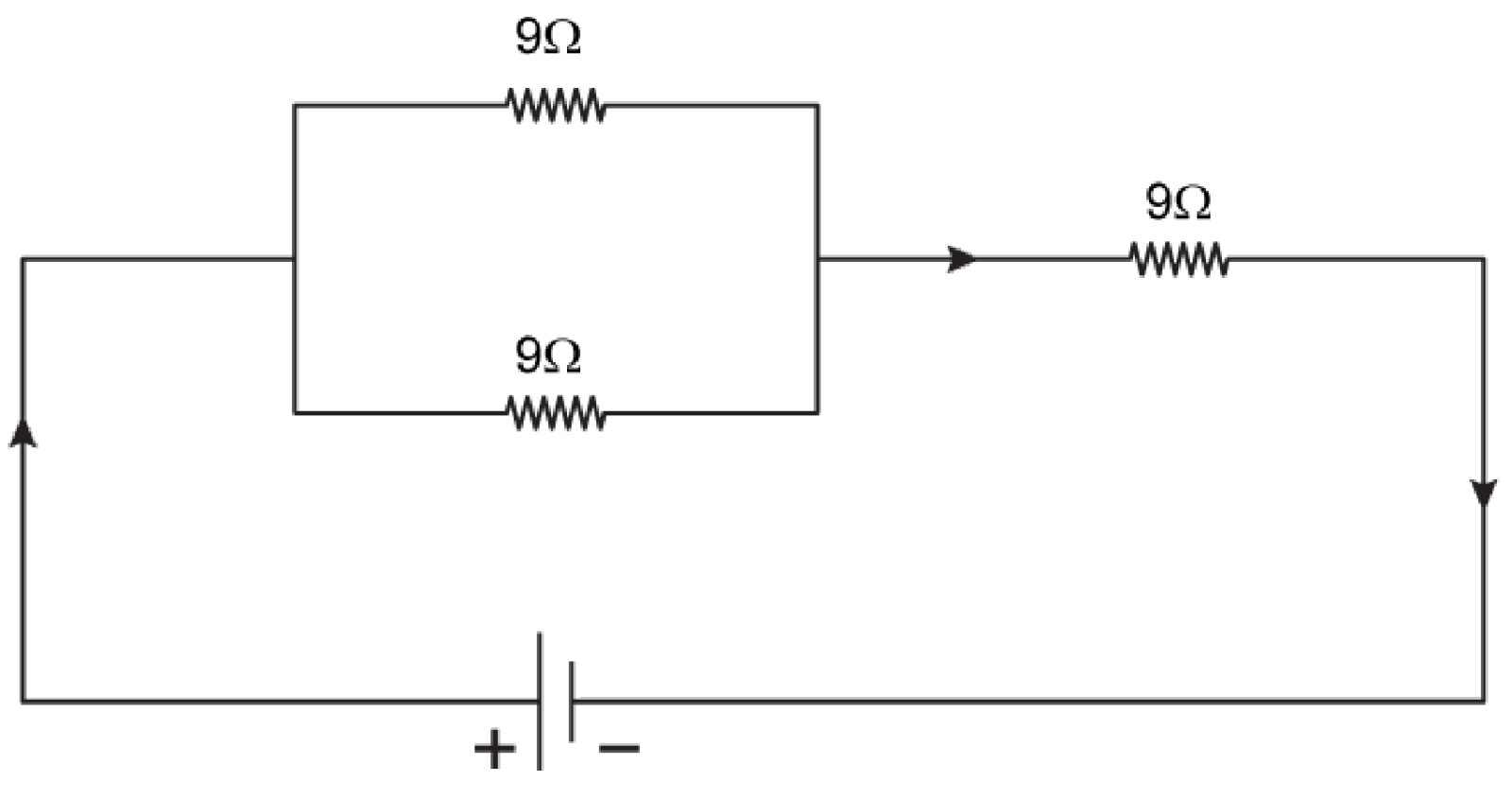
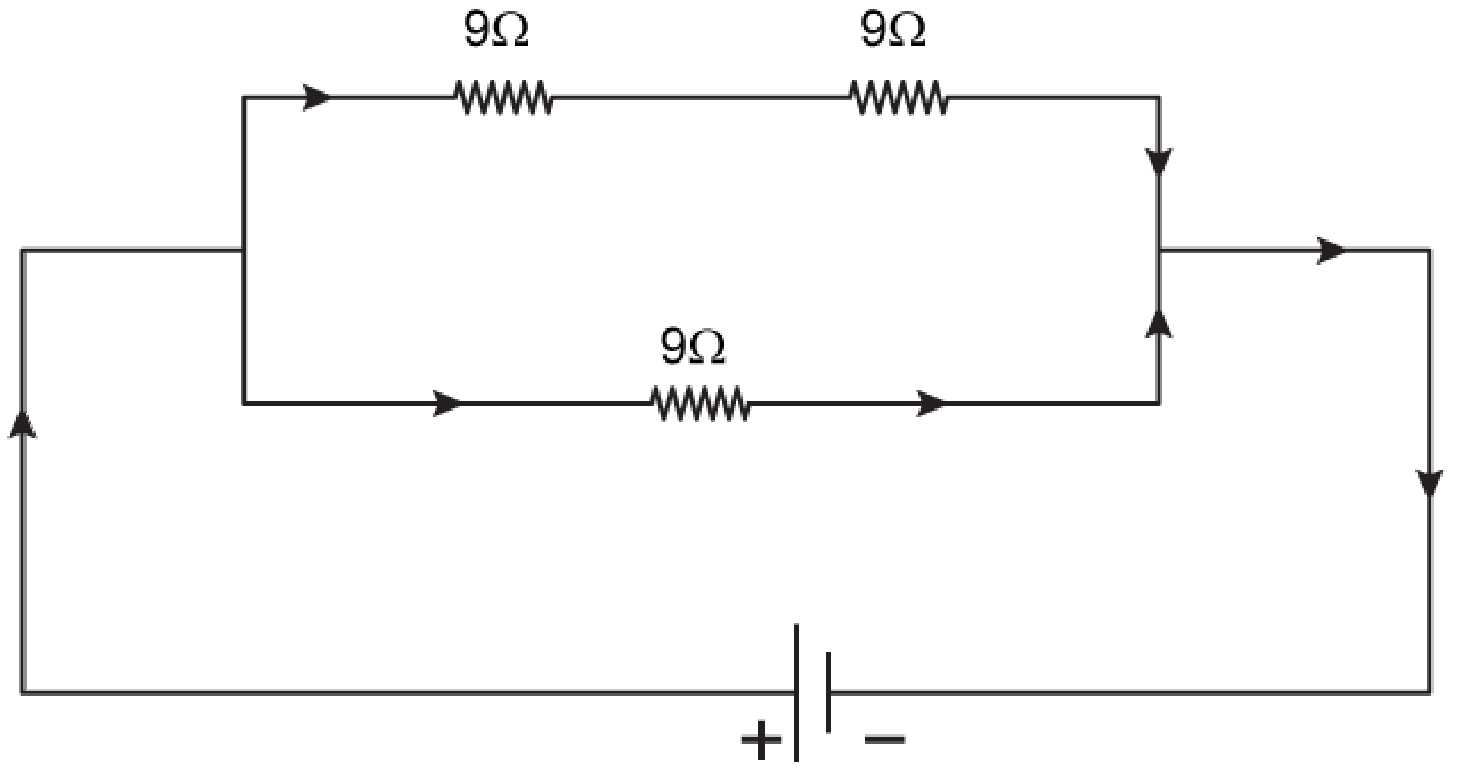
Show how would you join three resistors, each of resistance $9\Omega$ so that the equivalent resistance of the combination is:

  1. $13.5\Omega$

  2. $6\Omega$

Answer
Consider the resistors R1, R2 and R3 each of $9\Omega$ are connected in the circuit.

  1. When one resistor is connected in series with the other two resistors which are connected in parallel to each other, the equivalent resistance in the circuit is,


$\frac{1}{\text{R}_\text{p}}=\frac{1}{\text{R}_1}+\frac{1}{\text{R}_2}=\frac{1}{9}+\frac{1}{9}=\frac{2}{9}=0.22$

$\Rightarrow\ \text{R}_\text{p}=4.5\Omega$

$\text{R}_\text{s}=\text{R}_\text{p}+\text{R}_3=4.5\Omega+9\Omega=13.5\Omega$

$\therefore\ \text{R}_{\text{eq}}=13.5\Omega$

Thus, by connecting the resistors in this combination, the equivalent resistance in the circuit, $\text{R}_{\text{eq}}=13.5\Omega.$

  1. When one resistor is connected in parallel with the other two resistors which are connected in series with each other, the equivalent resistance in the circuit is,


$\text{R}_{\text{s}}=\text{R}_1+\text{R}_2=9\Omega+9\Omega=18\Omega$

$\frac{1}{\text{R}_\text{p}}=\frac{1}{\text{R}_\text{s}}+\frac{1}{\text{R}_3}=\frac{1}{18}+\frac{1}{9}=0.166$

$\Rightarrow\ \text{R}_\text{p}=6\Omega$

$\therefore\ \text{R}_{\text{eq}}=6\Omega$

Thus, by connecting the resistors in this combination, the equivalent resistance in the circuit, $\text{R}_{\text{eq}}=6\Omega.$​​​​​​​

View full question & answer
Question 133 Marks
  1. List the factors on which the resistance of a conductor in the shape of a wire depends.
  2. Why are metals good conductors of electricity whereas glass is a bad conductor of electricity? Give reason.
  3. Why are alloys commonly used in electrical heating devices? Give reason.
Answer
  1. Factors affecting the resistance of a conductor:
  1. Length of the conductor.
  2. Area of cross-section of the conductor.
  3. Nature of material of the conductor.
  4. Temperature of the conductor.
  1. Metals have low resistivity and glass has high resistivity. So, all the metals are good conductors, while glass is a bad conductor of electricity.
  2. The heating elements of electrical appliances are made of alloys because,
  1. The resistivity of an alloy is much higher than the metal.
  2. An alloy does not undergo oxidation or burn easily even if heated up to higher temperature.
View full question & answer
Question 143 Marks
Given below are the steps for the extraction of copper from its ore. Write the chemical equation of the reactions involved in each case.
  1. Roasting of copper (I) sulphide.
  2. Reduction of copper (I) oxide from copper (I) sulphide.
  3. Electrolytic refining.
Answer
  1. $2\text{Cu}_2\text{S}+3\text{O}_2\xrightarrow{\ \ \ \text{Heat}\ \ \ \ }2\text{Cu}_2\text{O}+2\text{SO}_2$

  2. $2\text{Cu}_2\text{O}+\text{Cu}_2\text{S}\xrightarrow{\ \ \ \text{Heat}\ \ \ \ }6\text{Cu}+\text{SO}_2$

  3. $\text{At anode}\xrightarrow{\ \ \ }\text{Cu}\xrightarrow{\ \ \ }\text{Cu}^{2+}+2\bar{\text{e}}$

$\text{At Cathode}\xrightarrow{\ \ \ }\text{Cu}^{2+}+\text{2e}\xrightarrow{\ \ \ }\text{Cu}$

View full question & answer
Question 153 Marks
  1. Write the mathematical expression for Joule's law of heating.
  2. Compute the heat generated while transferring 96000 coulomb of charge in two hours through a potential difference of 40V.
Answer
  1. The mathematical expression of the Joules Law of heating is:

H = I2 Rt

Here, H is a heating effect, I is the current flowing through the device, and t is the time taken

  1. Given,

Amount of charge transferred = 96000C

Time taken = 2hrs = 2 × 60 × 60sec

= 7200sec

Potential difference = 40V

Heat generated = V × i × t

And we know that;

$\text{i}=\frac{\text{Q}}{\text{t}}$

So, H = VQ

= 40 × 96000

= 3.84 × 10⁶J.

View full question & answer
Question 163 Marks
The near point of the eye of a person is 50cm. Find the nature and power of the corrective lens required by the person to enable him to see clearly the objects placed at 25cm. from the eye.
Answer
Near point of Hypermetropia eye = 50cm.

Book placed at, u = -25cm.

Convex lens/ converging lens It will form a virtual image of the abject at near point of defective eye.

V = -50cm

Lens formula,

$\frac{1}{\text{f}}=\frac{1}{\text{v}}-\frac{1}{\text{u}}$

$\frac{1}{\text{f}}=\frac{1}{(-50)}-\frac{1}{(-25)}=\frac1{50}$

$\text{f}=50\text{cm or }0.50\text{m}$

$\text{p}=\frac{1}{\text{f}}=\frac{1}{0.5}=+2\text{D}.$

View full question & answer
Question 173 Marks
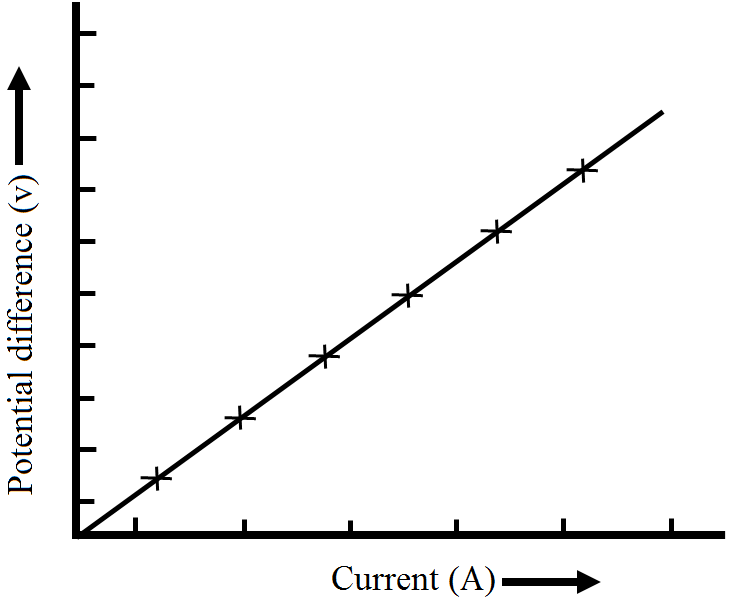
  1. State the relation correlating the electric current flowing in a conductor and the voltage applied across it. Also draw a graph to show this relationship.
  2. Find the resistance of a conductor if the electric current flowing through it is 0.35A when the potential difference across it is 1.4V.
Answer
  1. $\text{V}\alpha\text{ I}\text{ or }\frac{\text{V}}{\text{I}}=\text{Constant}$

$\text{Or}\text{ V}=1\text{R}$ 


  1. given I = 0.35A,

V = 1.4V

$\text{R}=\frac{\text{V}}{\text{I}}$

$=\frac{1.4}{0.35}$

$=4.'\Omega$

View full question & answer
Question 183 Marks
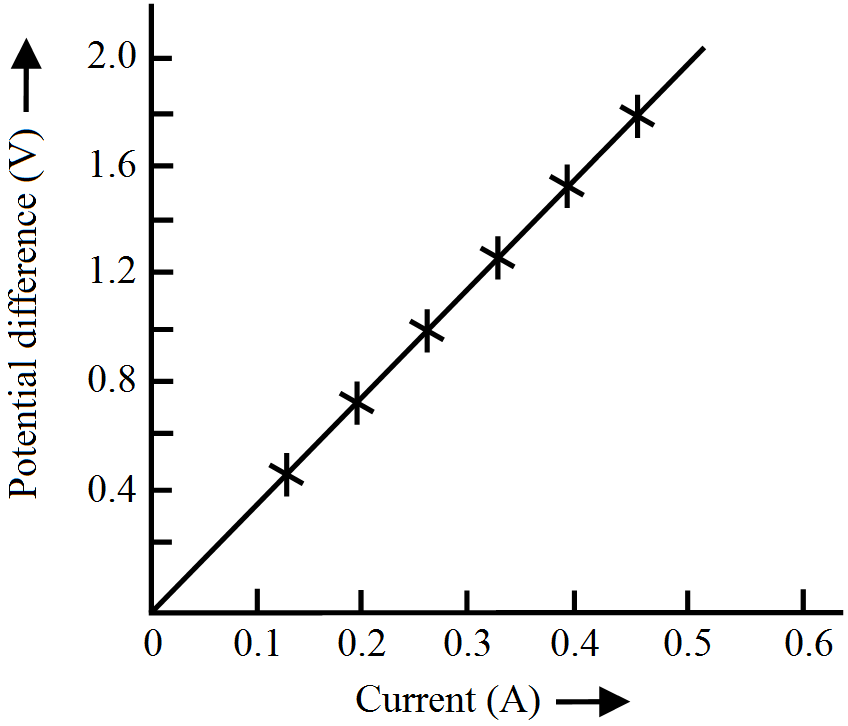
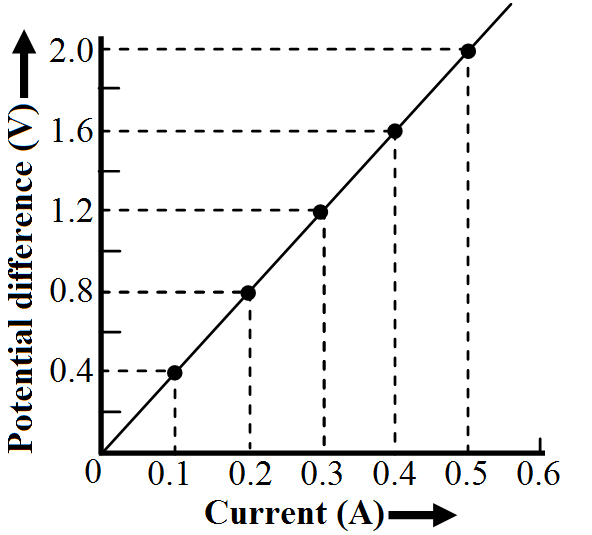
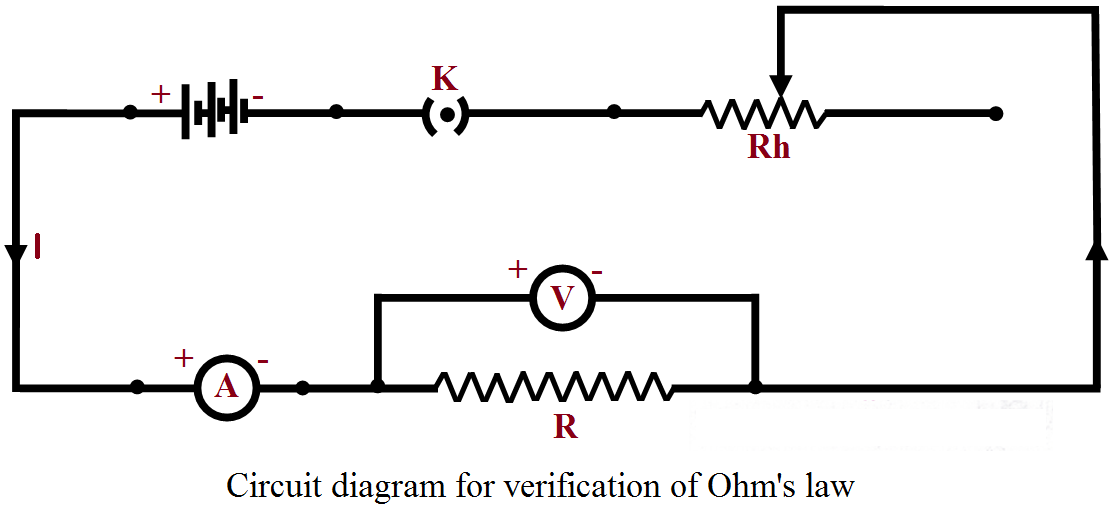
A V-1 graph for a nichrome wire is given below. What do you infer from this graph? Draw a labelled circuit diagram to obtain such a graph.
Answer


The graph between V & I is a straight line.

So we can conclude that Current flowing through the wire is directly proportional to the potential difference V across it.

The resistance of the wire can be calculated as,

$\text{R}=\frac{\text{V}}{\text{I}}$

$=\frac{0.4}{0.1}=4\Omega$

We can also conclude that nichrome wire has a constant value of the resistance as $4\Omega.$

Nichrome wire follows ohm's law thus it behaves as an ohmic conductor.

The circuit diagram corresponding to the above graph is as shown below.
View full question & answer
Question 193 Marks
You are given one hundred $1 Ω $ resister. What is the smallest and largest resistance you can make in a circuit using these?
Answer
Given: n = 100, R = 1 ohm
For obtaining the smallest resistance, these resistance are connected in parallel:
Equivalent resistance $=\frac{1}{1}+\frac{1}{1}+\frac{1}{1}....100\ \text{times}=\frac{100}{1}$
Req $=\frac{1}{100}=0.01\ \text{ohm}$
For obtaining the largest resistance, these are connected in series:
Equivalent reisistance = 1 + 1 + 1 .........100 Times = 100
Req = 100 ohm
View full question & answer
Question 203 Marks
Why, we do not use series combination of connecting electric appliances in household circuit?
Answer
In a house, there are many electrical appliances that have to run independent of each other. if the appliances were wired in series, the potential difference across each appliance would vary depending on the resistance of the appliance. This would make it very difficult to provide the right power to flow through the appliances. When house wiring is done in parallel this problem does not arise as the potential difference across each appliance is the same and equal to the potential difference being provided by the power company.
View full question & answer
Question 213 Marks
Why is parallel arrangement used in domestic wiring?
Answer
Parallel arrangement is used in domestic wiring due to the following reasons:
  • Each device will have the same voltage which is equal to the voltage of the supply.
  • If two or more devices are used at the same time then, each appliance will be able to draw the required current.
  • If one of the devices fails then other keeps working.​​​​​​​
View full question & answer
Question 223 Marks
When a current of 4.0A passes through a certain resistor for 10 minutes, 2.88 × 10J of heat are produced. Calculate:
  1. The power of the resistor.
  2. The voltage across the resistor.
Answer
Given: I = 4 amp, t = 10min = 10 × 60 = 600 sec, H = 2.88 × 104J

  1. We have

K = I2RT

28800 = 42 × R × 600

R = 3 ohm

We know that

P = I× R

= 42 × 3

P = 48W

  1. V = ?

We know that

V = IR

V = 4 × 3

V = 12V

View full question & answer
Question 233 Marks
What will be the resistance of a metal wire of length 2 metres and area of cross-section 1.55 × 10m , if the resistivity of the metal be 2.8 × 10 m?
Answer
I = 2m

A = 1.55 × 10-6 m2

P = 2.8 × 10-8m

$\text{R}=\text{P}\frac{\text{I}}{\text{A}}$

$=2.8\times10^{-8}\times\frac{2}{1.55\times10^{-6}}$

$0.036\Omega$

View full question & answer
Question 243 Marks
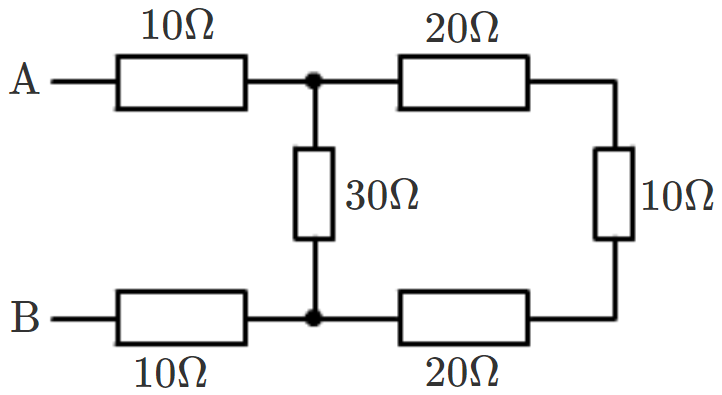
What is the resistance between A and B in the figure given below?
Answer
The three resistance of 20 ohm, 10 ohm and 20 ohm on the extreme right side are in series.

So, the resultant of these three resistance = 20 + 20 + 10 = 50 ohms.

This 50 ohms is in parallel with 30 ohms. so resultant of these two will be

$\frac{1}{\text{R}}=\frac{1}{30}+\frac{1}{50}$

$\frac{1}{\text{R}}=\frac{80}{1500}$

R = 18.75 ohms

Now, the resistance 10 ohms, 18.75 ohms and 10 ohms are in series.

Therefore, resultant resistance = 18.75 + 10 + 10 = 38.75 ohms.

View full question & answer
Question 253 Marks
What is, highest, and lowest, resistance which can be obtained by combining Com resistors having the following resistances?

$4 Ω, 8 Ω, 12 Ω, 24 Ω$

Answer
For obtaining the highest resistance by combining the given resistance, we must connect them in series.

We get,

R = 4 + 8 + 12 + 24 = 48 ohms

For obtaining the lowest resistance by combining the given resistance, we must connect them parallel.

We get,

$\frac{1}{\text{R}}=\frac{1}{4}+\frac{1}{8}+\frac{1}{12}+\frac{1}{24 }$

On solving we get, R = 2 ohms.

View full question & answer
Question 263 Marks
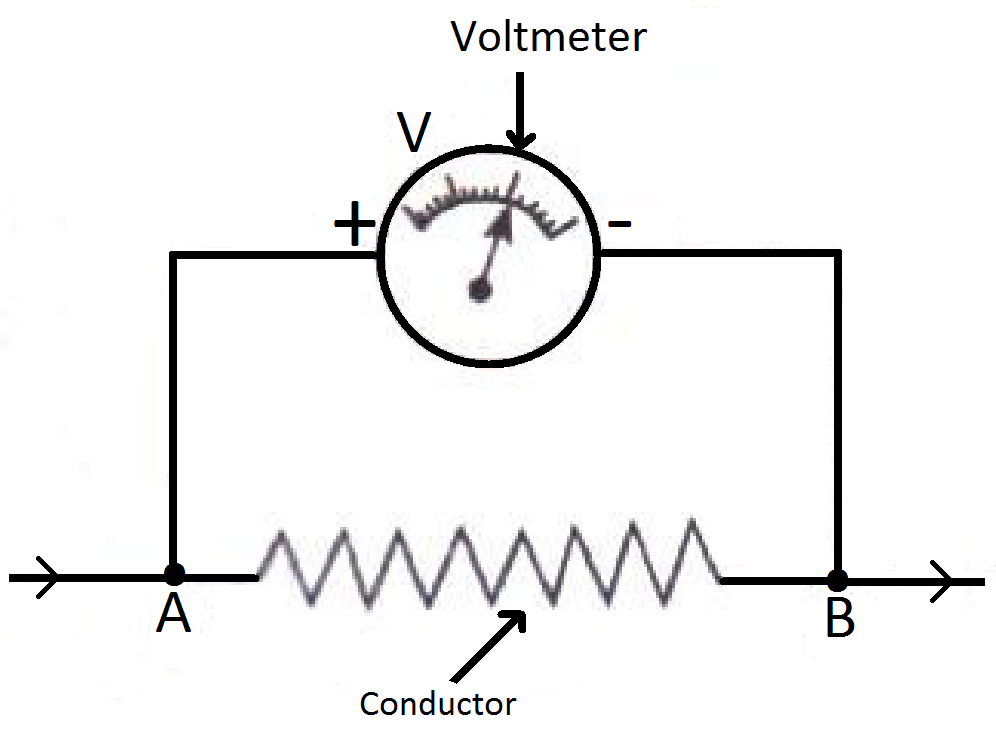
What is a voltmeter? How is a voltmeter connected in the circuit to measure the potential difference between two points. Explain with the help of a diagram.
Answer
A voltmeter is a device which is used to measure the potential difference between two points in an electric circuit. Voltmeter is always connected in parallel across the two points where the potential difference is to be measured.
View full question & answer
Question 273 Marks
What is (a) the highest, (b) the lowest total resistance that can be secured by combinations of four coils of resistance 4Ω, 8Ω, 12Ω, 24Ω?
Answer
  1. To obtain highest resistance, all the four resistances must be connected in series arrangement. In that case resultant

$\text{R} = \text{R}_1 + \text{R}_2 + \text{R}_3 $

$= 4 + 8 + 12 + 24 =48 \Omega$

  1. To obtain lowest resistance, all the four resistance must be connected in parallel arrangement.

$\frac{1}{\text{R}}=\frac{1}{\text{R}_1}+\frac{1}{\text{R}_2}+\frac{1}{\text{R}_3}$

$\frac{1}{4}+\frac{1}{8}+\frac{1}{12}+\frac{1}{24}=\frac{12}{24} \Omega$

$=\frac{24}{12}=2 \Omega$

View full question & answer
Question 283 Marks
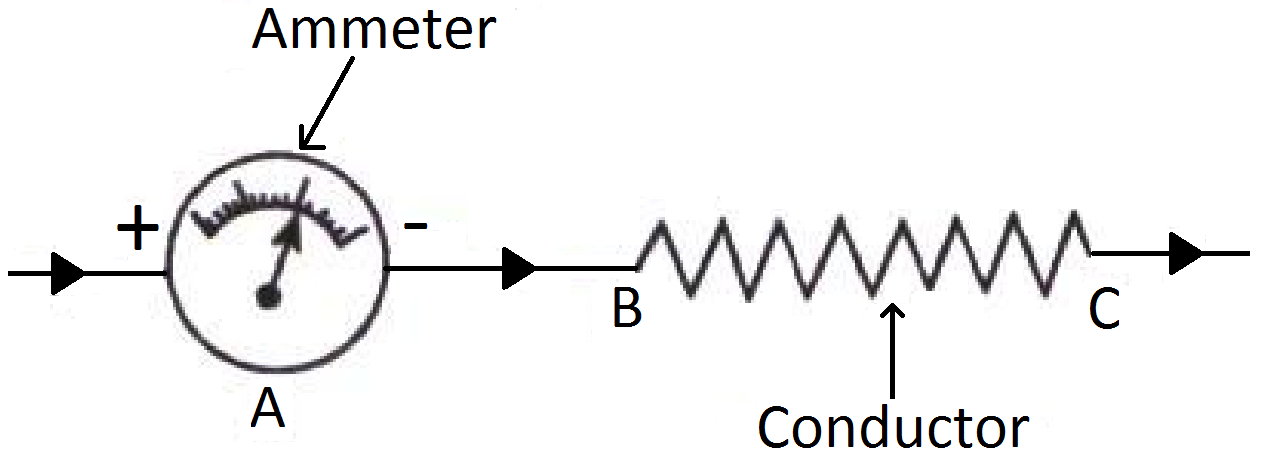
What is an ammeter? How is it connected in a circuit? Draw a diagram to illustrate your answer.
Answer
Ammeter is a device used for the measurement of electric current. It is always connected in series with the circuit in which the current is to be measured.
View full question & answer
Question 293 Marks
Two identical wires one of nichrome and other of copper are connected in series and a current (I) is passed through them. State the change observed in the temperatures of the two
wires. Justify your answer. State the law which explains the above observation.
Answer
Due to the heating effect of the current, the temperatures of the two wires will rise. Ohm's law explains this observation, which states that if physical conditions like temperature etc., of a
conductor are kept unchanged, the strength of current flowing through it is directly proportional to the potential difference across its ends. It is written as,
V = RI
R is called the resistance of a conductor, through which a current, I flows when a potential difference, V is applied across it. The value of resistance R depends on the temperature of the
conductor.
View full question & answer
Question 303 Marks
Two exactly similar electric lamps are arranged (i) in parallel, and (ii) in series. If the parallel and series combination of lamps are connected to 220V supply line one by one, what will be the ratio of electric power consumed by them?
Answer
Let resistance of each lamp = R ohms.

Case1: Parellel connection

Resultant resistance $=\frac{1}{\frac{1}{\text{R}}+\frac{1}{\text{R}}}=\frac{\text{R}}{2}$

Electric power consumed $\text{P}_1=\frac{\text{V}_2}{\text{R}}=\frac{220^2}{\frac{\text{R}}{2}}=\frac{96800}{\text{R}}$

Case2: Series connection

Resultant resistance = R + R = 2R

Electric Power consumed $\text{P}_2=\frac{\text{V}^2}{2\text{R}}=\frac{24200}{\text{R}}$

$\therefore\frac{\text{P}_1}{\text{P}_2}=\frac{\frac{96800}{\text{R}}}{\frac{24200}{\text{R}}}=\frac{4}{1}$ 

View full question & answer
Question 313 Marks
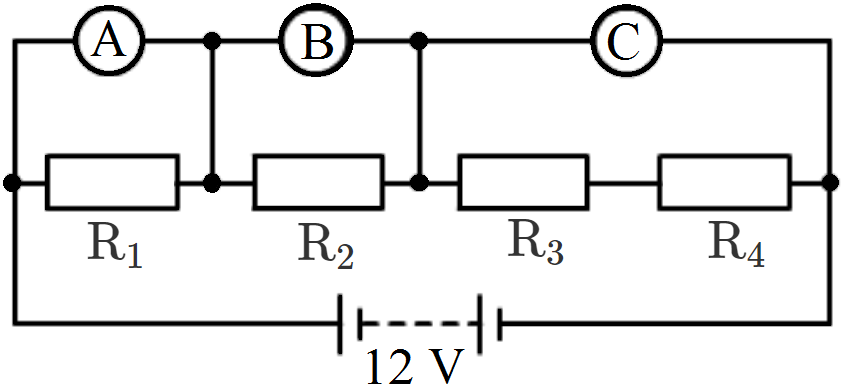
The resistors R1 , R2 , R3 and R4 in the figure given below are all equal in value.

What would you expect the voltmeters A, B and C to read assuming that the connecting wires in the circuit have negligible resistance?
Answer
Req = R + R + R + R = 4R ohm
Total current in the circuit, $\text{I}=\frac{\text{V}}{\text{R}}=\frac{12}{4\text{R}}=\frac{3}{\text{R}}$
Reading of voltmeter A = Voltage across $\text{R}_1=\text{I}\times\text{R}_1=\frac{3}{\text{R}}\times\text{R}=3\text{V}$
Reading of voltmeter B = Voltage across $\text{R}_2=\text{I}\times\text{R}_2=\frac{3}{\text{R}}\times\text{R}=3\text{V}$
Reading of voltmeter C = Voltage across the series combination of R3 and R4 $=\text{I}\times(\text{R}_3+\text{R}_4)=\frac{3}{\text{R}}\times2\text{R}=6\text{V}$
View full question & answer
Question 323 Marks
The electrical resistivities of four materials A, B, C and D are given below:

$\text{A}\ -110\times10^{-8}\Omega\text{ m}$

$\text{B}-\ 1.0\times10^{10}\Omega\text{ m}$

$\text{C}-\ 10.0\times10^{-8}\Omega\text{ m}$

$\text{D}-\ 2.3\times10^{3}\Omega\text{ m}$

Which material is:

  1. Good conductor.
  2. Resistor.
  3. Insulator, and
  4. Semiconductor
Answer
  1. Good conductor = C (10 × 10-8 ohm).
  2. Resistor = A (110 × 10-8 ohm).
  3. Insulator = B (1 × 10¹⁰ ohm).
  4. Semiconductor = D (2.3 × 10³ ohm).
View full question & answer
Question 333 Marks
The electrical resistivities of five substances A, B, C, D and E are given below:

$\begin{matrix}\text{B}&110\times10^{-8}\Omega\text{ m}\\\text{C}&2.60\times10^{-8}\Omega\text{ m}\\\text{D}&10.0\times10^{-8}\Omega\text{ m}\\\text{E}&1.70\times10^{-8}\Omega\text{ m}\end{matrix}$

Answer
  1. E is best conductor of electricity due to its least electrical resistivity.
  2. C, because its resistivity is lesser than that of A.
  3. B, because it has the highest electrical resistivity.
  4. C and E, because of their low electrical resistivities.
View full question & answer
Question 343 Marks
State three factors on which the heat produced by an electric current depends. How does it depend on these factors?
Answer
Heat produced by an electric current depends on the following factors:
  1. Heat produced is directly proportional to square of current.
  2. Heat produced is directly proportional to resistance.
  3. Heat produced is directly proportional to the time for which current flows.
View full question & answer
Question 353 Marks
State the factors on which the heat produced in a current conductor depends. Give one practical application of this effect.
Answer
The factors are:
Length, thickness and nature of material.
  1. With increase in length of conductor, increases the amount of heat produced.
  2. With increase in thickness ,less amount of heat is produced.
  3. Good conductors produce less amount of heat while bad conductors produce more heat.
    When a current passes through a wire, the wire gets heated. This is called heating effect of current. Glowing of light bulb is an example.
View full question & answer
Question 363 Marks
Show how you would connect two 4 ohm resistors to produce a combined resistance of:
  1. 2 ohms.
  2. 8 ohms.
Answer
By connecting in parallel: Since equivalent resistance will be

$\frac{1}{\text{R}}=\frac{1}{4}+\frac{1}{4}=\frac{2}{4}=\frac{1}{2}$

Therefore. R = 2 ohm

By connecting in series: since equilaent resistance will be R = 4 ohm + 4 ohm = 8 ohm.

View full question & answer
Question 373 Marks
Power of a lamp is 60 W. Find the energy in joules consumed by it in 1s.
Answer
Power of Bulb = 60w.

As we know 1 unit = 1kwh = 1000wh.

it means if we run 1000 watt of load for 1 hour then it will consume 1 unit, or 1KWH.

Hence,

if we will run 60watt of bulb for 1hours then it will consume 60wh = 0.06kwh.

1Hr = 60min, & 1minute = 60sec.

hence 1hr = 3600sec.

So if we will run 0.06KW of load for 1sec then it will consume:

$\frac{0.06}{3600}\text{kwh}$

$=1.67\times\text{e}-5\text{kwh}.$

Power at any instant will be 60W.

View full question & answer
Question 383 Marks
It is possible to replace resistors joined in series by an equivalent single resistor of resistance. How?
Answer
Yes, It's possible to replace resistors joined in series by an equivalent single resistor of resistance. 

Let us consider three resistors R1, R2 and R3 connected in series.
Let
R1 = 1ohms
R2 =2ohms
R3 = 3ohms
Now when resistors are connected in series same current flows .
IAB = I1 = I2 = I3
Equivalent resistance Req
= R+ R+ R3
= 1ohm + 2ohm + 3ohm
= 6ohms
Now resistors in circuit can be replaced by equivalent single resistor of 6ohms.
View full question & answer
Question 393 Marks
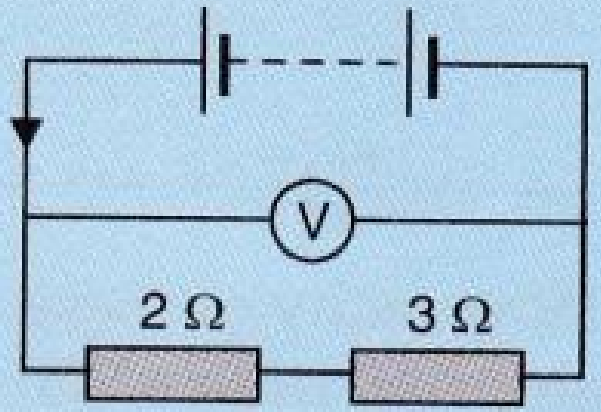
In the circuit shown below, the voltmeter reads 10V.

  1. What is the combined resistance?
  2. What current flows?
  3. What is the p.d. across $ 2 Ω$ resistor?
  4. What is the p.d. across $3 Ω$ resistor?
Answer
I = 6V

$\text{R}_1=2\Omega,\text{R}_2=3\Omega$

Combined resistance, Rtot = 2 + 3 = 5

$\text{I}=\frac{\text{V}}{\text{R}_\text{tot}}=\frac{10}{5}=2\text{A}$

p.d. across $2\Omega$ resistor = I × R1 = 2 × 2 = 4V.

p.d. across $3\Omega$ resistor = I × R2 = 2 × 3 = 6V.

View full question & answer
Question 403 Marks
In an experiment to study the relation between the potential difference across a resistor and the current through it, a student recorded the following observations:

  
Potential Difference V(volts)
Current I(amperes)
1.0
0.1
2.2
0.2
3.0
0.6
4.0
0.4
6.4
0.6

On examine the above observations, the teacher asked the student to reject one set of readings as the values were out of agreement with the rest. Which one of the above sets of

readings can be rejected? Calculate the mean value of resistance of the resistor based on the remaining four sets of readings.

Answer
For 1st potential difference and current

v=IR

1 = 0.1 × R

$\frac{1}{0.1} = \text{R}$

R = 10

for 2nd set of observation

v=IR

2.2 = 0.2 × R

$\frac{2.2}{0.2} =\text{R}$

R = 11

for 3rd set of observation

v= IR

3 = 0.6 × R

$\frac{3}{0.6} = \text{R}$

R = 5

View full question & answer
Question 413 Marks
In 10s, a charge of 25C leaves a battery, and 200j of energy are delivered to an outside circuit as a result.
  1. What is the p.d. across the battery?
  2. What current flows from the battery?
Answer
t = 10s

Q = 25C,

Energy deliverd = work done = 200J

$\text{p}.\text{d}.=\frac{\text{Work done}}{\text{Charge moved}}=\frac{200}{25}=8\text{V}$

$\text{I}=\frac{\text{Q}}{\text{t}}=\frac{25}{10}=2.5\text{A}$

View full question & answer
Question 423 Marks
If the charge on an electron is 1.6 × 10 coulombs, how many electrons should pass through a conductor in 1 second to constitute 1 ampere current?
Answer
We know that

$\text{I}=\frac{\text{Q}}{\text{T}}$

$\Rightarrow1\text{A}=\frac{\text{Q}}{1\text{s}}$

$\Rightarrow\text{Q}=1\text{C}$

Now, when charge is 1.6 × 10-19 Coulamb, number of electrone = 1

When charge is 1 Coulamb, number of electrone $=\frac{1}{1.6\times10^{-19}}=0.625\times10^{19}=625\times10^{18}$

View full question & answer
Question 433 Marks
If a potential difference of 10V causes a current of 2A to flow for 1 minute, how much energy is transferred?
Answer
Given: p.d. = 10V, I = 2amp, t = 1 min = 60s.

We know that:

$\text{I} = \frac{\text{Q}}{\text{T}}$

Thus, Q = I × t.

Q = × 60.

Q = 120C.

Work done = p.d. × charge moved

Work done = 120 × 10J

Work done = 1200J.

View full question & answer
Question 443 Marks
How will you connect three resistors of resistances $2Ω, 3Ω$ and $6Ω $ obtain a total n si stance of:
  1. $4 Ω,$
  2. $1Ω$
Answer
  1. Connects 2 ohms resistor in series with a parallel combinations of 3 ohms and 6 ohms.
  2. Connects 2 ohms, 3 ohms, and 6 ohms in parallel.
View full question & answer
Question 453 Marks
Give three reasons why different electrical appliances in a domestic circuit are connected in parallel.
Answer
Different electrical appliances in a domestic circuit are connected in parallel because of the following advantages:
  1. If one electrical appliance stops working due to some defect, then all other appliances keep working properly.
  2. Each electrical appliance has its own switch due to which it can be turned on or turned off independently, without affecting other appliances.
  3. Each electrical appliance gets the same voltage as that of the power supply line.
View full question & answer
Question 463 Marks
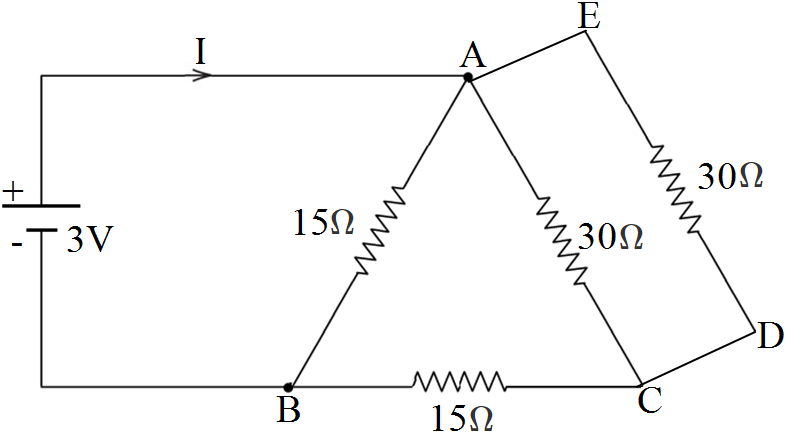
Find the value of current I in the circuit given below:
Answer
RAC abd RED are in parellel, so

$\frac{1}{\text{R'}_\text{p}}=\frac{1}{\text{R}_\text{AC}}+\frac{1}{\text{R}_\text{ED}}=\frac{1}{30}+\frac{1}{30}=\frac{1}{15}$

$\Rightarrow\text{R'}_\text{p}=15\Omega$

Now R'p and RBC are in series, so 

$\text{R'}_\text{s}=\text{R'}_\text{p}+\text{R'}_\text{BC}=15+15=30\Omega$

Again ,RAB and R'p are in parallel, so 

$\frac{1}{\text{R''}_\text{p}}=\frac{1}{\text{R}_\text{AB}}+\frac{1}{\text{R'}_\text{s}}$

$=\frac{1}{15}+\frac{1}{30}=\frac{1}{10}$

$\therefore \text{R''}_\text{p}=10\Omega$

So, current flowing through the circuit is 

$\text{I}=\frac{\text{V}}{\text{R''}_\text{P}}=\frac{3}{10}=0.3\text{A}$

View full question & answer
Question 473 Marks
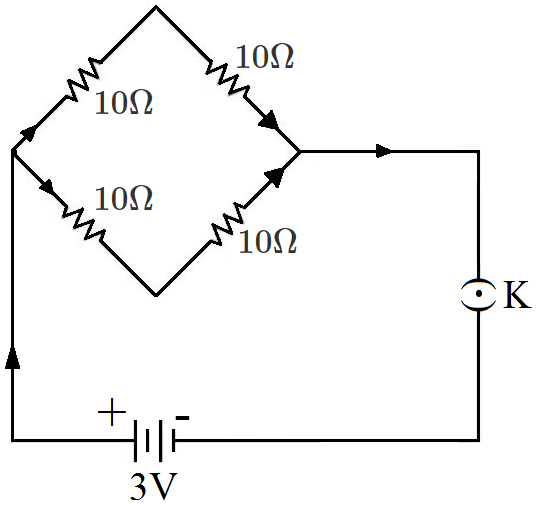
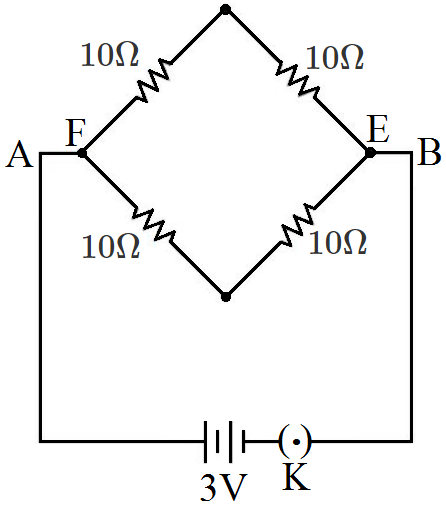
Find the current drawn from the battery by network of four resistors shown in the figure?
Answer


Resistance of the upper branch FCE are in series.
So, equivalent resistance in the branch FCE $=\text{R}_{1}=10\Omega+10\Omega=20\Omega$

Resistance of lower branch FDE are in series

So, equivalent resistance in the branch FDE $=\text{R}_{2}=10\Omega+10\Omega=20\Omega$

The two resistance R1 and R2 are parallel to each other.

If R is the equvalent resistance of network, then

$\frac{1}{\text{R}}=\frac{1}{20}+\frac{1}{20}=\frac{2}{20}=\frac{1}{100}$

or $\text{R}=10\Omega$

Current, V = IR

$\text{I}=\frac{\text{V}}{\text{R}}=\frac{3\text{V}}{10\Omega}=0.3\text{A}$

Thus, Current drawn by the resistor from the battery is 0.3 A.

View full question & answer
Question 483 Marks
Draw circuit symbols for:
  1. Fixed resistance.
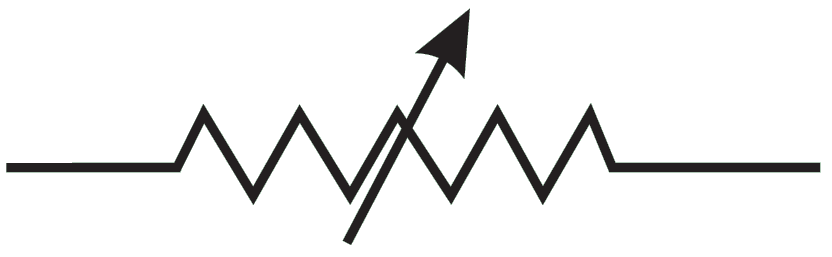
  2. Variable resistance.
  3. A cell.
  4. A battery of three cells.
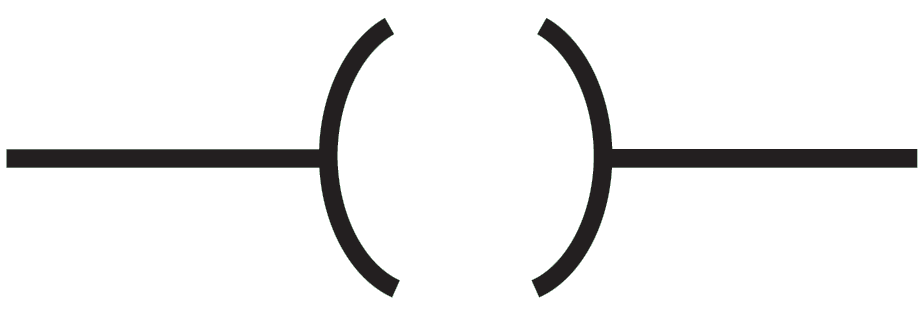
  5. An open switch.
  6. A closed switch.
Answer
  1. Fixed resistance


  1. Variable Resistance.


  1. Cell.


  1. Battery of three cells.


  1. Open Switch.


  1. Closed Switch.

View full question & answer
Question 493 Marks
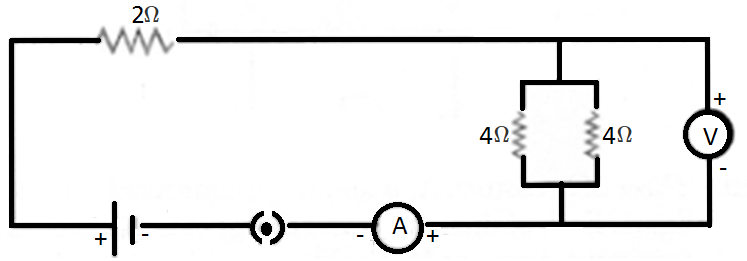
Draw a circuit diagram of an electric circuit containing a cell, a key, an ammeter, a resistor of 2Ω in series with a combination of two resistors (4Ω each) in parallel and a voltmeter across the parallel combination. Will the potential difference across the 2Ω resistor be the same as that across the parallel combination of 4Ω resistors? Give reason.
Answer


Equivalent resistance of two resistors (4Ω each) connected in parallel is given by

$\frac{1}{\text{R}}=\frac{1}{4}+\frac{1}{4}=\frac{1}{2}\text{ or R}=2\Omega$

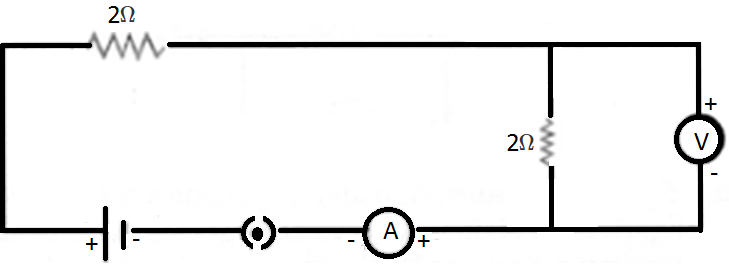
Therefore, the above circuit can be redrawn as given below:


Therefore, potential difference across 2Ω resistor will be same; as that of across the parallel combination of 4Ω resistors. V = IR.
As R and I in both the cases is same so V = same.
View full question & answer
Question 503 Marks
Define resistance. Write the SI unit of resistance and define it. Match the correct range of resistivity with the materials given.
  1. Conductors (i) 10-6Nm
  2. Alloys (ii) 1012 to $10^{17} \Omega$
  3. Insulators (iii) 10-6 to 10-8 m
Answer
Electrical resistance of a conductor may be considered as a measure of the opposition offered by it for the flow of electric charge through it. SI unit of resistance is ohm. 
  1. $\text{Conductors } — 10^{-6} \text{ to } 10^{-8}\Omega$
  2. $\text{Alloys } — 10^{-6} \Omega$
  3. $\text{Insulators} — 10 ^{12} \text{ to } 10^{17}Ωm. $
View full question & answer
Answer the questions.[Phy-3M] - Science STD 10 Questions - Vidyadip