Question
What is the role of natural indicators in identifying acidic and basic substances?

Answer

→ Natural indicators play a crucial role in identifying acidic and basic substances by changing color depending on the acidity or basicity of the solution.
 → These indicators are derived from natural sources like plants, flowers, and vegetables. For example, litmus, extracted from lichens, turns red in acidic solutions and blue in basic solutions.
→ Similarly, red rose petals and turmeric can be used as indicators, changing color in response to acids and bases.
 → By observing these color changes, one can easily determine whether a substance is acidic or basic, making natural indicators a simple and accessible tool for acid-base identification.

Need a full question paper?

Generate a complete, print-ready paper with questions like this in minutes — across 16+ boards, with answer keys.

Start Generating Free

Similar questions

Sachin lives in an area where on and off water scarcity is there. He gave a thought to the problem and planned to get a solution. He decided to harvest rainwater in his village. He made efforts to convince the people of his area, built some drainage system and water tanks where rainwater could be collected.
  1. Name few structures he might have built.
  2. Name the process of water cycle, Sachin will use for harvesting water.
  3. Write the methods, Sachin will tell the people to use water wisely.
Match the parts of the heart in column $I$ with the direction of flow of blood in column $II.$
 
Column $I$
 
Column $II$
$(i)$
Right ventricle
$(a)$
Pushes blood into the pulmonary artery.
$(ii)$
Pulmonary veins
$(b)$
Take deoxygenated blood from the heart to lungs.
$(iii)$
Left atrium
$(c)$
Receives blood from different parts of the body.
$(iv)$
Pulmonary arteries
$(d)$
Bring oxygenated blood from lungs to the heart.
$(v)$
Left ventricle
$(e)$
Pushes blood into the aorta.
vi)$
Right auricle
$(f)$
Receives deoxygenated blood from the pulmonary veins.
State few properties of bases.
Explain different types of soil found in India.
Describe the working of a torchlight.
Briefly state the characteristics of image formed by a plane mirror.
Match the items in Column $I$ with those in Column $II:$
 
Column $I$
 
Column $I$
$(a)$
Yeast
$(i)$
Earthworm
$(b)$
Diaphragm
$(ii)$
Gills
$(c)$
Skin
$(iii)$
Alcohol
$(d)$
Leaves
$(iv)$
Chest cavity
$(e)$
Fish
$(v)$
Stomata
$(f)$
Frog
$(vi)$
Lungs and skin
 
 
$(vii)$
Tracheae
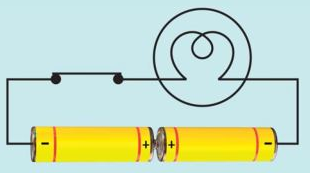
The bulb in the circuit shown in Figure does not glow. Can you identify the problem? Make necessary changes in the circuit to make the bulb glow.
Image
Match the items given in Column $I$ with one or more items of Column $II.$
Column I Column II
A plane mirror Used as a magnifying glass.
A convex mirror Can form image of objects spread over a large area.
A convex lens Used by dentists to see enlarged image of teeth.
A concave mirror The image is always inverted and magnified.
A concave lens The image is erect and of the same size as the object.
  The image is erect and smaller in size than the object
Classify the following as motion along a straight line, circular or oscillatory motion.
  • Motion of our hands while running.
  • Motion of a horse pulling a cart on a straight road.
  • Motion of a kid in a merry-go-round.
  • Motion of a child on a see-saw.
  • Motion of the hammer of an electric bell.
  • Motion of a train on a straight bridge.