Question
What is the S.I. unit of electric potential? 

Answer

  1. Volt
Explanation:
An electric potential (also called the electric field potential or the electrostatic potential) is the amount of electric potential energy that a unitary point electric charge would have if located at any point of space, and is equal to the work done by an electric field in carrying a unit positive charge from infinity to that point.
This value can be calculated in either a static (time-invariant) or a dynamic (varying with time) electric field at a specific time in units of joules per coulomb, or volts (V). The electric potential at infinity is assumed to be zero.

Need a full question paper?

Generate a complete, print-ready paper with questions like this in minutes — across 16+ boards, with answer keys.
Start Generating Free

Similar questions

For a triode $m = 64$ and $g_m =1600m$ mho. It is used as an amplifier and an input signal of $1V\ (rms)$ is applied. The signal power in the load of $40\ kW$ will be
The ratio of contributions made by the electric field and magnetic field components to the intensity of an $\ce{EM}$ wave is:
To reduce the value of capacitance of a parallel plate capacitor, the empty space between the plates:
Consider the following two statements A and B and identify the correct choice in the given answer
A :  The characteristic X-ray spectrum depends on the nature of the material of the target.
B :  The short wavelength limit of continuous X-ray spectrum varies inversely with the potential difference applied to the X-rays tube(a) A is true and B is false(b) A is false and B is true(c) Both A  and B  are true(d) Both A and B are false
   
   
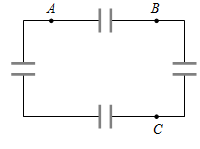
Four capacitors of each of capacity $3\ \mu F$ are connected as shown in the adjoining figure. The ratio of equivalent capacitance between $A$ and $B$ and between $A$ and $C$ will be
The ratio of the energy of an $X-$ray photon of wavelength $1 \mathring A$ to that of visible light of wavelength $5000 \mathring A$ is
A moving coil sensitive galvanometer gives at once much more deflection. To control its speed of deflection(a) A high resistance is to be connected across its terminals(b) A magnet should be placed near the coil(c) A small copper wire should be connected across its terminals(d) The body of galvanometer should be earthed


A radioactive nucleus emits a beta particle. The parent and daughter nuclei are (a) Isotopes(b) Isotones(c) Isomers(d) Isobars
       
Which is not an electrostatic phenomenon:
A man cannot see clearly the objects beyond a distance of 20 cm from his eyes. To see distant objects clearly he must use which kind of lenses and of what focal length(a) 100 cm convex(b) 100 cm concave(c) 20 cm convex(d) 20 cm concave