Current Electricity — Physics STD 12 Science — Question
Maharashtra BoardEnglish MediumSTD 12 SciencePhysicsCurrent Electricity4 Marks
Question
What is the sign convention used for Kirchhoff's second law ? Explain with an example.
✓
Answer
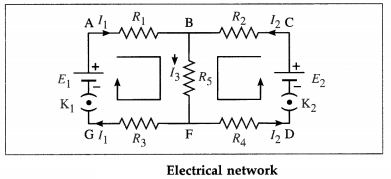
(1) While tracing a loop, if we traverse a resistor along the direction of conventional current, the potential difference across the resistor is considered negative. If we traverse the resistor opposite to the direction of conventional current, the potential difference across the resistor is considered positive. (2) While tracing a loop within the source, if we travel from the negative terminal of the source (cell) to the positive terminal of the source (cell), the emf of the source (cell) is considered positive. On the contrary, if we travel from the positive terminal of the source (cell) to the negative terminal of the source (cell), the emf of the source (cell) is considered negative.
Consider the electrical network shown in above figure. Tracing loop ABFGA in the clockwise direction, we get, $-I_1 R_1-I_3 R_5-l_1 R_3+E_1=0$ $\therefore E_1=I_1 R_1+I_3 R_5+I_1 R_3$ Tracing loop BFDCB in the anticlockwise direction, we get, $-I_3 R_5-I_2 R_4+E_2-I_2 R_2=0$ $\therefore E _2= I _2 R _2+ I _3 R _5+ I _2 R _4$ [Notes : (1) We may as well consider loop ABCDFGA and write the corresponding equation. (2) As the emf of a cell is the energy provided by the cell per unit charge in circulating the charge and the potential difference across a resistance is the work done per unit charge, it follows that this law (voltage law /loop law) is based on the conservation of energy.]
Need a full question paper?
Generate a complete, print-ready paper with questions like this in minutes — across 16+ boards, with answer keys.