MCQ
What is the torque of the force $\mathop F\limits^ \to   = (2\hat i - 3\hat j + 4\hat k)N$ acting at the pt. $\mathop r\limits^ \to   = (3\hat i + 2\hat j + 3\hat k)\,m$ about the origin
  • A
    $-17\hat i + 6\hat j + 13\hat k$
  • B
     $-6\hat i + 6\hat j - 12\hat k$
  • $17\hat i - 6\hat j - 13\hat k$
  • D
    $6\hat i - 6\hat j + 12\hat k$

Answer

Correct option: C.
$17\hat i - 6\hat j - 13\hat k$
c
Torque of a Force $\vec{F}$ acting on a point with position vector $\vec{r}$ is given by:

$\vec{\tau}=\vec{r} \times \vec{F}$

To, we can find Torque by finding the cross product of $\vec{r}$ and $\vec{F}$

We have:

$\vec{r}=3 \hat{\imath}+2 \hat{\jmath}+3 \hat{k} m$

$\vec{F}=2 \hat{\imath}-3 \hat{\jmath}+4 \hat{k} N$

So, torque will be:

$\vec{\tau}=\left|\begin{array}{ccc}{\hat{\imath}} & {\hat{\jmath}} & {\hat{k}} \\ {3} & {2} & {3} \\ {2} & {-3} & {4}\end{array}\right|$

$\Longrightarrow \vec{\tau}=\hat{\imath}((2)(4)-(-3)(3))-\hat{\jmath}((3)(4)-(2)(3))+\hat{k}((3)(-3)-(2)(2))$

$\Longrightarrow \vec{\tau}=\hat{\imath}(8+9)-\hat{\jmath}(12-6)+\hat{k}(-9-4)$

$\Longrightarrow[\vec{\tau}=17 \hat{\imath}-6 \hat{\jmath}-13 \hat{k}, N m]$

This is the torque of the force acting about Origin.
Need a full question paper?

Generate a complete, print-ready paper with questions like this in minutes — across 16+ boards, with answer keys.

Start Generating Free

Similar questions

A heavy stone is thrown from a cliff of height $h$ with a speed $\nu.$ The stone will hit the ground with maximum speed if it is thrown:
The maximum error in the measurement of resistance, current and time for which current flows in an electrical circuit are $1 \%, 2 \%$ and $3 \%$ respectively. The maximum percentage error in the detection of the dissipated heat will be
The point on the pressure temperature phase diagram where all the phases co-exist is called
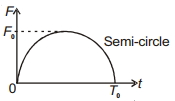
The magnitude of force acting on a particle moving along $x$-axis varies with time $(t)$ as shown in figure. If at $t=0$ the velocity of particle is $v_0$, then its velocity at $t=T_0$ will be
Correct formula for height of a satellite from earths surface is :
Two stretched membranes of area $2\, cm^2$ and $3\, cm^2$ are placed in a liquid at the same depth. The ratio of pressures on them is
A point charge is brought in an electric field. The electric field at a nearby point.
  1. Will increase if the charge is positive.
  2. Will decrease if the charge is negative.
  3. May increase if the charge is positive.
  4. May decrease if the charge is negative.
Given below are two statements :

Statement $(I)$ : Dimensions of specific heat is $\left[\mathrm{L}^2 \mathrm{~T}^{-2} \mathrm{~K}^{-1}\right]$

Statement $(II)$ : Dimensions of gas constant is $\left[\mathrm{ML}^2 \mathrm{~T}^{-1} \mathrm{~K}^{-1}\right]$

When a particle is thrown vertically upwards, its velocity at one third of its maximum height is $10 \sqrt{2}\,m / s$. The maximum height attained by it is .......... $m$
The ratio of intensities between two coherent sound sources is $4: 1$. The difference of loudness in dB between maximum and minimum intensities when they interfere in the space is ..........