Question
What is the total energy of a simple harmonic oscillator?

Answer

$\frac{1}{2}\text{m}\omega^2\text{r}^2$ where r = amplitude, $\omega$ = angular frequency, m = mass of the oscillator.

Need a full question paper?

Generate a complete, print-ready paper with questions like this in minutes — across 16+ boards, with answer keys.
Start Generating Free

Similar questions

What would be the modulus of elasticity of perfectly elastic substance?
Consider the statements $A$ And $B$ in question $5$. Thomson effect is caused:
When a pendulum clock is taken to a mountain, it becomes slow. But a wrist watch controlled by a spring remains unaffected. Explain.
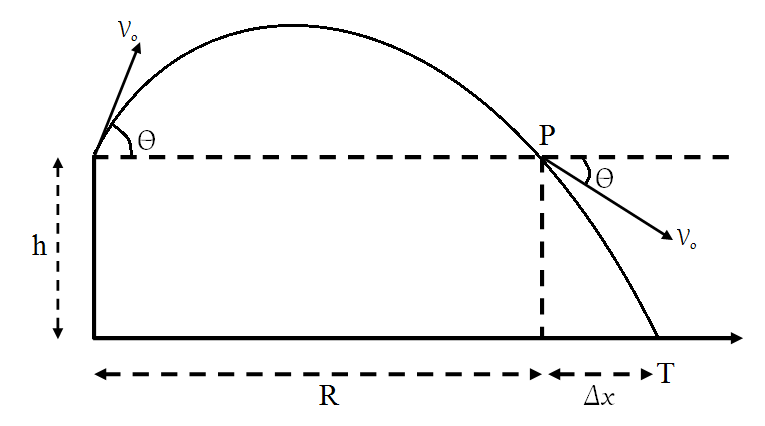
A gun can fire shells with maximum speed $v_0$ and the maximum horizontal range that can be achieved is $\text{R}=\frac{\text{v}^2_0}{\text{g}}.$

If a target farther away by distance $\Delta\text{x}$ (beyond R) has to be hit with the same gun (Fig), show that it could be achieved by raising the gun to a height at least $\text{h}=\Delta\text{x}\Big[1+\frac{\Delta\text{x}}{\text{R}}\Big]$ (Hint: This problem can be approached in two different ways:
  1. Refer to the diagram: target T is at horizontal distance $\text{x}=\text{R}+\Delta\text{x}$ and below point of projection y = – h.
  2. From point P in the diagram: Projection at speed $v_0$ at an angle $\theta$ below horizontal with height h and horizontal range $\Delta\text{x}$.)
As the speed of a particle increases, its rest mass:
Can mechanical energy be negative?
What are the forces which make any process irreversible?
A sphere of radius 1.00cm is placed in the path of a parallel beam of light of large aperture. The intensity of the light is $0.5W/cm^{-2}$. If the sphere completely absorbs the radiation falling on it, find the force exerted by the light beam on the sphere.
What is the amount of work done in bringing a mass from the surface of Earth on one side to a point diametrically opposite to the other side?
A cylinder of mass $10\ kg$ and radius $15\ cm$ is rolling perfectly on a plane of inclination $30^\circ$ . The coefficient of static friction $\mu_\text{s}= 0.25$
  1. How much is the force of friction acting on the cylinder?
  2. What is the work done against friction during rolling?
  3. If the inclination $\theta$ of the plane is increased, at what value of $\theta$ does the cylinder begin to skid, and not roll perfectly?