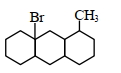
MCQ
What is the value of azimuthal quantum number for $‘g’$ sub shell ?
- A$3$
- B$4$
- C$6$
- ✓$5$
Generate a complete, print-ready paper with questions like this in minutes — across 16+ boards, with answer keys.
The number of possible product for $x$ and $y$ is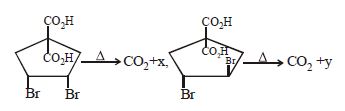
$\begin{array}{*{20}{c}}
{\,\,\,\,\,C{H_3}{\mkern 1mu} {\mkern 1mu} {\mkern 1mu} \,\,\,\,\,{\mkern 1mu} {\mkern 1mu} {\mkern 1mu} O{\mkern 1mu} } \\
{\,\,\,|{\mkern 1mu} {\mkern 1mu} {\mkern 1mu} {\mkern 1mu} {\mkern 1mu} {\mkern 1mu} {\mkern 1mu} {\mkern 1mu} {\mkern 1mu} {\mkern 1mu} {\mkern 1mu} \,\,\,\,\,\,\,\,\,\,{\mkern 1mu} {\mkern 1mu} ||} \\
{C{H_3} - CH - C - OH}
\end{array}$ $+ C{H_3} - N{H_2} \to 'A'\xrightarrow[\Delta ]{}'B'\xrightarrow{\begin{subarray}{l}
{\text{LiAl}}{{\text{H}}_4} \\
{\text{(excess)}}
\end{subarray} }'C'$
The final product $‘C’$ will be
In addition of $HOBr$ to $(I)$ and $(II)$
$(A)$ $\sigma$ orbital has a total of two nodal planes.
$(B)$ $\sigma^*$ orbital has one node in the $x z$-plane containing the molecular axis.
$(C)$ $\pi$ orbital has one node in the plane which is perpendicular to the molecular axis and goes through the center of the molecule.
$(D)$ $\pi^*$ orbital has one node in the $x y$-plane containing the molecular axis.