Question
What is vertical analysis of financial statements?

Answer

Vertical Analysis: In such type of analysis, financial statements for a single year or on a particular date are reviewed and analysed with the help of proper devices like ratios It involes a study quantitative amongs various items of Balance Sheet or Statement of Profit & Loss of a single period. The items in the financial statement are expressed as a percentage to total and the total is taken as equivalent to 100. Statements containing such analysis are termed as 'Common Size Statements'.

Need a full question paper?

Generate a complete, print-ready paper with questions like this in minutes — across 16+ boards, with answer keys.
Start Generating Free

Similar questions

'Suvidha Ltd.' is registered with an authorised capital of ₹ 10,00,00,000 divided into 10,00,000 equity shares of ₹ 100 each. The company issued 1,00,000 shares for public subscription. A shareholder holding 100 shares, failed to pay the final call of ₹ 20 per share. His shares were forfeited. The forfeited shares were re-issued at ₹ 90 per share as fully paid up.
Present the 'Share Capital' in the Balance Sheet of the company as per Schedule VI Part I of the Companies Act, 1956. Also prepare 'Notes to Accounts'.
Under which major head/sub-head will the following items be presented in the Balance Sheet of a company as per Schedule III Part I of the the Companies Act, 2013?
  1. Capital Advances
  2. Income received in advance
  3. Capital work-in-progress
  4. Motor vehicles
  5. Stores and spare parts
  6. 9% Debentures
Net Profit after Interest but before Tax ₹ 65,000; Shareholder's Funds ₹ 3,00,000; 15% Long-Term Debt ₹ 1,00,000. Calculate Return on Investment.
Calculate Trade Receivables Turnover Ratio in the following:
Case: Revenue from Operations (Net Sales) ₹ 30,00,000; Cash Revenue from Operations, i.e., Cash Sales ₹ 6,00,000; Opening Trade Receivables ₹ 2,00,000; Closing Trade Receivables ₹ 6,00,000.
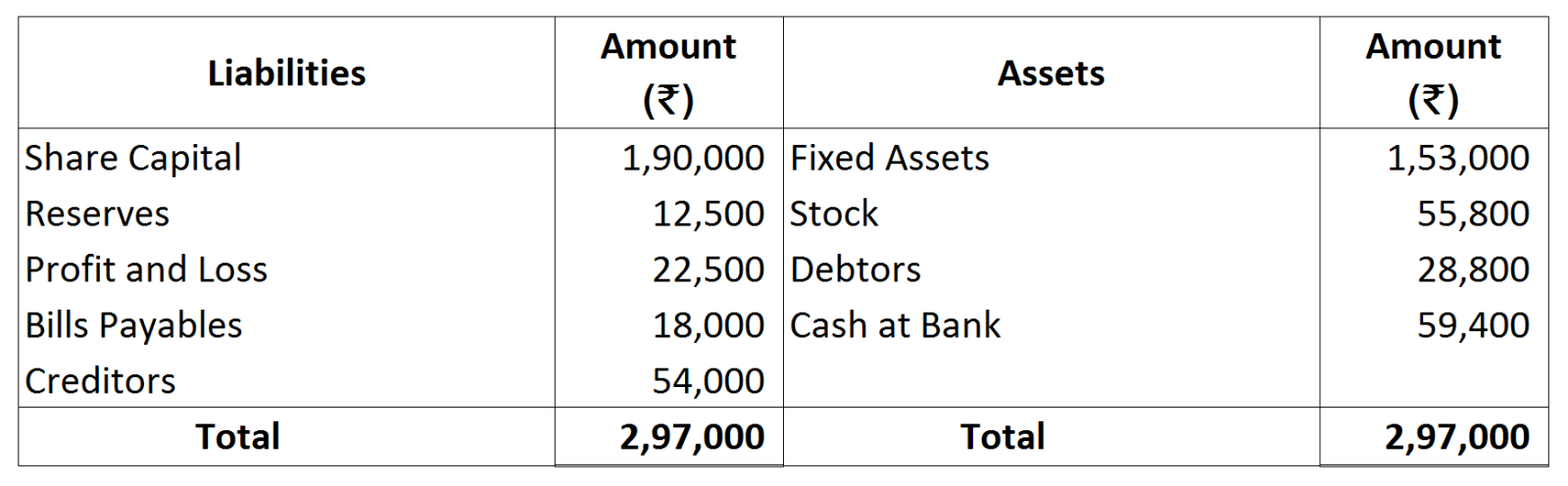
Following is the Balance Sheet of Rohit and Co. as on March 31, 2006.

Calculate Current Ratio.
Operating Cycle and the period when payment is made is given below. How will you classify the liability?
Particulars
(i)
(ii)
(iii)
(iv)
(v)
(vi)
Operating Cycle (Months)
9
11
11
18
18
10
Expected Period when payment is made (Months)
12
12
13
20
16
12
A holds 100 shares of ₹ 10 each on which he has paid ₹ 1 per share on application. B holds 200 Shares of ₹ 10 each on which he has paid ₹ 1 on application ₹ 2 on allotment. C holds 300 shares of₹ 10 each who has paid ₹ 1 on applications, ₹ 2 on allotment and ₹ 3 on first call. They all failed to pay their arrears and second call of ₹ 4 per share as well. All the shares of A, B and C were forfeited and subsequently reissued at ₹ 11 per share as fully Paid-up.
Current Liabilities ₹ 20,000; Working Capital ₹ 80,000. Calculate Current Ratio:
Opening Inventory ₹ 28, 000; Closing Inventory ₹ 52,000 ; Revenue from Operations ₹ 6,00, 000; Gross Profit $33\frac{1}{3}\%$ on Revenue from Operations. Calculate Inventory Turnover Ratio.
C India Ltd. purchased machinery from B India Ltd. Payment to B India Ltd. was made as follows:
  1. By issuing 10,000 equity shares of ₹ 10 each at a premium of 20%.
  2. By issuing 1000, 9% debentures of ₹ 100 each at a discount of 5%.
  3. Balance by giving a bank draft of ₹ 37,000.
Pass necessary journal entries in the books of C India Ltd. for the purchase of machinery and payment to B India Ltd.