Question
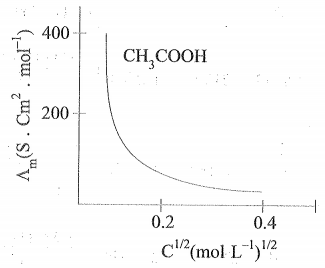
What is weak electrolyte? Explain relation between concentration of weak electrolyte and molar conductivity.

Answer

→ "Electrolyte which is incompletely ionized in its aqueous solution are known as weak electrolyte.
→" Weak electrolytes like acetic acid have lower degree of dissociation at higher concentrations and hence for such electrolytes, the change in $\hat{m}_{ m }$ with dilution is due to increase in the degree of dissociation and consequently the number of ions in total volume of solution that contains 1 mol of electrolyte.
→ In such cases $\wedge_{ m }$ increases steeply on dilution especially near lower concentrations. Therefor $\wedge_{ m }^0$ cannot be obtained by extra polation of $\wedge_{ m }^0$ zero concentration.
→ At infinite dilution (i.e. concentration $c \rightarrow$ zero electrolyte dissociates completely $(\alpha=1)$, but such low concentration the conductivity of the solution is so low that it cannot be measured accurately.
→ Therefore, $\wedge_{ m }^0$ for weak electrolytes is obtained by using Kohlrausch law of independent migration of ions.
Image
→ At any concentration c , if a is the degree of dissociation then it can be approximated to the ratio of molar conductivity $\wedge_{ m }$ at the concentration c to limiting molar conductivity, $\wedge_{ m }^0$ Thus we have :
$\begin{aligned} \alpha & =\frac{\Lambda_{ m }}{\Lambda_{ m }^0} \\ k _{ a } & =\frac{ c \alpha^2}{1-\alpha}=\frac{ c \Lambda_{ m }^2}{\Lambda_{ m }^{02}\left(1-\frac{\Lambda_{ m }}{\Lambda_{ m }^0}\right)}=\frac{ c \Lambda_{ m }^2}{\Lambda_{ m }^0 \Lambda_{ m }^0-\Lambda_{ m }}\end{aligned}$

Need a full question paper?

Generate a complete, print-ready paper with questions like this in minutes — across 16+ boards, with answer keys.
Start Generating Free

Similar questions

Give reasons for the following:
  1. Acetylation of aniline reduces its activation effect.
  2. $\ce{CH_3NH_2}$ is more basic than $\ce{C_6H_5NH_2}.$
  3. Although $-\ce{NH_2}$ is $o/p$ directing group, yet aniline on nitration gives a significant amount of $m-$nitroaniline.
Write equations of the following reactions:
  1. Acetylation of aniline
  2. Coupling reaction
  3. Carbyl amine reaction
Write the structures of $A, B$ and $C$ in the following$:$
  1. $\text{C}_{6}\text{H}_{5}-\text{CONH}_{2}\xrightarrow{Br_2/aq.KOH}A\xrightarrow[0-5^oC]{NaNO_2+Hcl}B\xrightarrow{KI}C$
  2. $\text{CH}_{3}-\text{Cl}\xrightarrow{KCN}A\xrightarrow{LiAlH_4}B\xrightarrow[\Delta]{CHCl_3+alc.KOH}C$
  1. Describe the following giving suitable examples:
  2. Give a chemical test to distinguish between ethanal and propanal.
  3. Cannizzaro reaction.
  4. Aldol condensation.
A solution Ni(NO3)2 is electrolysed between platinum electrodes a current of 5 amperes for 20 minutes. What mass of Ni is deposited at the cathode?
Give reasons for the following:
  1. Transition metals form alloys.
  2. $\ce{Mn_2O_3}$ is basic whereas $\ce{Mn_2O_7}$ is acidic.
  3. $\ce{Eu^{2+}} $ is a strong reducing agent.
Calculate the charge of one mole of electrons.
Complete the following chemical reaction equations:
$\text{Cr}_2\text{O}^{2-}_7(\text{aq})+\text{Fe}^{2+}(\text{aq})+\text{H}^+(\text{aq})\xrightarrow{\ \ \ \ \ \ \ \ \ }$
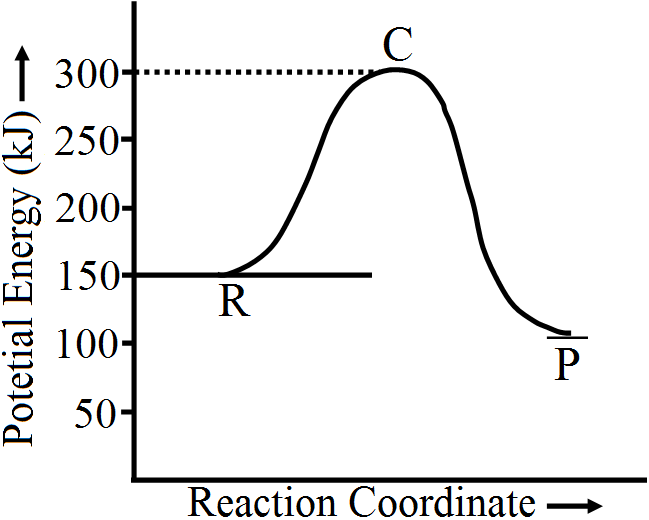
Answer the following questions on the basis of the given plot of potential energy vs reaction coordinate$:$
  1. What is the threshold energy for the reaction?
  2. What is the activation energy for forward reaction?
  3. What is the activation energy for backward reaction?
  4. What is enthalpy change for the forward reaction?
Give reasons for the following:
  1. Aniline does not undergo Friedal$-$Crafts reaction.
  2. $(CH_3)_2 NH$ is more basic than $(CH_3)_3 N$ in an aqueous solution.
  3. Primary amines have higher boiling point than tertiary amines.