Question
What is Wheatstone bridge? Explain its principle.

Answer

Image
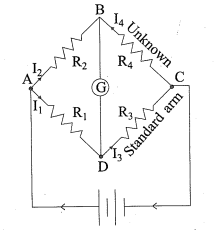
$\rightarrow $ The circuit shown in the figure is called the wheatstone bridge. It uses four resistors $R_1, R_2$, $R _3$ and $R _4$ out of them three resistors are known and one is unknown, wheatstone bridge is used to find the value of unknown resistance.
$\rightarrow$ As shown in the figure, across one pair of diagonally opposite points $(A$ and $C$ in the figure$)$ a source is connected hence $AC$ is called the battery arm.
$\rightarrow$ Between the other two vertices $, B$ and $D,$ a galvanomenter $G$ is connected hence $BD$ is called the galvanometer arm.
$\rightarrow$ When battery is connected, the currents flowing through the resistors $R_1, R_2, R_3$ and $R_4$ are $I_1$, $I _2, I _3$ and $I _4$ respectively.
$\rightarrow$ Here, there resistors are chosen in such a way that current flowing through galvanometer is zero $\left(I_g=0\right.$ ).
$\rightarrow$ When the current flowing through the galvanometer becomes zero, the bridge is said to be in balanced condition.
$\rightarrow$ From the figure, in balanced condition
$I _1= I _3 $ and $I _2= I _4$
$\rightarrow $ Applying Kirchhoff's loop rule to closed loop
$A - D - B - A$
$- I _1 R _1+0+ I _2 R _2=0$
$\therefore I _1 R _1= I _2 R _2$
$\rightarrow$ Applying similarly, for closed loop $C - B - D - C$
$I _4 R _4+0- I _3 R _3=0$
$\therefore I _3 R _3= I _4 R _4$
$\rightarrow$ Taking ratio of equation $(1)$ and $(2)$
$\therefore \frac{ I _1 R _1}{ I _3 R _3}=\frac{ I _2 R _2}{ I _4 R _4}$
But $I _1= I _3$ and $I _2= I _4$
$\therefore \frac{ R _1}{ R _3}=\frac{ R _2}{ R _4}$ OR $\frac{ R _1}{ R _2}=\frac{ R _3}{ R _4}$
$\rightarrow$ which is a condition for the whetstone bridge to be in balanced condition.
$\rightarrow$ If three resistors $R_1, R_2$ and $R _3$ are known then unknown resistence of $R_4$ is given by
$R _4= R _3 \cdot \frac{ R _2}{ R _1}$
$\rightarrow A$  practical device using this principle is called the meter bridge.

Need a full question paper?

Generate a complete, print-ready paper with questions like this in minutes — across 16+ boards, with answer keys.
Start Generating Free

Similar questions

Two cells of emf $2E$ and $E$ and internal resistances $2r$ and $r$ respectively, are connected in parallel. Obtain the expressions for the equivalent emf and the internal resistance of the combination.
$\text{ }^{197}_{80}\text{Hg}$ decay to $\text{ }^{197}_{79}\text{Au}$ through electron capture with a decay constant of 0.257 per day.
  1. What other particle or particles are emitted in the decay?
  2. Assume that the electron is captured from the K shell. Use Moseley's law $\sqrt{\text{v}}=\text{a(Z}-\text{b})$ with $\text{a}=4.95\times10^7\text{s}^{-\frac{1}{2}}$ and b = 1 to find the wavelength of the $\text{K}_{\alpha}$ X-ray emitted following the electron capture.
A beam of light having wavelengths distributed uniformly between $450\ nm$ to $550\ nm$ passes through a sample of hydrogen gas. Which wavelength will have the least intensity in the transmitted beam?
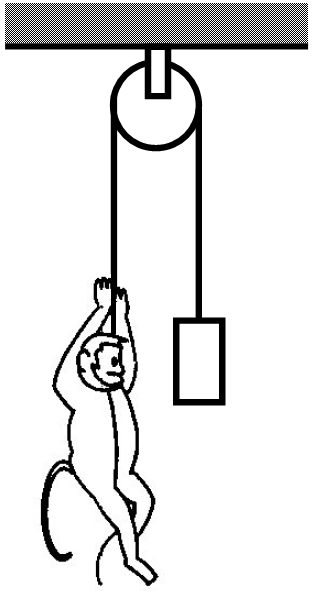
A monkey is climbing on a rope that goes over a smooth light pulley and supports a block of equal mass at the other end figure. Show that whatever force the monkey exerts on the rope, the monkey and the blockmove in the same direction with equal acceleration. If initially both were at rest, their separation will not change as time passes.
Consider a sphere of radius R with charge density distributed as$\rho\text{(r)}=\text{kr for r}\leq\text{R}$
$=0\text{ for f}>\text{R}.$
Find the electric field at all points r.
A radioactive isotope is being produced at a constant rate $\frac{\text{dN}}{\text{dt}}=\text{R}$ in an experiment. The isotope has a half-life $\text{t}_{\frac{1}2{}}.$ Show that after a time $\text{t}>>\text{t}_{\frac{1}{2}},$ the number of active nuclei will become constant. Find the value of this constant.
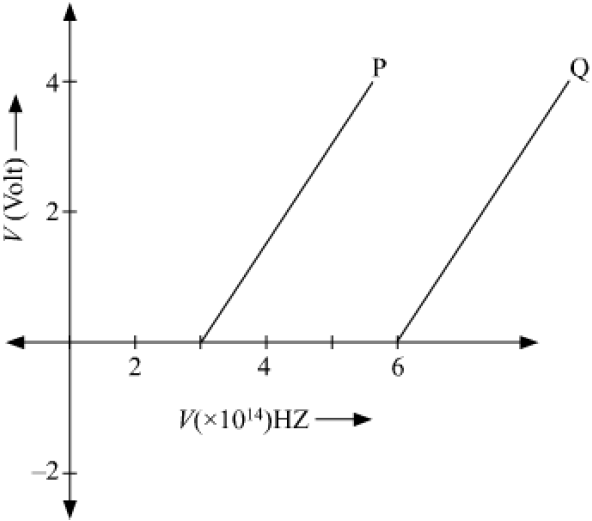
In the study of a photoelectric effect the graph between the stopping potential $V$ and frequency $v$ of the incident radiation on two different metals $P$ and $Q$ is shown below
  1. Which one of the two metals has higher threshold frequency?
  2. Determine the work function of the metal which has greater value.
  3. Find the maximum kinetic energy of electron emitted by light of frequency $8 \times 10^{14} Hz$ for this metal.
What is drift velocity? Explain the dependence of drift velocity and electric field on the mobility.
A circular hole of diameter $2.00\ cm$ is made in an aluminium plate at $0^\circ C$. What will be the diameter at $100^\circ C$? $\alpha$ for aluminium $= 2.3 \times 10^{-5 }{}^{\circ} C^{-1}.$
A proton and an $\alpha$-particle move perpendicular to a magnetic field. Find the ratio of radii of the circular paths described by them when both (i) have equal momenta, and (ii) were accelerated through the same potential difference.