Question 13 Marks
Derive the formula for conductivity and resistivity of metals by obtaining the relationship between drift velocity and current density.
Answer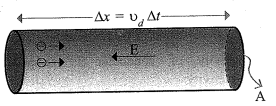
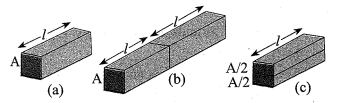
$\rightarrow$ A conductor of cross$-$sectional area $\overrightarrow{ A }$ is shown in the figure.
The electric field inside the conductor is $\overrightarrow{ E }$.
$\rightarrow$ Due to this electric field, there will be net flow of charges across any area of the conductor.
$\rightarrow$ Because of the drift, distance travelled by electron in time $\Delta t$ is $\left|\overrightarrow{v_d}\right| \Delta t$.
$\rightarrow$ Suppose the number of free electrons per unit volume in metal is $n$, then the number of electrons passing through the area $A$ is $N =n A \left|\overrightarrow{v_d}\right| \Delta t$.
$\rightarrow$ The total charge flowing through the cross sectional area in time $\Delta t$ is $-n e A\left|\overrightarrow{v_d}\right| \Delta t \ldots (1)$
$\rightarrow$ Here, electric field $\overrightarrow{ E }$ is directed towards the left as a result the total electric charge passing through the surface in the direction of $\vec{E}$, will be equal to the negative value of above equation $(1).$
$\therefore q=-\left(-n e A\left|\overrightarrow{v_d}\right| \Delta t\right)$
$\therefore q=n e A\left|\overrightarrow{v_d}\right| \Delta t$
$\rightarrow$ The amount of charge crossing the area $\overrightarrow{ A }$ in time $\Delta t$ is by definition $I \Delta t\ ($where $I$ is the magnitude of the current$)$.
$\rightarrow$ Hence,
$\therefore I \Delta t=n e A\left|\overrightarrow{ v _d}\right| \Delta t$
$\therefore I =\text { A } A \left|\overrightarrow{v_d}\right|$
$\rightarrow$ but current density $j=\frac{ I }{ A }$
$I =j A$
$\therefore j A=n e A\left|\overrightarrow{v_d}\right| \quad\left(\because \text { from } e q^{ n }(3)\right)$
$\therefore j=n e\left|\overrightarrow{v_d}\right|$
$\therefore j=n e\left(\frac{e E }{m}\right) \cdot \tau\left(\because\left|\overrightarrow{v_d}\right|=\frac{e E }{m} \tau\right)$
$\therefore j=\frac{n e^2 E }{m} \tau$
$\rightarrow$ Writing above equation $(5)$ in vector form
$\vec{j}=\frac{n e^2 \tau}{m} \cdot \overrightarrow{ E }$
$\rightarrow$ Now comparing above equation with $\vec{j}=\sigma \overrightarrow{ E }$ we get
$\therefore \sigma \overrightarrow{ E } =\frac{n e^2 \tau}{m} \cdot \overrightarrow{ E }$
$\therefore \sigma=\frac{n e^2 \tau}{m}$
$\rightarrow$ Resistivity of conductor is reciprocal of conductivity
$\rho=\frac{1}{\sigma}$
$\therefore \rho =\frac{m}{n e^2 \tau}$
View full question & answer→$\rightarrow$ A conductor of cross$-$sectional area $\overrightarrow{ A }$ is shown in the figure.
The electric field inside the conductor is $\overrightarrow{ E }$.
$\rightarrow$ Due to this electric field, there will be net flow of charges across any area of the conductor.
$\rightarrow$ Because of the drift, distance travelled by electron in time $\Delta t$ is $\left|\overrightarrow{v_d}\right| \Delta t$.
$\rightarrow$ Suppose the number of free electrons per unit volume in metal is $n$, then the number of electrons passing through the area $A$ is $N =n A \left|\overrightarrow{v_d}\right| \Delta t$.
$\rightarrow$ The total charge flowing through the cross sectional area in time $\Delta t$ is $-n e A\left|\overrightarrow{v_d}\right| \Delta t \ldots (1)$
$\rightarrow$ Here, electric field $\overrightarrow{ E }$ is directed towards the left as a result the total electric charge passing through the surface in the direction of $\vec{E}$, will be equal to the negative value of above equation $(1).$
$\therefore q=-\left(-n e A\left|\overrightarrow{v_d}\right| \Delta t\right)$
$\therefore q=n e A\left|\overrightarrow{v_d}\right| \Delta t$
$\rightarrow$ The amount of charge crossing the area $\overrightarrow{ A }$ in time $\Delta t$ is by definition $I \Delta t\ ($where $I$ is the magnitude of the current$)$.
$\rightarrow$ Hence,
$\therefore I \Delta t=n e A\left|\overrightarrow{ v _d}\right| \Delta t$
$\therefore I =\text { A } A \left|\overrightarrow{v_d}\right|$
$\rightarrow$ but current density $j=\frac{ I }{ A }$
$I =j A$
$\therefore j A=n e A\left|\overrightarrow{v_d}\right| \quad\left(\because \text { from } e q^{ n }(3)\right)$
$\therefore j=n e\left|\overrightarrow{v_d}\right|$
$\therefore j=n e\left(\frac{e E }{m}\right) \cdot \tau\left(\because\left|\overrightarrow{v_d}\right|=\frac{e E }{m} \tau\right)$
$\therefore j=\frac{n e^2 E }{m} \tau$
$\rightarrow$ Writing above equation $(5)$ in vector form
$\vec{j}=\frac{n e^2 \tau}{m} \cdot \overrightarrow{ E }$
$\rightarrow$ Now comparing above equation with $\vec{j}=\sigma \overrightarrow{ E }$ we get
$\therefore \sigma \overrightarrow{ E } =\frac{n e^2 \tau}{m} \cdot \overrightarrow{ E }$
$\therefore \sigma=\frac{n e^2 \tau}{m}$
$\rightarrow$ Resistivity of conductor is reciprocal of conductivity
$\rho=\frac{1}{\sigma}$
$\therefore \rho =\frac{m}{n e^2 \tau}$