Question
What is Wheatstone bridge ? Explain its use in detail.

Answer

Wheatstone Bridge: It is an arrangement of four resistance used to measure one of them in terms of the other three resistances. It was devised by a scientist of England Professor C.F. Wheatstone in 1843 and in his honour it is known as Wheatstone bridge. It is one of the most accurate methods for measuring resistance.
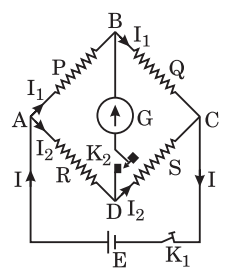
Construction: Wheatstone bridge consists of four resistances P, Q, R and S connected in series so as to form a closed loop in the form of a quadrilateral ABCD. A cell E is connected between diagonally opposite corners of one of its diagonals (say between A and C) through a key $K_1$. A galvanometer G is connected between diagonally opposite corners of the other diagonal (say between B and D) through a key $K_2$. The whole ar-rangement is shown in adjoining figure.
Image
Principle : If the resistances forming the four arms of the quadrilateral are so adjusted that on sending current in the closed loop by the cell, there is no deflection in the galvanometer then Wheatstone Bridge is said to be balanced. In this condition the ratio of the resistances in any of the two adjacent arms of the quadrilateral is equal to the ratio of the resistances in the remaining two adjacent arms.
In this way for Wheatstone Bridge shown in adjoin-ing fig. in its balanced position, we have
$ \frac{P}{Q} = \frac{R}{S} $
This relation is known as balanced condition of Wheatstone bridge.
Proof : When key $K_1$ is pressed current I drawn from the cell E is divided into two parts at A. One part $I_1$ flows in the arm AB and the other part $I_2$ in the arm AD of the quadrilateral.
In the beginning, on pressing $K_2$; the galvanometer G shows deflection. This means that the current in the arm BD flows either from B to D or from D to B according to the situation B is at higher potential than D or vice-versa. Now the values of resistance P, Q, R and S, are so adjusted that there is no deflection in the galva-nometer. In this condition bridge is said to be balanced. This condition is obtained only when potentials at B and D are equal. Consequently, the current flowing in AB and BC arms is I, and in arms AD and DC it is 12. These currents recombine at C to form again current I. Thus circuit of cell is completed. In the balanced position of Wheatstone Bridge there is no current in the diagonal BD through galvanometer G. On applying Kirchhoff's second law for closed loop ABDA, we have
$
I_1 P-I_2 R=0 \Rightarrow I_1 P=I_2 R
$ ...(1)
In the same way for closed loop BCDB, we have
$I_1 Q-I_2 S=0 \Rightarrow I_1 Q=I_2 S$ ...(2)
Dividing eq. (1) by eq. (2), we get
$\frac{P}{Q}=\frac{R}{S}$ ...(3)
Resistance R and ratio P/Q are known, hence un-known resistance S can be determined by equation (3). This is the balanced condition of the bridge. For this rea-son, the P and Q arms are known as ratio arms, arm R as known arm and arm S as unknown arm. In the balanced position of the bridge on interchanging the positions of the cell and galvanometer, balanced position of the bridge remains unchanged. Therefore, the arms BD and CD are called conjugate arms of the bridge.
Determination of specific resistance of the ma-terial of a given wire : Meter Bridge and Post Office Box are two apparatus based on the principle of Wheat-stone bridge. With the help of one of these apparatus using formula (3) the unknown resistance of the given wire S is calculated and using the following formula specific resistance 'ρ' of the material of the given wire may be calculated :
$\rho=\frac{\pi r^2 S}{l} \quad\left\{\because R =\rho \frac{1}{A}=\rho \times \frac{1}{\pi r^2}\right\}$
where r = radius of the wire, which is measured by screw gauge.
l = length of the wire which is measured by metre scale.
On the basis of principle of Wheatstone Bridge, meter bridge and post office box two instruments are divided to calculate unknown resistance.

Need a full question paper?

Generate a complete, print-ready paper with questions like this in minutes — across 16+ boards, with answer keys.
Start Generating Free

Similar questions

A ball of mass $100g$ and having a charge of $4.9 \times 10^{-5}C$ is released from rest in a region where a horizontal electric field of $2.0 \times 10^4NC^{-1}$ exists.
  1. Find the resultant force acting on the ball.
  2. What will be the path of the ball?
  3. Where will the ball be at the end of $2s?$
A ball of mass 50g moving at a speed of 2.0m/s strikes a plane surface at an angle of incidence 45°. The ball is reflected by the plane at equal angle of reflection with the same speed. Calculate
  1. The magnitude of the change in momentum of the ball.
  2. The change in the magnitude of the momentum of the ball.
What is radioactivity? State the laws of $\alpha$-rays and $\beta$-rays.
A particle of mass m is kept on a fixed, smooth sphere of radius R at a position, where the radius through the particle makes an angle of 30° with the vertical. The particle is released from this position.
  1. What is the force exerted by the sphere on the particle just after the release?
  2. Find the distance travelled by the particle before it leaves contact with the sphere.
(II) (a) Using Kirchhoff'᾿s laws obtain the equation of the balanced state in Wheatstone bridge.
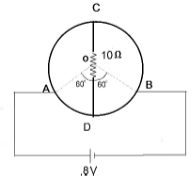
b) A wire of uniform cross-section and resistance of 12 ohm is bent in the shape of circle as shown in the figure. A resistance of 10 ohms is connected to diametrically opposite ends C and D. A battery of emf 8V is connected between A and B. Determine the current flowing through arm AD.

Image
A diverging lens of focal length $20\ cm$ and a converging lens of focal length $30\ cm$ are placed $15\ cm$ apart with their principal axes coinciding. Where should an object be placed on the principal axis so that its image is formed at infinity?
Explain the shortcomings of Rutherford's Atomic Model.###Write two shortcomings of Rutherford's Atomic Model.
Consider an excited hydrogen atom in state $n$ moving with a velocity $u(ν << c).$ It emits a photon in the direction of its motion and changes its state to a lower state $m.$ Apply momentum and energy conservation principles to calculate the frequency $ν$ of the emitted radiation. Compare this with the frequency $ν_0$ emitted if the atom were at rest.
The current in a discharging LR circuit without the battery drops from 2.0A to 1.0A in 0.10s.
  1. Find the time constant of the circuit.
  2. If the inductance of the circuit is 4.0H, what is its resistance?
Obtain expression for force on unit length of two straight parallel current carrying conductors. Under what conditions is this force attractive or repulsive? Define the standard unit of electric current.