MCQ
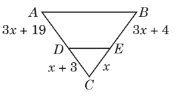
What values of $x$ will make $D E \| A B$ in the figure?
Image
  • A
    $1$
  • $2$
  • C
    $3$
  • D
    $4$

Answer

Correct option: B.
$2$
$D E \| A B$ if $\frac{C D}{D A}=\frac{C E}{E B}$
$($By converse of Thales theorem$)$
$\therefore \frac{x+3}{3 x+19}=\frac{x}{3 x+4}$
$\Rightarrow \quad(x+3)(3 x+4)=x(3 x+19)$
$\Rightarrow 3 x^2+4 x+9 x+12$
$=3 x^2+19 x$
$\Rightarrow 12=6 x $
$\Rightarrow x=2$
Hence, $x=2$ will make $D E \| A B$.

Need a full question paper?

Generate a complete, print-ready paper with questions like this in minutes — across 16+ boards, with answer keys.

Start Generating Free

Similar questions

The area of a circle whose area and circumference are numerically equal, is:
A tangent $P Q$ at a point $P$ of a circle of radius 5 cm meets a line through the centre $O$ at a point $Q$ such that $O Q=12 cm$. Length $P Q$ is
The calculation for mode for the following distribution is given below:
Here, the maximum frequency is 32 and the corresponding modal class is $30-40$.
$\therefore \quad l=30, h=10, f_0=12, f_1=32, f_2=20($ Step 1$)$
$\therefore \quad$ Mode $=l+\left(\frac{f_1-f_0}{2 f_1-f_0-f_2}\right) \times h \quad$ (Step 2)
$=30+\left(\frac{32-12}{64-12-20}\right) \times 10=30+\frac{25}{4}=36.25$ (Step 3$)$
In which step is there an error in solving?
MarksNumber of students
0-106
10-2010
20-3012
30-4032
40-5020
Choose the correct answer from the given four options in the following questions:
If one of the zeroes of the cubic polynomial $x^3+a x^2+b x+c$ is $-1$ , then the product of the other two zeroes is:
.
A bag contains cards numbered from $1$ to $25$. A card is drawn at random from the bag. The probability that the number on this card is divisible by both $2$ and $3$ is :
Assertion and Reason Type
Each question consists of two statements, namely, Assertion $(A)$ and Reason $(R)$. For selecting the correct answer, use the following code:
Assertion $(A)$
Reason $(R)$
The curved surface area of a cone of base radius $3 cm$ and height $4 cm$ is $15\pi\text{cm}^2$
Volume of a cone $\pi\text{r}^2\text{h}$
If three points $(0, 0), (3,\sqrt{3})$ and $(3,\lambda)$ form an equilateral triangle, then $\lambda=$
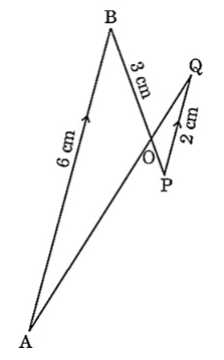
In the given figure, $\ce{AB \| PQ.}$ If $AB = 6 \ cm, PQ = 2 \ cm$ and $OB = 3 \ cm,$ then the length of $OP$ is:
Image
The ratio in which the line segment joining $P\left(x_1, y_1\right)$ and $Q\left(x_2, y_2\right)$ is divided by $x$-axis is
The coordinates of the circumcentre of the triangle formed by the points $O(0, 0), A(a, 0)$ and $B(0, b)$ are,