MCQ
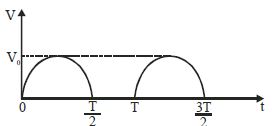
What will be $r.m.s.$ value of given $A.C.$ over one cycle.
  • A
    ${V_0}$
  • B
    $\frac{{{V_0}}}{{\sqrt 2 }}$
  • $\frac{{{V_0}}}{2}$
  • D
    $\frac{{{V_0}}}{4}$

Answer

Correct option: C.
$\frac{{{V_0}}}{2}$
c
$(\mathrm{RMS})^{2}=\frac{\int_{0}^{\mathrm{T} / 2} \mathrm{V}_{0}^{2} \sin ^{2} \mathrm{td} \mathrm{t}}{\mathrm{T}}=\frac{\mathrm{V}_{0}^{2}}{4}$

So $\mathrm{RMS}=\mathrm{V}_{0} / 2$

Need a full question paper?

Generate a complete, print-ready paper with questions like this in minutes — across 16+ boards, with answer keys.

Start Generating Free

Similar questions

Ray optics is valid, when characteristic dimensions are
A metal rod moves at a constant velocity in a direction perpendicular to its length. A constant uniform magnetic field exists in space in a direction perpendicular to the rod as well as its velocity. Select the correct statement(s) from the following
A capacitor with plate separation $d$ is charged to $V$ volts. The battery is disconnected and a dielectric slab of thickness $\frac{d}{2}$ and dielectric constant ' $2$ ' is inserted between the plates. The potential difference across its terminals becomes
In Fresnel’s biprism experiment, on increasing the prism angle, fringe width will
The energy stored in a condenser of capacity C which has been raised to a potential V is given by
Four equal charges Q are placed at the four corners of a square of each side is ‘d’. Work done in removing a charge – Q from its centre to infinity is
Point charge $\mathrm{q}_1=2 \mu \mathrm{C}$ and $\mathrm{q}_2=-1 \mu \mathrm{C}$ are kept at points x = 0 and x = 6 respectively. Electrical potential will be zero at points
In intrinsic semiconductor at room temperature, number of electrons and holes are
$'Z\ '$ is not.
To calculate the size of a hydrogen ion using the Bohr's model, we assume that its two electrons move in an orbit such that they are always on diametrically opposite sides of the nucleus. With each electron having the angular momentum $\hbar=h / 2 \pi$ and taking electron interaction into account the radius of the orbit in terms of the Bohr's radius of hydrogen atom $a_{B}=\frac{4 \pi \varepsilon_{ e } h^{2}}{m e^{2}}$ is