MCQ
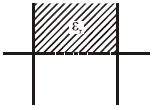
What will be the capacity of a parallel-plate capacitor when the half of parallel space between the plates is filled by a material of dielectric constant ${\varepsilon _r}$ ? Assume that the capacity of the capacitor in air is $C$
  • A
    $\frac{{2{\varepsilon _r}C}}{{1 + {\varepsilon _r}}}$
  • $\frac{{C({\varepsilon _r} + 1)}}{2}$
  • C
    $\frac{{{\varepsilon _r}C}}{{1 + {\varepsilon _r}}}$
  • D
    ${\varepsilon _r}C$

Answer

Correct option: B.
$\frac{{C({\varepsilon _r} + 1)}}{2}$
b

Need a full question paper?

Generate a complete, print-ready paper with questions like this in minutes — across 16+ boards, with answer keys.

Start Generating Free

Similar questions

The half life of a radioactive isotope $X$ is $50$ years. It decays to another element $Y$ which is stable. The two elements $X$ and $Y$ were found to be in the ratio of $1 : 15$ in a sample of a given rock. The age of the rock was estimated to be..........$years$
To convert a moving coil galvanometer into voltmeter
Current sensitivity of a moving coil galvanometer is $5\,div/mA$ and its voltage sensitivity (angular deflection per unit voltage applied) is $20\,div/V$. The resistance of the galvanometer is ................. $\Omega$
A sphere is rotating about a diameter:
A neon sign does not produce
A moving coil galvanometer of resistance $100 \,\Omega$ is used as an ammeter using a resistance $0.1 \,\Omega$. The maximum deflection current in the galvanometer is $100\,\mu A$. Find the minimum current in the circuit so that the ammeter shows maximum deflection ............... $mA$
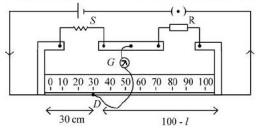
In meter bridge experiment for measuring unknown resistance ' $S$ ', the null point is obtained at a distance $30 cm$ from the left side as shown at point $D$. If $R$ is $5.6 k \Omega$, then the value of unknown resistance ' $S$ ' will be $\Omega .$
The magnet of a vibration magnetometer is heated so as to reduce its magnetic moment by 19%. By doing this the periodic time of the magnetometer will
Three point charges $q_1, q_2, q_3$ are placed at the vertices of a triangle if force on $q_1$ and $q_2$ are $\left( {2\hat i - \hat j} \right)\,N$ and $\left( {\hat i + 3\hat j} \right)\,N$, respeactively, then what will be force on $q_3$ ?
The value of internal resistance of an ideal cell is $\Omega$