MCQ
What will be the force constant of the spring system shown in the figure
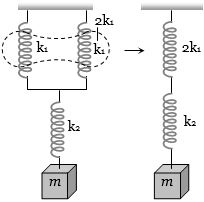
  • A
    $\frac{{{K_1}}}{2} + {K_2}$
  • ${\left[ {\frac{1}{{2{K_1}}} + \frac{1}{{{K_2}}}} \right]^{ - 1}}$
  • C
    $\frac{1}{{2{K_1}}} + \frac{1}{{{K_2}}}$
  • D
    ${\left[ {\frac{2}{{{K_1}}} + \frac{1}{{{K_1}}}} \right]^{ - 1}}$
Answer

Correct option: B.
${\left[ {\frac{1}{{2{K_1}}} + \frac{1}{{{K_2}}}} \right]^{ - 1}}$
b
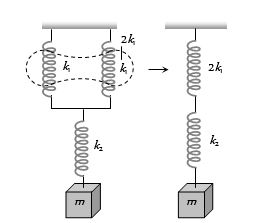
(b)In series combination
$\frac{1}{{{k_S}}} = \frac{1}{{2{k_1}}} + \frac{1}{{{k_2}}}$
==> ${k_S} = {\left[ {\frac{1}{{2{k_1}}} + \frac{1}{{{k_2}}}} \right]^{ - 1}}$

Need a full question paper?

Generate a complete, print-ready paper with questions like this in minutes — across 16+ boards, with answer keys.

Start Generating Free

Similar questions

If a force of $250\, N$ act on body, the momentum acquired is $125\, kg-m/s$. What is the period for which force acts on the body  ......... $\sec$
The amount of work done in forming a soap film of size $10\,cm \times 10\,cm$ is (Surface tension $T = 3 \times {10^{ - 2}}\,N/m$)
The work done by the external forces on a system equals the change in:
  1. Total energy.
  2. Kinetic energy.
  3. Potential energy.
  4. None of these.
A heavy stone is thrown from a cliff of height h with a speed $\nu.$ The stone will hit the ground with maximum speed if it is thrown:
  1. Vertically downward.
  2. Vertically upward.
  3. Horizontally.
  4. The speed does not depend on the initial direction.
$1\, g$ of a steam at $100°C$ melt ........ $gm$ ice at $0°C\,?$ $($Latent heat of ice $= 80 \,cal/gm$ and latent heat of steam $= 540\, cal/gm)$
A dancer moves counterclockwise at constant speed around the path shown below. The path is such that the lengths of its segments, $PQ, QR, RS$, and $SP$, are equal. Arcs $QR$ and $SP$ are semicircles. Which of the following best represents the magnitude of the dancer’s acceleration as a function of time $t$ during one trip around the path, beginning at point $P$ ?
The angle turned by a body undergoing circular motion depends on time as $\theta = {\theta _0} + {\theta _1}t + {\theta _2}{t^2}$. Then the angular acceleration of the body is
A container of mass $M$ containing liquid of mass $m_0$ is kept on weighing machine. A ball of mass $m$ is released from rest from given position. Then choose correct option just after ball is released
Avogadro's number is the number of molecules in:
Which of the following surfaces radiates more energy :