MCQ
What will be the grouping of cells when the current in the circuit is $\frac{\text{ne}}{(\text{R+nr})}$?
  • A
    Parallel grouping.
  • Series grouping.
  • C
    Mixed grouping.
  • D
    When there is no grouping.

Answer

Correct option: B.
Series grouping.

When n identical cells, each of emf $' e\ '$ and internal resistance $' r\ '$ are connected to the external resistance $' R\ '$ in series, its called series grouping. In series grouping $e _{ eq }= ne$ and $r _{ eq }= nr$ Therefore, current in the circuit $( l )=\frac{ ne }{( R + nr )}$

Need a full question paper?

Generate a complete, print-ready paper with questions like this in minutes — across 16+ boards, with answer keys.
Start Generating Free

Similar questions

An electron is accelerated through a $p.d.$ of $ 45.5$ volt. The velocity acquired by it is (in $ms^{-1}$)
When two monochromatic lights of frequency, $v$ and $\frac{v}{2}$ are incident on a photoelectric metal, their stopping potential becomes $\frac{V_{S}}{2}$ and $V_{s}$ respectively. The threshold frequency for this metal is :
Three capacitors whose capacitances are 2,4 and $\chi_\mu F$ respectively. They are combine first in series and then in parallel. In both the cases the ratio of their equivalents will be :
When two deuterium nuclei fuse together to form a tritium nucleus, we get a:
When a metal surface is illuminated by light of wavelengths 400 nm and 250 nm, the maximum velocities of the photoelectrons ejected are v and 2v respectively. The work function of the metal is (h = Planck’s constant, c = velocity of light in air)
The Bohr model of atoms
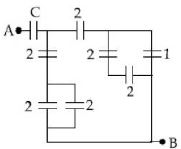
In the circuit shown, find $C$ if the effective capacitance of the whole circuit is to be $0.5\,\mu F.$ All values in the circuit are in $\mu F.$
Two current elements $P$ and $Q$ have current voltage characteristics as shown below :

Which of the graphs given below represents current voltage characteristics when $P$ and $Q$ are in series.
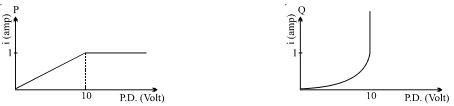
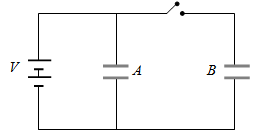
Figure given below shows two identical parallel plate capacitors connected to a battery with switch S closed. The switch is now opened and the free space between the plate of capacitors is filled with a dielectric of dielectric constant 3. What will be the ratio of total electrostatic energy stored in both capacitors before and after the introduction of the dielectric
Light travels a distance $x$ in time $t_1$ in air and $10 x$ in time $t_2$ in another denser medium. What is the critical angle for this medium?