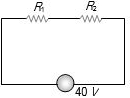
What will happen when a $40\, watt$, $220\, volt$ lamp and $100\, watt$, $220\, volt$ lamp are connected in series across $40\, volt$ supply
Diffcult


Download our appand get started for free
Experience the future of education. Simply download our apps or reach out to us for more information. Let's shape the future of learning together!No signup needed.*
Similar Questions
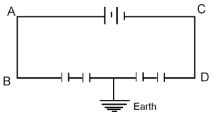
- 1Four equal capacitors are connected to a battery as shown in the adjoining figure. The potential of $A$ and $B$ areView Solution
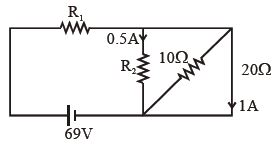
- 2In the circuit shown in the given figure the resistance $R_1$ and $R_2$ are respectivelyView Solution
- 3For driving a current of $2\, A$ for $6$ minutes in a circuit, $1000\, J$ of work is to be done. The $e.m.f.$ of the source in the circuit is ................ $V$View Solution
- 4A cell of internal resistance $r$ drives current through an external resistance $R$ . The power delivered by the cell to the external resistance will be maximum when:View Solution
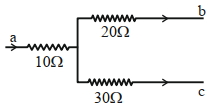
- 5Figure shows a part of an electric circuit. The potentials at points $a , b$ and $c$ are $30\,V , 12\,V$ and $2\,V$ respectively. The current through the $20 \Omega$ resistor will be $........\,A$View Solution
- 6For a cell of $e.m.f.$ $2\,V$, a balance is obtained for $50\, cm$ of the potentiometer wire. If the cell is shunted by a $2\,\Omega $ resistor and the balance is obtained across $40\, cm$ of the wire, then the internal resistance of the cell is ............. $\Omega $View Solution
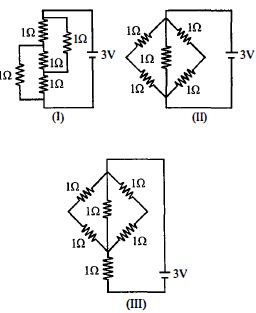
- 7The figure shows three circuits $I, II$ and $III$ which are connected to a $3\,V$ battery. If the powers dissipated by the configurations $I, II$ and $III$ are $P_1 , P_2$ and $P_3$ respectively, thenView Solution
- 8View SolutionWhich of the following will NOT be observed when a multimeter (operating in resistance measuring mode) probes connected across a component, are just reversed?
- 9In india electricity is supplied for domestic use at $220\,\,V$. It is supplied at $110\,\, V$ in $USA$. If resistance of $60\,\, W$ bulb for use in India is $R$, then the resistance of $60\,\, W$ bulb for use in $USA$ will beView Solution
- 10When a current $I$ is passed through a wire of constant resistance, it produces a potential difference $V$ across its ends. The graph drawn between $\log\, I$ and $\log\, V$ will beView Solution