Question
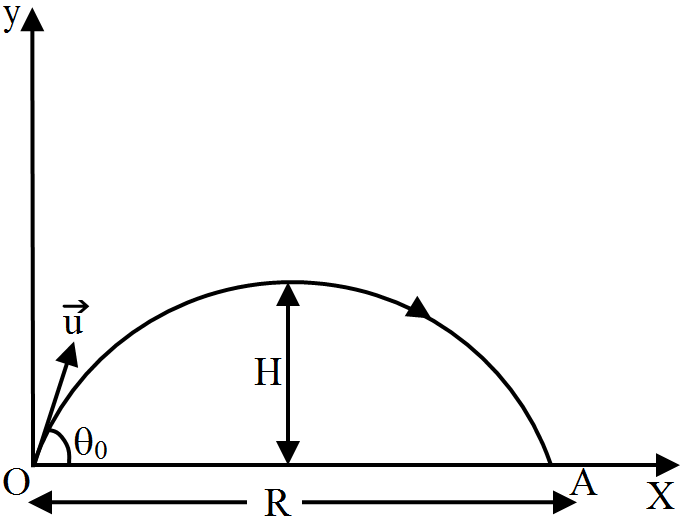
Show that the projection angle $\theta_0$ for a projectile launched from the origin is given by, $\theta_0=\tan^{-1}\Big(\frac{4\text{H}}{\text{R}}\Big)$ where, H is the maximum height attained by the projectile and R is the range of the projectile.
Answer


The path followed by a proiectile prolected at an angle $\theta_0$ with velocity $\vec{\text{u}}$ is shown in figure. The maximum height attained by the projectile is given by
$\text{H}=\frac{\text{u}^2\sin^2\theta_0}{2\text{g}}\dots(\text{i})$
The range of the projectile is given by
$\text{R}=\frac{\text{u}^2\sin2\theta_0}{\text{g}}$
$=\frac{2\text{u}^2\sin\theta_0\cos\theta_0}{\text{g}}\dots(\text{ii})$
Dividing eq. (i) by eq. (ii), we get
$\tan\theta_0=\frac{4\text{H}}{\text{R}}\Rightarrow\ \theta_0=\tan^{-1}\Big(\frac{4\text{H}}{\text{R}}\Big).$

Need a full question paper?

Generate a complete, print-ready paper with questions like this in minutes — across 16+ boards, with answer keys.

Start Generating Free

Similar questions

Two bodies of m and 4m are placed at a distance. The gravitational field is zero at a point on the line joining the two masses. What will be the gravitational potential at this point?
A block of mass $100g$ is moved with a speed of $5.0m/s$ at the highest point in a closed circular tube of radius $10cm$ kept in a vertical plane. The cross-section of the tube is such that the block just fits in it. The block makes several oscillations inside the tube and finally stops at the lowest point. Find the work done by the tube on the block during the process.
Explain with the suitable example that a reversible process must be carried slowly and a fast process is necessarily irreversible.
A block at rest explodes into three equal parts. Two parts start moving along X and Y axes respectively with equal speeds of 10m/s. Find the initial velocity of the third part.
If R be the horizontal range for inclination $\theta$ and h be the maximum height reached by the projectile, show that maximum range is given by $\frac{\text{R}^2}{8\text{h}}+2\text{h.}$
Two bodies make an elastic head-on collision on a smooth horizontal table kept in a car. Do you expect a change in the result if the car is accelerated on a horizontal road because of the noninertial character of the frame? Does the equation "Velocity of separation = Velocity of approach" remain valid in an accelerating car? Does the equation "Final momentum = Initial momentum" remain valid in the accelerating car?
Find the moment of inertia of a uniform square plate of mass m and edge a about one of its diagonals.
Earth can be thought of as a sphere of radius 6400km. Any object (or a person) is performing circular motion around the axis of earth due to earth’s rotation (period 1 day). What is acceleration of object on the surface of the earth (at equator) towards its centre? what is it at latitude $\theta?$ How does these accelerations compare with $g = 9.8m/ s^2?$
A high jumper can jump $1.5m$ on earth. With the same effort, how high will he be able to jump on a planet whose density is one-third and radius is one-fourth of that of the earth?
The mass and diameter of a planet are twice of those of the earth. What will be the period of oscillation of a pendulum on this planet, if it is a second's pendulum on the earth?