Question
When 1.0 × 10¹² electrons are transferred from one conductor to another, a potential difference of 10V appears between the conductors. Calculate the capacitance of the two-conductor system.

Answer

Given that

Number of electron = 1 × 10¹²

Net charge Q = 1 × 1012 × 1.6 × 10-19 = 1.6 × 10⁻⁷C

$\therefore$ The net potential difference = 10L.

$\therefore$ Capacitance

$\text{C}=\frac{\text{q}}{\text{v}}$

$=\frac{1.6\times10^{-7}}{10}=1.6\times10^{-8}\text{F}.$

Need a full question paper?

Generate a complete, print-ready paper with questions like this in minutes — across 16+ boards, with answer keys.
Start Generating Free

Similar questions

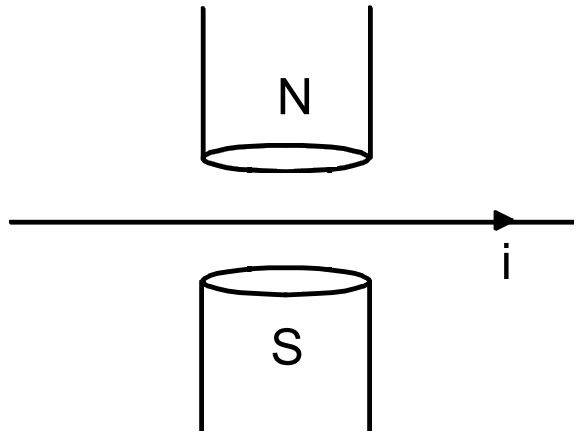
A magnetic field of strength 1.0T is produced by a strong electromagnet in a cylindrical region of radius 4.0cm, as shown in the figure. A wire, carrying a current of 2.0A, is placed perpendicular to and intersecting the axis of the cylindrical region. Find the magnitude of the force acting on the wire.

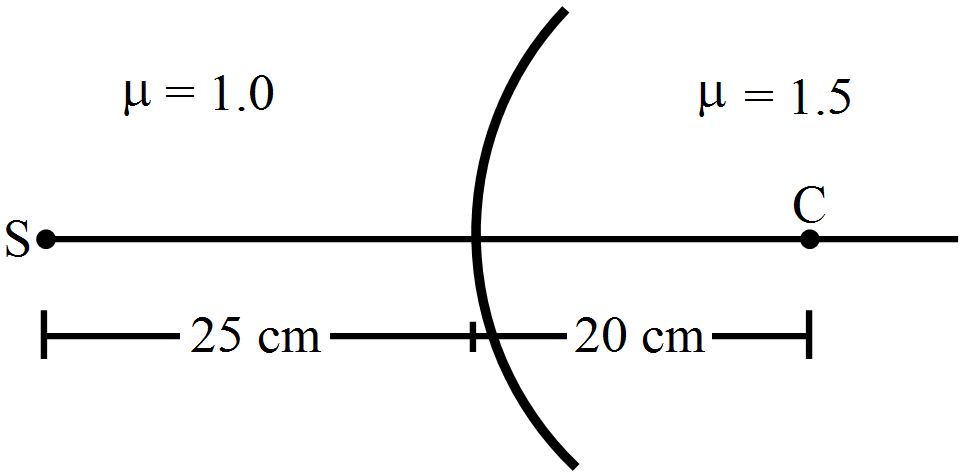
Locate the image formed by refraction in the situation shown in figure.

A straight wire carrying an electric current is placed along the axis of a uniformly charged ring. Will there be a magnetic force on the wire if the ring starts rotating about the wire? If yes, in which direction?
Rate of change of electric field in the region between the plates of capacitor is $1.5 \times 10^{12} Vm ^{-1} s^{ 1 }$. If circular plate of capacitor has a radius of 55 mm , then find the magnitude of displacement current.
What is electric flux? Write its S.I. units.

Using Gauss’s theorem, deduce an expression for the electric field at a point due to a uniformly charged infinite plane sheet.

A charge of 3.14 × 10⁻⁶C is distributed uniformly over a circular ring of radius 20.0cm. The ring rotates about its axis with an angular velocity of 60.0 rad/s. Find the ratio of the electric field to the magnetic field at a point on the axis at a distance of 5.00cm from the centre.
  1. In a metre bridge [Fig. 3.27], the balance point is found to be at 39.5 cm from the end A, when the resistor Y is of $12.5\ \Omega.$ Determine the resistance of X. Why are the connections between resistors in a Wheatstone or meter bridge made of thick copper strips?
  2. Determine the balance point of the bridge above if X and Y are interchanged.
  3. What happens if the galvanometer and cell are interchanged at the balance point of the bridge? Would the galvanometer show any current?
Indium antimonide has a band gap of 0.23eV between the valence and the conduction band. Find the temperature at which kT equals the band gap.
The band gap between the valence and the conduction bands in zinc oxide (ZnO) is 3.2eV. Suppose an electron in the conduction band combines with a hole in the valence band and the excess energy is released in the form of electromagnetic radiation. Find the maximum wavelength that can be emitted in this process.
  1. State the law of radioactive decay. Write the SI unit of ‘activity’.
  2. There are $4\sqrt{2}\times10^6$ radioactive nuclei in a given radioactive sample. If the half life of the sample is 20 s, how many nuclei will decay in 10 s?