Question
When a $12\,\Omega $ resistor is connected with a moving coil galvanometer then its deflection reduces from $50$ divisions to $10$ divisions. The resistance of the galvanometer is ............. $\Omega $

Answer

${i_g} = \frac{{iS}}{{S + G}}$ $ \Rightarrow $ $10 = \frac{{50 \times 12}}{{12 + G}}$ $ \Rightarrow $ $12 + G = 60$ $ \Rightarrow $ $G = 48\,\Omega $

Need a full question paper?

Generate a complete, print-ready paper with questions like this in minutes — across 16+ boards, with answer keys.
Start Generating Free

Similar questions

A particle of mass $m$ moving eastward with a speed $v$ collides with another particle of the same mass moving northward with the same speed $v$. The two particles coalesce on collision. The new particle of mass $2m$ will move in the north-easterly direction with a velocity
An object of $1 \,kg$ mass has a momentum of $10 \,kg$ $m/sec $ then the kinetic energy of the object will be .............. $\mathrm{J}$
A point object is placed at a distance of $10\,cm$ and its real image is formed at a distance of $20\,cm$ from a concave mirror. If the object is moved by $0.1cm$ towards the mirror, the image will shift by about
The pair having the same dimensions is
Consider a hydrogen atom with its electron in the $n ^{\text {th }}$ orbital. An electromagnetic radiation of wavelength $90 \ nm$ is used to ionize the atom. If the kinetic energy of the ejected electron is $10.4 \ eV$, then the value of $n$ is ( $hc =1242 \ eV \ nm$ )
The upper portion of an inclined plane of inclination $\alpha $ is smooth and the lower portion is rough. A particle slides down from rest from the top and just comes to rest at the foot. If the ratio of the smooth length to rough length is $m : n$ , the coefficient of friction is
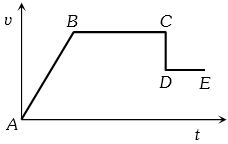
The adjoining diagram shows the velocity versus time plot for a particle. The work done by the force on the particle is positive from
A particle moves with constant angular velocity in circular path of certain radius and is acted upon by a certain centripetal force $F$. if the angular velocity is kept same but the radius of the path is halved, the new force will be
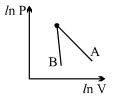
The figure, shows the graph of logarithmic reading of pressure and volume for two ideal gases $A$ and $B$ undergoing adiabatic process. From figure it can be concluded that
Select the false statement