Questions

2 Marks Questions

Take a timed test

19 questions · self-marked practice — reveal the answer and mark yourself.

Question 12 Marks
A sphere collides with another stationary sphere of equal mass. If the coefficient of resitution is $e$ then what will be the ratio of velocities of the spheres after the collision?
Answer
  Let the mass of both the spheres is $m$ and the initial velocity of first sphere is $u$. Afte the collision the velocities of first and second spheres are $v_1$ and $v_2$ respectively. Second sphere is at rest initially.By the low of conservation of momentum,
$\begin{aligned}
m u & =m v_1+m v_2 \\
v_1+v_2 & =u.....(1)
\end{aligned}$
Restitution coefficient
$\begin{aligned}
e & =-\left(\frac{v_1-v_2}{u}\right) \\
v_1-v_2 & =-e u......(2)
\end{aligned}$
By addition of equation (1) and (2)
$\begin{aligned}
2 v_1 & =u-e u=(1-e) u \\
v_1 & =\frac{1-e}{2} u......(3)
\end{aligned}$
By substracting the equation (2) from (1)
$\begin{aligned}
2 v_2 & =u+e u \\
2 v_2 & =(1+e) u \\
\Rightarrow \quad v_2 & =\left(\frac{1+e}{2}\right) u.....(4)
\end{aligned}$
From equtions (3) and (4)
$\frac{v_1}{v_2}=\frac{1-e}{1+e}$
View full question & answer
Question 22 Marks
A horse, applying a force of 40 N at an angle of $60^{\circ}$ to the horizontal to pull a cart tied behind it with velocity of $7.2 km / h$. Then, (i) how much total work did this horse do in 10 minutes (ii) what is the power of horse?
Answer
 It is given,
$\begin{aligned}
F & =40 N \\
v & =7.2 km / h \\
& =\frac{7.2 \times 1000}{60 \times 60}=2 m / s
\end{aligned}$
Distance covered in 1 minute,
Distance $=$ Velocity $\times$ time $=2 \times 60=120 m$
(i) Work done by horse in 10 minutes,
$\begin{aligned}
W & =FS \cos \theta \\
& =40 \times 120 \cos 60^{\circ} \times 10 \\
& =40 \times 120 \times \frac{1}{2} \times 10=40 \times 120 \times 5 \\
W & =24000 J \quad \text { Ans. }
\end{aligned}$
(ii) Power $( P )=\frac{ W }{t}=\frac{24000}{10 \times 60}=40 watt.\quad \text { Ans. }$ 
View full question & answer
Question 32 Marks
A spring whose force constant is $k$ obeys Hooke's is law 4 J of work is required by pulling it to a length of 10 cm from the original length. Calculate :(i) Value of k
(ii) Additional work required to stretch the spring by additional 10 cm length.
Answer
 (i)
$w =\frac{1}{2} k x^2$
$ \therefore \quad k=\frac{2 w}{x^2}$
It is given
$\begin{aligned}
w & =4 J \\
x & =10 cm=0.1 m \\
k & =\frac{2 \times 4}{(0.1)^2}=\frac{8}{0.01}=800 N / m
\end{aligned}$
(ii) Total work in pulling the spring by 20 cm
$\begin{aligned}
w & =\frac{1}{2} k x^2 \\
& =\frac{1}{2} \times 800 \times(0.2)^2
\end{aligned}$
$\begin{aligned}
w & =400 \times 0.04 \\
& =16 J
\end{aligned}$
Additional work $=16-4=12 J \quad \text { Ans. }$
View full question & answer
Question 42 Marks
A tube well pump throws up 2400 kg of water in every mintue. If the speed of water coming out is $3 m / s$ then find the power of the pump. If the pump runs for 5 hours then find the value of work done by the pump.
Answer
 Given,
$\begin{aligned}
m & =2400 kg \\
t & =1 minute=60 \text { seconds } \\
v & =3 m / s \\
\therefore \text { Power of pump } & =\frac{1}{2} \frac{m v^2}{t} \\
& =\frac{2400 \times 3 \times 3}{2 \times 60}=180 \text { watt }
\end{aligned}$
If the pump runs for 5 hours then work done,
$\begin{aligned}
W & =P \times t \\
& =180 \times 5 \times 60 \times 60 \\
& =18 \times 5 \times 6 \times 6 \times 10^3 J \\
& =3240 \times 10^3 \\
or
W & =3.24 \times 10^6 J \quad Ans.
\end{aligned}$
View full question & answer
Question 52 Marks
The relation between the position and time of a particle under the influence of constant force is $x$ $=(t-4)^2$, where $x$ is in meters and $t$ is in seconds. Then calculate the work done by force in the first 8 seconds.
Answer
 From the work energy theorem,
$\begin{aligned}
\text { work done } & =\text { change in kinetic energy } \\
& =\left(\frac{1}{2} m v_{-}^2-\frac{1}{2} m v_{\# 0}^2\right)
\end{aligned}$
Here  $x=(t-4)^2$
Velocity $v =\frac{d x}{d t}=\frac{d}{d t}(t-4)^2$
$v=2(t-4)$
Hence,
$\begin{aligned}
v_{t=0} & =2(0-4)=-8 m / s \\
v_{t=8} & =2(8-4)=8 m / s \\
W & =\frac{1}{2} m\left[(8)^2-(-8)^2\right] \\
& =\frac{1}{2} m[64-64]=0
\end{aligned}$
or $W=0\quad \text { Ans. }$
View full question & answer
Question 62 Marks
A car of mass 1000 kg moving with speed of $32 m / s$ collides with a truck of mass 8000 kg moving with velocity $4 m / s$ in the same direction. After the collision, the car returns in opposite direction with a velocity of $8 m / s$. Find the velocity of truck after the collision
Answer
 Total momentum of car and truck
$\begin{array}{l}
=1000 \times 32+8000 \times 4 \\
=32000+32000 \\
=64000 kgm / s
\end{array}$
Total momentum of the car and truck after the collision will remain the same as it was before the collision. If the velocity of truck at the time of collision is $v$ then,
$\text { or } \begin{aligned}
8000 v+1000(-8) & =64000 \\
8000 v & =64000+8000 \\
8000 v & =72000 \\
\therefore \quad & v
\end{aligned}=\frac{72000}{8000}=9 m / s .$
Hence, the vleocity of the truck after the collision is
$9 m / s\quad \text { Ans. }$
View full question & answer
Question 72 Marks
A pump engine pulls 100 kg of water to a height of 10 m in 10 seconds, while the efficiency of the engine is $6 0$ percent. What will be the actual power of the engine ( $g =10 m / s ^2$ )?
Answer
It is given, $M=100 kg$
$\begin{aligned}
g & =10 m / s^2 \\
h & =10 m \\
t & =10 seconds
\end{aligned}$
Power of pump engine
$\begin{array}{l}
=\frac{m g h}{t} \\
=\frac{100 \times 10 \times 10}{10}=1000 watt \\
=1 kw
\end{array}$
Let the actual power of engine $=x kw$
$\begin{aligned}
\frac{x \times 60}{100} & =1 kw \\
\Rightarrow \quad x & =\frac{100 \times 1}{60} kw \\
& =1.67 kw \quad Ans.
\end{aligned}$
View full question & answer
Question 82 Marks
An object of 2 kg falls into the sand from a height of 10 m . If the object moves 2 cm in the sand before coming to rest, what will be the average resistance force? $\left(g=10 m / s ^2\right)$
Answer
It is given,
$\begin{aligned}
m & =2 kg \\
h & =10 m \\
g & =9.8 m / s^2
\end{aligned}$
Displacement $s=2 cm=\frac{2}{100} m$
Potential energy of 2 kg object falling on sand $=m g h$
$\begin{array}{l}
=2 \times 9.8 \times 10 \\
=196 J
\end{array}$
Let F newton is the resistance force.
Then, in this case,
$\begin{aligned}
F \times s & =m g h \\
F \times \frac{2}{100} & =196 \\
\Rightarrow \quad F & =\frac{196 \times 100}{2}=196 \times 50 \\
& =9800 N
\end{aligned}$
View full question & answer
Question 92 Marks
The length of steel wire got increases by 0.25 cm by hanging a weight of 2.5 kg . Find the work done in pulling the wire $\left(g=10 m / s ^2\right)$
Answer
It is given,
$\therefore \quad \begin{aligned}
M & =2.5 kg wt \\
Mg & =2.5 \times 10=25 \\
x & =0.25 cm \\
& =\frac{0.25}{100} m
\end{aligned}$
From formula, $Mg =k x$
$\begin{aligned}
k & =\frac{Mg}{x}=\frac{25}{\frac{0.25}{100}} \\
& =\frac{2.5 \times 100}{0.25}=10000 N / m=10^4 N / m
\end{aligned}$
Work done in pulling the wire,
$\begin{aligned}
W & =\frac{1}{2} k x^2 \\
W & =\frac{1}{2} \times 10^4 \times\left(\frac{0.25}{100}\right)^2 \\
W & =\frac{1}{2} \times(0.25)^2=\frac{1}{2} \times 0.0625 \\
& =0.03125 J \quad Ans.
\end{aligned}$

View full question & answer
Question 102 Marks
Two identical blocks of mass 2 kg move towards each other with a uniform speed ( $2 m / s$ ) on a frictionless horizontal plane. They collide with each other and get attached to each other and comes to a state of rest. Calculate the work done by external forces and internal forces on the system of both the particles.
Answer
Since there is no external force acting on the blocks.
$\therefore$ Work done by external forces $=0$
Kinetic energy before the collision of two block
$=\frac{1}{2} \times 2 \times(2)^2+\frac{1}{2} \times 2 \times(2)^2$
$=4+4=8 J$
On collision both blocks are attaches and comes to a state of rest. Hence their total energy will be zero.
$\therefore$ Work done by internal forces
$\begin{array}{l}
=k_{f}-k_{i} \\
=0-8=-8 J \quad Ans.
\end{array}$

View full question & answer
Question 112 Marks
A human is moving on a plane surface with a box in his hand whose mass is 2 kg . If he walks with an acceleration of $0.5 m / s ^2$ to distance 40 m then what will be the work done by the man on the box during the motion?
Answer
 Given,
$\begin{aligned}
m & =2 kg \\
a & =0.5 m / s^2 \\
s & =40 m
\end{aligned}$
Here force and displacement are in same direction, then
$\therefore \quad \theta=0^{\circ}$
$\begin{aligned}work ( W ) & =\text { mas } \cos \theta \\ & =2 \times 0.5 \times 40 \cos 0^{\circ} \\ & =2 \times 0.5 \times 40 \quad \therefore \cos 0=1 \\ W & =40 J\end{aligned}$
View full question & answer
Question 122 Marks
If the force constant of two springs are $k_1$ and $k_2$ respectively and $k_1=2 k_2$ then find the ratio of work done on pulling those springs by applying equal force.
Answer
Here,
$ \begin{aligned} k_1 & =2 k_2 \\ F_1 & =F_2 \\ -k_1 x_1 & =-k_2 x_2 \end{aligned} $
or
$ \begin{array}{l} \frac{x_1}{x_2}=\frac{k_2}{k_1} \\ \frac{x_1}{x_2}=\frac{k_2}{2 k_2} \quad \because k_1=2 k_2 \end{array} $
or
$ \frac{x_1}{x_2}=\frac{1}{2} $
and
$ \begin{aligned} \frac{W_1}{W_2} & =\frac{-\frac{1}{2} k_1 x_1^2}{-\frac{1}{2} k_2 x_2^2} \\ & =\frac{2 k_2}{k_2} \times\left(\frac{x_1}{x_2}\right)^2=\frac{2 k_2}{k_2} \times \frac{1}{4} \\ \frac{W_1}{W_2} & =\frac{1}{2} \\ W_1: W_2 & =1: 2 \end{aligned} $
View full question & answer
Question 132 Marks
As oscillating pendulum stops after some time. Is this a violation of the law of conservation of mechanical energy?
Answer
There is mutual conversion between the kinetic energy and potential energy of an oscillating pendulum. But the total energy of the object remains constant and the law of conservation of mechanical energy is followed. But this situation is possible only when friction force is not present but in reality there is some friction force in the oscillating pendulum due to which the pendulum stops after some time.
View full question & answer
Question 142 Marks
Two springs $A$ and $B$ are similar in all respects, but spring $A$ is stiffer than $B$, i.e., $K_A>k_B$, on which spring more work will be done if :
(a) both should be drawn to equal length,
(b) both should be pulled with equal force?
Answer
 (a) If the tensions of the springs are $x_1$ and $x_2$ then work done
$W _1=\frac{1}{2} k_1 x_1^2$
$\begin{aligned}  W _2 =\frac{1}{2} k_2 x_2^2 \\ \because  x_1 =x_2 \text { and } k_1>k_2 \\ \text { Hence } p; W _1  > W _2\end{aligned}$
So, more work will go on spring A.
(b) $F _1=k_1 x_1, F_2=k_2 x_2$
$\begin{array}{l}
W_1=\frac{1}{2} F_1 x_1 \ldots(1) \\
W_2=\frac{1}{2} F_2 x_2 \ldots(2)
\end{array}$
$\because$ It is given $F _1= F _2$
Hence, $\quad k_1 x_1=k_2 x_2$
$\because \quad k_1>k_2 \quad$ Hence, $x_1<  x_2$
$\therefore$ From equations (1) and (2), it is clear that
$W_1< W_2$
Hence, more work will be done on spring B.
View full question & answer
Question 152 Marks
Define conservative and non- conservative forces. Give examples of these also
Answer
 Conservative force : If a work done by force doesn't depend on the path but depends only on initial and final conditions, then the force is called conservative. Under the influence of conservative force the work done in a complete cycle is zero.
For example : Restoring force, central force, gravitational force etc.
Non-conservative force: If the work done by a force depends on the path then the force is called non-conservative. The work done in complete cycle is not zero.
For example : Viscous force, friction force, damping force etc.
View full question & answer
Question 162 Marks
What is kinetic energy? Prove that the value of kinetic energy is $\frac{1}{2} m v^2.$
Answer
 
Kinetic energy : The ability of an object to do work due to its motion is called kinetic energy.
For example, a bullet coming out of a gun, flowing water of a river, a moving bicycle have kinetic energy.
Kinetic energy is measured by the amount of work that a moving object can do against forces opposing motion until it comes to rest. We usually represent this by K.
Suppose an object whose mass is $m$ moves with velocity $v m / s$. A constant force F is acting on object. Due to the opposing force, the velocity of the object is continously decreasing and it finally attains a stable state. Let the object comes to rest after travelling a distance S . Hence, kinetic energy of object
$
\begin{array}{llr} 
K=W=F \times S \\
K =W=m a \times S & \because F=m a \\
\therefore \quad K=m a S & \ldots . .(1)
\end{array}
$
From Newton's third equation
$v ^2=u^2-2 a S \quad(\because$ There is deceleration $)$
$0=v^2-2 a S$( $\because$ Final velocity is 0 )
$\therefore a=\frac{v^2}{2 S}$
Put value of $a$ in equation (1)
$\begin{aligned}
\therefore \quad K & =m\left(\frac{v^2}{2 S}\right) \times S=\frac{1}{2} m v^2 \\
K & =\frac{1}{2} m v^2
\end{aligned}$
View full question & answer
Question 172 Marks
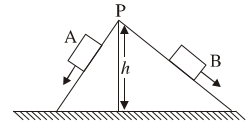
Two smooth inclined planes are shown in the figure. On these, two objects $A$ and $B$ of equal masses start sliding from rest from point $P$. Which object will reach the ground with greater speed?
Image
Answer
Increase in kinetic energy
$=$ Lose of potential energy
or
$\frac{1}{2} m v^2=m g h$
$\therefore \quad v=\sqrt{2 g h}$
$\because$ Both the balls/objects falls from the same height so both the objects will reach on the earth with same speed.
View full question & answer
Question 182 Marks
When a ball is thrown upward, its momentum first decreases and then increases. Does this violate the principle of conservation of momentum?
Answer
No, because the momentum of the system (ball and air molecules) always remains constant. When the momentum of the ball decreases, the momentum of air particles increases, and when the momentum of the ball increases, the momentum of the air particles decreases.
View full question & answer
Question 192 Marks
If the sum and difference of two vector $\vec{A}$ and $\vec{B}$ are perpendicular to each other then prove that two vectors are equal in magnitude.
Answer
Sum of two vectors $\vec{A}$ and $\vec{B}=\vec{A}+\vec{B}$
$\text { Difference }=\vec{A}-\vec{B}$
$\because$ It is given that both are perpendicular hence their scalar product will be zero.
$\begin{aligned}
(\vec{A}+\vec{B}) \cdot(\vec{A}-\vec{B}) & =0 \\
\text { or } \quad \vec{A} \cdot \vec{A}-\vec{A} \cdot \vec{B}+\vec{B} \cdot \vec{A}-\vec{B} \cdot \vec{B} & =0
\end{aligned}$
We know that $\vec{A} \cdot \vec{B}=\vec{B} \cdot \vec{A}$
$\begin{aligned}
A^2-B^2 & =0 \\
A & =B
\end{aligned}$
Hence, both vectors are equal in magnitude.
View full question & answer
Generate Paper FreeAll PART - 1 CH - 5Work, Energy and Power topics