MCQ
When a bar magnet is broken into two pieces:
  • A
    We will have a single pole on each piece.
  • Each piece will have two unlike poles.
  • C
    Each piece will have two like poles.
  • D
    None of these.

Answer

Correct option: B.
Each piece will have two unlike poles.

When we break a magnet into two, both act as magnets, that is both have a north and south pole each. In both these pieces the corresponding north and south poles remain on the sides as in the original magnet. This means that the $2$ broken sides must get oppositely polarized.

Need a full question paper?

Generate a complete, print-ready paper with questions like this in minutes — across 16+ boards, with answer keys.
Start Generating Free

Similar questions

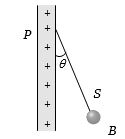
A charged ball $B$ hangs from a silk thread $S$, which makes an angle $\theta $ with a large charged conducting sheet $P$, as shown in the figure. The surface charge density $\sigma $ of the sheet is proportional to
Which one of the following statements is true
For sky wave propagation of a $10 \ \ce{MHz}$ signal, what should be the minimum electron density in ionosphere
The reactance of a circuit is zero. It is possible that the circuit contains :
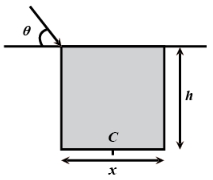
A student sees the top edge and the bottom centre $C$ of a pool simultaneously from an angle $\theta$ above the horizontal as shown in the figure. The refractive index of water which fills up to the top edge of the pool is $\frac{4}{3} .$ If $\frac{h}{x}=\frac{7}{4}$, then $\cos \theta$ is
A uniform wire of resistance $R$ is uniformly compressed along its length, until its radius becomes $n$ times the original radius. Now resistance of the wire becomes
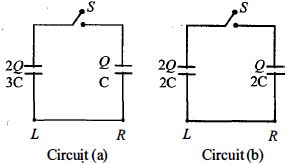
Two circuits $(a)$ and $(b)$ have charged capacitors of capacitance $C, 2C$ and $3C$ with open switches. Charges on each of the capacitor are as shown in the figures. On closing the switches
The frequency order for $\gamma -$ rays $(a)$, $X-$ rays $(b)$ and $UV-$ rays $(c)$ is given as
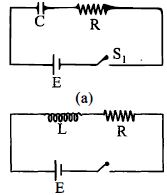
In the circuits $(a)$ and $(b)$ switches $S_1$ and $S_2$  are closed at $t = 0$  and are kept closed for a long time. The variation of current in the two circuits for $t \ge 0$ are roughly shown by figure (figures are schematic and not drawn to scale)
A $36 \,\Omega$ galvanometer is shunted by resistance of $4\,\Omega$. The percentage of the total current, which passes through the galvanometer is