MCQ
Which one of the following statements is true
  • A
    An object situated at the principle focus of a concave lens will have its image formed at infinity
  • B
    Concave mirror can give diminished virtual image
  • C
    Given a point source of light, a convex mirror can produce a parallel beam of light
  • The virtual image formed in a plane mirror can be photographed
Answer

Correct option: D.
The virtual image formed in a plane mirror can be photographed
d
(d) Virtual image is seen on the photograph.

Need a full question paper?

Generate a complete, print-ready paper with questions like this in minutes — across 16+ boards, with answer keys.

Start Generating Free

Similar questions

A coil of $200$ turns and area $0.20 \mathrm{~m}^2$ is rotated at half a revolution per second and is placed in uniform magnetic field of $0.01 \mathrm{~T}$ perpendicular to axis of rotation of the coil. The maximum voltage generated in the coil is $\frac{2 \pi}{\beta}$ volt. The value of $\beta$ is______________
A cubical volume is bounded by the surfaces $x =0, x = a , y =0, y = a , z =0, z = a$. The electric field in the region is given by $\overrightarrow{ E }= E _0 \times \hat{ i }$. Where $E _0=4 \times 10^4 NC ^{-1} m ^{-1}$. If $a =2 cm$, the charge contained in the cubical volume is $Q \times 10^{-14} C$. The value of $Q$ is $...........$

Take $\left.\varepsilon_0=9 \times 10^{-12} C ^2 / Nm ^2\right)$ 

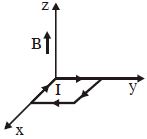
A uniform magnetic field of $3000\,G$ is established in the positive $z-$ direction. A rectangular loop of side $10\,cm$ and $5\,cm$ carries a current of $12\,A.$ What is the magnitude of placed as shown torque on the loop is
Dispersive power depends upon
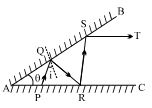
Two plane mirror $AB$ and $AC$ are inclined at an angle $\theta = 20^o$.$ A$ ray of light starting from point $P$ is incident at point $Q$ on the mirroe $AB$, then at $R$ on mirror $AC$ and again on $S$ on $AB$ finally the ray $ST$ goes parallel to mirror $AC$. The angle iwhich the ray makes with the normal at point $Q$ on mirror $AB$ is
C and Si both have the same lattice structure, having 4 bonding electrons in each. However, C is an insulator whereas Si is an intrinsic semiconductor. This is because
A. In case of C the valence band is not completely filled at absolute zero temperature.
B. In case of C the conduction band is partly filled even at absolute zero temperature.
C. The four bonding electrons in the case of C lie in the second orbit, whereas in the case of Si they lie in the third.
D. The four bonding electrons in the case of C lie in the third orbit, whereas for Si they lie in the fourth orbit.
When air in a capacitor is replaced by a medium of dielectric constant $K$, the capacity
A conducting sphere of radius $R = 20$ $cm$ is given a charge $Q = 16\,\mu C$. What is $\overrightarrow E $ at centre
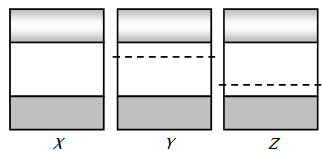
The energy band diagrams for three semiconductor samples of silicon are as shown. We can then assert that
Electron volt is a unit of