MCQ
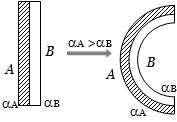
When a bimetallic strip is heated, it
  • A
    Does not bend at all
  • B
    Gets twisted in the form of an helix
  • Bend in the form of an arc with the more expandable metal outside
  • D
    Bends in the form of an arc with the more expandable metal inside
Answer

Correct option: C.
Bend in the form of an arc with the more expandable metal outside
c
(c) A bimetallic strip on being heated bends in the form of an arc with more expandable metal $(A)$ outside (as shown) correct.

Need a full question paper?

Generate a complete, print-ready paper with questions like this in minutes — across 16+ boards, with answer keys.
Start Generating Free

Similar questions

A body, thrown upwards with some velocity reaches the maximum height of $50 \,m$. Another body with double the mass thrown up with double the initial velocity will reach a maximum height of............$m$
In the given arrangement all surfaces are smooth. What acceleration should be given to the system, for which the block $m_2$ doesn't slide down?
A particle is projected at angle $\theta$ with horizontal from ground. The slop $(m)$ of the trajectory of the particle varies with time $(t)$ as ...........
If Poission's ratio $\sigma $ is $ - \frac{1}{2}$ for a material, then the material is
This question has Statement $1$ and Statement $2.$ Of the four choices given after the Statements, choose the one that best describes the two Statements.

Statement $1 :$ An inventor claims to have constructed an engine that has an efficiency of $30\%$ when operated between the boiling and freezing points of water. This is not possible.

Statement $2:$ The efficiency of a real engine is always less than the efficiency of a Carnot engine operating between the same two temperatures.

In terms of potential difference $V$, electric current $I$, permittivity $\varepsilon_0$, permeability $\mu_0$ and speed of light $c$, the dimensionally correct equation$(s)$ is(are)

$(A)$ $\mu_0 I ^2=\varepsilon_0 V ^2$ $(B)$ $\varepsilon_0 I =\mu_0 V$ $(C)$ $I =\varepsilon_0 cV$ $(D)$ $\mu_0 cI =\varepsilon_0 V$
A solid sphere moves at a terminal velocity of 20m/s in air at a place where g = 9.8m/s2. The sphere is taken in a gravity free hall having air at the same pressure and pushed down at a speed of 20m/s.
  1. Its initial acceleration will be 9.8m/s2 downward.
  2. Its initial acceleration will be 9.8m/s2 upward.
  3. The magnitude of acceleration will decrease as the time passes.
  4. It will eventually stop.
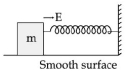
A block of mass ' $m$ ' (as shown in figure) moving with kinetic energy $E$ compresses a spring through a distance $25\,cm$ when, its speed is halved. The value of spring constant of used spring will be $nE\; Nm ^{-1}$ for $n=$
A particle of mass $m$ moves in a circular path of radius $r$, under the action of force which delivers it constant power $p$ and increases its speed. The angular acceleration of particle at time $(t)$ is proportional
A person of height $1.6 \mathrm{~m}$ is walking away from a lamp post of height $4 \mathrm{~m}$ along a straight path on the flat ground. The lamp post and the person are always perpendicular to the ground. If the speed of the person is $60 \mathrm{~cm} \mathrm{~s}^{-1}$, the speed of the tip of the person's shadow on the ground with respect to the person is. . . . $\mathrm{cm} \mathrm{s}^{-1}$.