MCQ
When a body is charged by induction, then the body.
- ABecomes neutral.
- BDoes not lose any charge.
- CLoses whole of the charge on it.
- DLoses part of the charge on it.
Generate a complete, print-ready paper with questions like this in minutes — across 16+ boards, with answer keys.
Select the correct statement
|
(a) In a full wave rectifier, two diodes work alternately |
|
(b) In a full wave rectifier, two diodes work simultaneously |
|
(c) The efficiency of full wave and half wave rectifiers is same |
|
(d) The full wave rectifier is bi-directional |
If a radioactive substance reduces to  of its original mass in 40 days, what is its half-life
|
(a) 10 days |
(b) 20 days |
(c) 40 days |
(d) None of these |
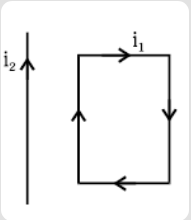
$\text{Zero.}$
$\text{Mga}$
$\text{Mga}\sin\theta$
$\frac{1}{2}\text{Mga}\sin\theta$
In the figure a carbon resistor has bands of different colours on its body as mentioned in the figure. The value of the resistance is

|
(a) 2.2 k W |
(b) 3.3 k W |
(c) 5.6 k W |
(d) 9.1 k W |
The ionisation potential of hydrogen atom is 13.6 volt. The energy required to remove an electron in the n = 2 state of the hydrogen atom is
|
(a) 27.2 eV |
(b) 13.6 eV |
(c) 6.8 eV |
(d) 3.4 eV |
What is the area of the plates of a 3F parallel plate capacitor, if the separation between the plates is 5mm
|
(a) 1.694 |
(b) 4.529 |
(c) 9.281 |
(d) 12.981 |
