When a body is placed on a rough plane inclined at an angle $\theta $ to the horizontal, its acceleration is
Easy


Download our appand get started for free
Experience the future of education. Simply download our apps or reach out to us for more information. Let's shape the future of learning together!No signup needed.*
Similar Questions
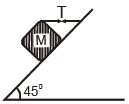
- 1A block of mass $15 \,kg $ is resting on a rough inclined plane as shown in figure. The block is tied up by a horizontal string which has tension of $50\,N$. The minimum coefficient of friction between the surfaces of contact is $(g = 10\,m/s^2)$View Solution
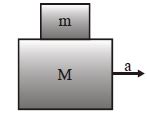
- 2A block of mass $m$ is placed on the top of another block of mass $M$ as shown in the figure. The coefficient of friction between them is $\mu $. What is the maximum acceleration with which the block $M$ may move so that m also moves along with it ?View Solution
- 3A car moves along a circular track of radius $R$ banked at an angle of $30^o$ to the horizontal. The coefficient of static friction between the wheels and the track is $\mu$ . The maximum speed with which the car can move without skidding out isView Solution
- 4A lift is moving downwards with an acceleration equal to acceleration due to gravity. $A$ body of mass $M$ kept on the floor of the lift is pulled horizontally. If the coefficient of friction is $\mu $, then the frictional resistance offered by the body isView Solution
- 5A $2\,kg$ block slides on a horizontal floor with a speed of $4\, m/s$. It strikes a uncompressed spring, and compresses it till the block is motionless. The kinetic friction force is $110\,N$ and spring constant is $1000\, N/m$. The spring compresses by ........ $cm$View Solution
- 6A boy is sitting on the horizontal platform of a joy wheel at a distance of $5 \,m$ from the center. The wheel begins to rotate and when the angular speed exceeds $1 \,rad / s$, the boy just slips. The coefficient of friction between the boy and the wheel is $\left(g=10 \,m / s ^2\right)$View Solution
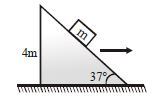
- 7If the coefficient of friction between block & wedge is $\mu $, then the maximum horizontal acceleration of the wedge for which block will remain at rest w.r.t. the wedge isView Solution
- 8The force required just to move a body up an inclined plane is double the force required just to prevent the body from sliding down. If $\mu $ is the coefficient of friction, the inclination of plane to the horizontal isView Solution
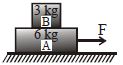
- 9Two blocks $A$ and $B$ of masses $6\, kg$ and $3\, kg$ rest on a smooth horizontal surface as shown in the figure. If coefficient of friction between $A$ and $B$ is $0.4$, the maximum horizontal force which can make them without separation is ........ $N$View Solution
- 10The maximum speed of a car on a road-turn of radius $30\, m$, if the coefficient of friction between the tyres and the road is $0.4$, will be .......... $m/sec$View Solution