MCQ
When a body moves in a circular path, no work is done by the force since,
  • A
    There is no displacement
  • B
    There is no net force
  • Force and displacement are perpendicular to each other
  • D
    The force is always away from the centre

Answer

Correct option: C.
Force and displacement are perpendicular to each other
(c) $\because W=F S \cos \theta \quad \therefore \theta=90^{\circ}$

Need a full question paper?

Generate a complete, print-ready paper with questions like this in minutes — across 16+ boards, with answer keys.
Start Generating Free

Similar questions

The exposure time of a camera lens at the $\frac{f}{2.8}$ setting is $\frac{1}{200}$ second. The correct time of exposure at $\frac{f}{5.6}$ is
A pendulum bob has a speed of $3 m / s$ at its lowest position. The pendulum is $0.5 m$ long. The speed of the bob, when the length makes an angle of $60^{\circ}$ to the vertical, will be (if $g=10 m / s ^2$ )
If aperture of lens is halved then image will be
If $u_1$ and $u_2$ are the units selected in two systems of measurement and $n_1$ and $n_2$ their numerical values, then
A body cools from $50.0^{\circ} \mathrm{C}$ to $49.9^{\circ} \mathrm{C}$ in $5 \mathrm{~s}$. How long will it take to cool from $40.0^{\circ} \mathrm{C}$ to $39.9^{\circ} \mathrm{C}$ ? Assume the temperature of surroundings to be $30.0^{\circ} \mathrm{C}$ and Newton's law of cooling to be valid
If the amount of heat given to a system be $35$ joules and the amount of work done by the system be $-15$ joules, then the change in the internal energy of the system is
Gas escapes from the surface of a planet because it acquires an escape velocity. The escape velocity will depend on which of the following factors : $1$. Mass of the planet $II$. Mass of the particle escaping III. Temperature of the planet $IV$. Radius of the planet Select the correct answer from the codes given below :
Which of the accompanying $P V$, diagrams best represents an isothermal process
The gas law $\frac{P V}{T}=$ constant is true for
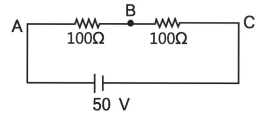
Consider the diagram shown below. A voltmeter of resistance $150\,\Omega$ is connected across $A$ and $B$. The potential drop across $B$ and $C$ measured by voltmeter is $...........\,V$