MCQ
When a body moves in a circular path, no work is done by the force since
  • A
    there is no net force
  • B
    there is no displacement
  • C
    force is always away from the centre
  • force and displacement are perpendicular to each other

Answer

Correct option: D.
force and displacement are perpendicular to each other
d
The radial force and displacement are normal to each other in circular motion.

Need a full question paper?

Generate a complete, print-ready paper with questions like this in minutes — across 16+ boards, with answer keys.

Start Generating Free

Similar questions

The key feature of Bohr's theory of spectrum of hydrogen atom is the quantization of angular momentum when an electron is revolving around a proton. We will extend this to a general rotational motion to find quantized rotational energy of a diatomic molecule assuming it to be rigid. The rule to be applied is Bohr's quantization condition.

$1.$ A diatomic molecule has moment of inertia I. By Bohr's quantization condition its rotational energy in the $\mathrm{n}^{\text {th }}$ level ( $\mathrm{n}=0$ is not allowed) is

$(A)$ $\frac{1}{\mathrm{n}^2}\left(\frac{\mathrm{h}^2}{8 \pi^2 \mathrm{I}}\right)$ $(B)$ $\frac{1}{\mathrm{n}}\left(\frac{\mathrm{h}^2}{8 \pi^2 \mathrm{I}}\right)$

$(C)$ $n\left(\frac{h^2}{8 \pi^2 \mathrm{I}}\right)$ $(D)$ $\mathrm{n}^2\left(\frac{\mathrm{h}^2}{8 \pi^2 \mathrm{I}}\right)$

$2.$ It is found that the excitation frequency from ground to the first excited state of rotation for the $\mathrm{CO}$ molecule is close to $\frac{4}{\pi} \times 10^{11} \mathrm{~Hz}$. Then the moment of inertia of $\mathrm{CO}$ molecule about its centre of mass is close to (Take $\mathrm{h}=2 \pi \times 10^{-34} \mathrm{Js}$ )

$(A)$ $2.76 \times 10^{-46} \mathrm{~kg} \mathrm{~m}^2$ $(B)$ $1.87 \times 10^{-46} \mathrm{~kg} \mathrm{~m}^2$

$(C)$ $4.67 \times 10^{-47} \mathrm{~kg} \mathrm{~m}^2$ $(D)$ $1.17 \times 10^{-47} \mathrm{~kg} \mathrm{~m}^2$

$3.$ In a $\mathrm{CO}$ molecule, the distance between $\mathrm{C}$ (mass $=12$ a.m.u) and $\mathrm{O}$ (mass $=16$ a.m.u.), where $1$ a.m.u. $=\frac{5}{3} \times 10^{-27} \mathrm{~kg}$, is close to

$(A)$ $2.4 \times 10^{-10} \mathrm{~m}$ $(B)$ $1.9 \times 10^{-10} \mathrm{~m}$

$(C)$ $1.3 \times 10^{-10} \mathrm{~m}$ $(D)$ $4.4 \times 10^{-11} \mathrm{~m}$

Give the answer question $1,2$ and $3.$
A vibrating string of certain length $l$ under a tension $T$ resonates with a mode corresponding to the first overtone (third harmonic) of an air column of length $75\, cm$ inside a tube closed at one end. The string also generates $4\, beats$ per second when excited along with a tuning fork of frequency $n$. Now when the tension of the string is slightly increased the number of beats reduces to $2\, per second$. Assuming the velocity of sound in air to be $340\, m/s$, the frequency $n$ of the tuning fork in $Hz$ is
A projectile is fired from horizontal ground with speed $v$ and projection angle $\theta$. When the acceleration due to gravity is $g$, the range of the projectile is $d$. If at the highest point in its trajectory, the projectile enters a different region where the effective acceleration due to gravity is $g^{\prime}=\frac{g}{0.81}$, then the new range is $d^{\prime}=n d$. The value of $n$ is. . . . .
In a hypothetical Bohr hydrogen, the mass of the electron is doubled. The energy ${E_0}$ and the radius ${r_0}$ of the first orbit will be (${a_0}$ is the Bohr radius)
A nucleus of mass $M + \Delta m$ is at rest and decays into two  daughter nuclei of equal mass $\frac{M}{2}$ each. Speed of light is $c.$ The binding energy per nucleon for the parent nucleus is $E_1$ and that for the daughter nuclei is $E_2$ . Then
Equation of the progressive wave is given by : $y = a\sin \pi (40t - x)$ where $a$ and $x$ are in metre and $t$ in second. The velocity of the wave is  ..... $m/s$
A solenoid of $1200$ turns is wound uniformly in a single layer on a glass tube $2\,m$ long and $0.2\,m$ in diameter. The magnetic intensity at the center of the solenoid when a current of $2\,A$ flows through it is:
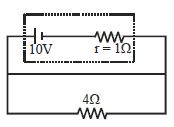
Potential difference across the terminals of the battery shown in figure is .................... $V$ ($r =$ internal resistance of battery)
A block of mass $m$ is at rest with respect to a lift when placed on inclined plane of  inclination $\theta$ inside the lift. If lift move upward at constant  velocity $v$ then work  done by friction force on block in $t$ time is :-
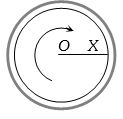
The diagram shows a cup of tea seen from above. The tea has been stirred and is now rotating without turbulence. A graph showing the speed $ v$ with which the liquid is crossing points at a distance $ X$  from $O $ along a radius $XO$  would look like