When a car is approaching the observer, the frequency of horn is $100 Hz$. After passing the observer, it is $50\,Hz$. If the observer moves with the car, the frequency will be $\frac{ x }{3} Hz$ where $x =.....$
JEE MAIN 2022, Diffcult


Download our appand get started for free
Experience the future of education. Simply download our apps or reach out to us for more information. Let's shape the future of learning together!No signup needed.*
Similar Questions
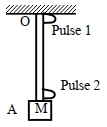
- 1A block $\mathrm{M}$ hangs vertically at the bottom end of a uniform rope of constant mass per unit length. The top end of the rope is attached to a fixed rigid support at $O$. A transverse wave pulse (Pulse $1$ ) of wavelength $\lambda_0$ is produced at point $O$ on the rope. The pulse takes time $T_{O A}$ to reach point $A$. If the wave pulse of wavelength $\lambda_0$ is produced at point $A$ (Pulse $2$) without disturbing the position of $M$ it takes time $T_{A 0}$ to reach point $O$. Which of the following options is/are correct?View Solution
(image)
[$A$] The time $\mathrm{T}_{A 0}=\mathrm{T}_{\mathrm{OA}}$
[$B$] The velocities of the two pulses (Pulse $1$ and Pulse $2$) are the same at the midpoint of rope.
[$C$] The wavelength of Pulse $1$ becomes longer when it reaches point $A$.
[$D$] The velocity of any pulse along the rope is independent of its frequency and wavelength.
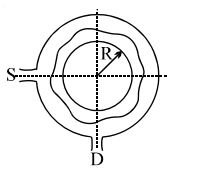
- 2A narrow tube is bent in the form of a circle of radius $R,$ as shown in the figure. Two small holes $S$ and $D$ are made in the tube at the positions right angle to each other. A source placed at $S$ generated a wave of intensity $I_0$ which is equally divided into two parts : One part travels along the longer path, while the other travels along the shorter path. Both the part waves meet at the point $D$ where a detector is placed The maximum intensity produced at $D$ is given byView Solution
- 3Two cars ${X}$ and ${Y}$ are approaching each other with velocities $36\; {km} / {h}$ and $72\; {km} / {h}$ respectively. The frequency of a whistle sound as emitted by a passenger in car ${X}$, heard by the passenger in car ${Y}$ is $1320 \;{Hz}$. If the velocity of sound in air is $340\; {m} / {s}$, the actual frequency of the whistle sound produced is ........ $Hz.$View Solution
- 4The driver of a bus approaching a big wall notices that the frequency of his bus's horn changes from $420\, Hz$ to $490\, Hz ,$ when he hears it after it gets reflected from the wall. Find the speed of the bus (in $kmh^{-1}$) if speed of the sound is $330\, ms ^{-1}$.View Solution
- 5Two waves are given by ${y_1} = a\sin (\omega t - kx)$ and ${y_2} = a\cos (\omega \,t - kx)$ The phase difference between the two waves isView Solution
- 6The apparent frequency of a sound wave as heard by an observer is $10\%$ more than the actual frequency. If the velocity of sound in air is $330\,m/sec$ , thenView Solution
$(i)$ The source may be moving towards the observer with a velocity of $30\,ms^{-1}$
$(ii)$ The source may be moving towards the observer with a velocity of $33\,ms^{-1}$
$(iii)$ The observer may be moving towards the source with a velocity of $30\,ms^{-1}$
$(iv)$ The observer may be moving towards the source with a velocity of $33\,ms^{-1}$
- 7A wave is given by $y = 3\sin 2\pi \left( {\frac{t}{{0.04}} - \frac{x}{{0.01}}} \right)$, where $y$ is in $cm$. Frequency of wave and maximum acceleration of particle will beView Solution
- 8When a wave travels in a medium, the particle displacements are given by $y = a\, sin\, 2\pi\, (bt -cx)$ where $a, b,$ and $c$ are constants. The maximum particle velocity will be twice the wave velocity ifView Solution
- 9The frequency of the sinusoidal wave $y = 0.40\cos [2000\,t + 0.80\,x]$ would beView Solution
- 10Progressive wave of sound is represented by $y = a\sin [400\pi \,t - \pi x/6.85]$ where $x$ is in $m$ and $t$ is in sec. Frequency of the wave will be .... $Hz$View Solution