Question
When a ceiling fan is switched off, its angular velocity falls to half while it makes $36$ $rotations.$ How many more rotations will it make before coming to rest (Assume uniform angular retardation)

Answer

$1st \,case:$­­­­­­­

We can write the equation of motion for circular motion as:

$\omega^{2}=\omega_{0}^{2}+2 a \theta_{n}$

Now, $\omega=\frac{\omega_{0}}{2}, \theta=36 \times 2 \pi$ (given)

So, $\frac{\omega_{0}^{2}}{4}=\omega_{o}^{2}+2 \alpha \times 36 \times 2 \pi$

So, $\alpha=\frac{-3 \omega_{0}^{2}}{4 \times 144 \pi}$

$2nd \,case:$

$0=\frac{\omega_{0}^{2}}{4}-2 \times \frac{3 \omega_{0}^{2}}{4 \times 144 \pi} \times \theta$

So, $\theta=24 \pi$ 

So, number of rotations made by the fan before coming to rest

$=\frac{24 \pi}{2 \pi}=12$

Need a full question paper?

Generate a complete, print-ready paper with questions like this in minutes — across 16+ boards, with answer keys.

Start Generating Free

Similar questions

The binding energy of the innermost electron in tungsten is $40 keV$. To produce characteristic $X-$ rays using a tungsten target in an $X-$ rays tube the potential difference $V$ between the cathode and the anti-cathode should be
A body of mass $6\,kg$ is under a force which causes displacement in it given by $S = \frac{{{t^2}}}{4}$ metres where $t$ is time. The work done by the force in $2 \,seconds$ is ............... $\mathrm{J}$
When air is filled in the balloon, the pressure and volume both increases while temperature does not change. Here Boyle's law is not obeyed because
A composite rod made up of two rods $AB$ and $BC$ are joined at $B$ . The rods are of equal length at room temperature and have equal masses. The coefficient of linear expansion a of $AB$ is more than that of $BC$. The composite rod is suspended horizontal by means of a thread at $B$. When the rod is heated
Product $(C)$ of the reaction is
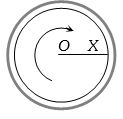
The diagram shows a cup of tea seen from above. The tea has been stirred and is now rotating without turbulence. A graph showing the speed $ v$ with which the liquid is crossing points at a distance $ X$  from $O $ along a radius $XO$  would look like
$A$ disc of radius $r$ is rotating about its centre with an angular speed $\omega_0$. It is gently placed on a rough horizontal surface. After what time it will be in pure rolling ?
Two sources of sound of same frequency are placed at a distance of $100\,m$ from each  other. An observer moving in between them hears $4$ beats per second. If the distance  between the sound sources is increased to $400\,m$, then number of beats heard by him will be :-
A small metal sphere of radius $a$ is falling with a velocity $v$ through a vertical column of a viscous liquid. If the coefficient of viscosity of the liquid is $\eta $ , then the sphere encounters an opposing force of
In gamma ray emission from a nucleus